Style combination · Pairs well
Afrofuturist Design × Harlem Renaissance Graphic Art
Carry Douglas's Egyptian profiles and radiating light into a jewel-dark cosmos for a Black futurism that knows its own lineage.
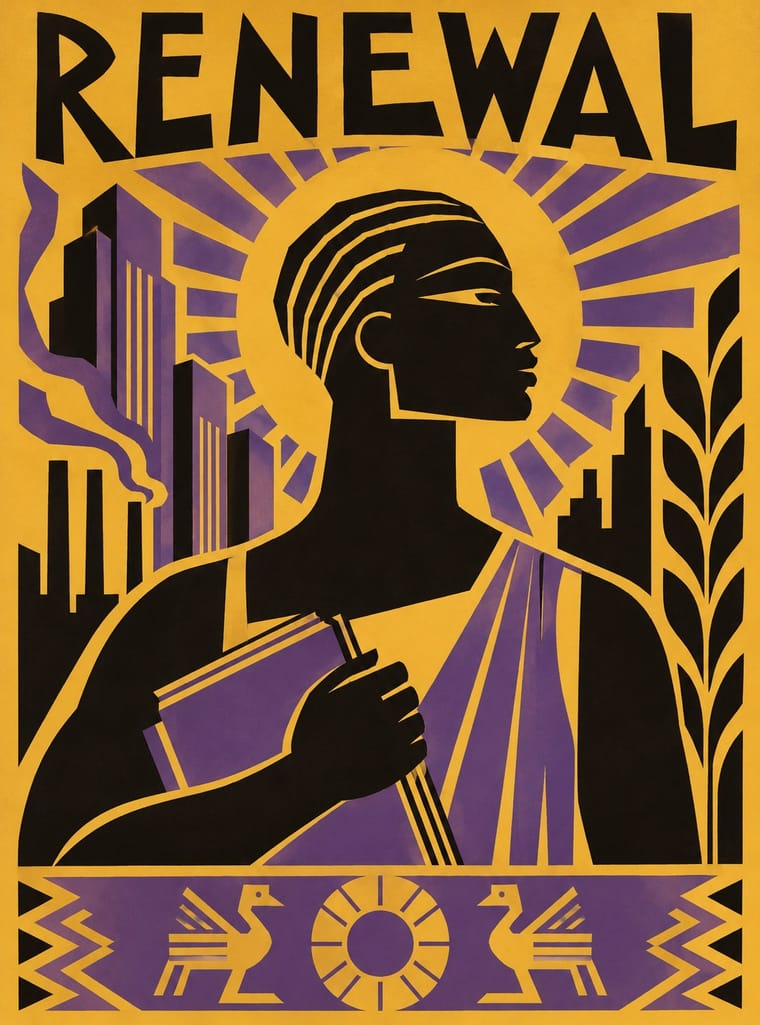
Aaron Douglas's Egyptian profiles and radiating bands of light are an early Black modernist vision; borrow his stepped light for cosmic scenes that acknowledge their lineage.
Mix them and make something Afrofuturist Design Harlem Renaissance Graphic Art
01
What each style brings
Each part of the design comes from the style with the stronger say in it, and each style gives at least two.
Afrofuturist Design Harlem Renaissance Graphic Art
- Type from Harlem Renaissance Graphic Art
- Colour from Harlem Renaissance Graphic Art
- Form from Afrofuturist Design
- Composition from Afrofuturist Design
- Surface from Afrofuturist Design
02
The type
Open fonts standing in for each style’s own type, which is often hand-drawn or commercial.
Display · Harlem Renaissance Graphic Art
Rise
Limelight, standing in for Aaron Douglas's hand-lettered Deco capitals on jackets and covers
Text · Afrofuturist Design
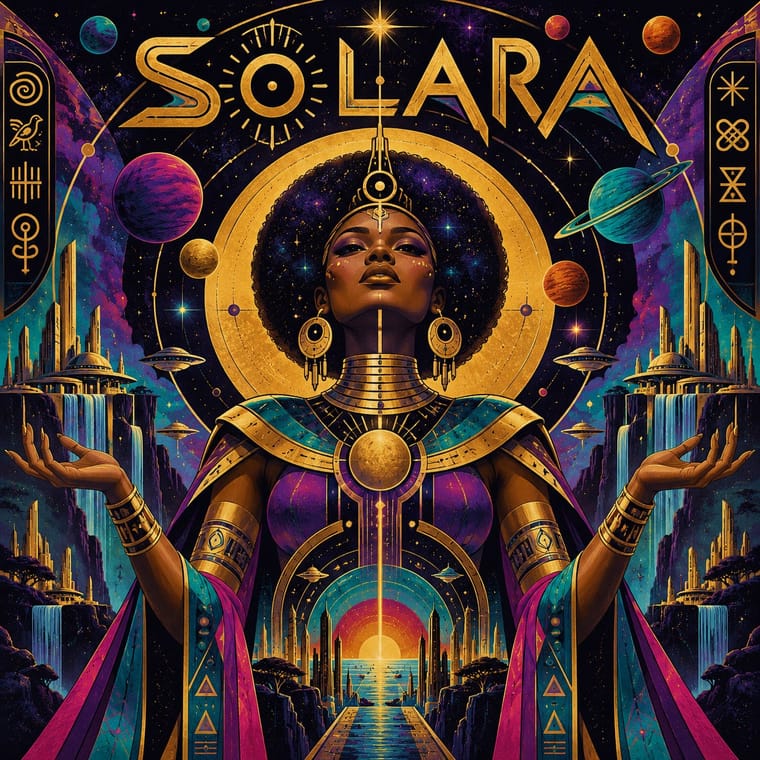
A visual language of Black futures that fuses African and diasporic iconography (pyramids and ankhs, Adinkra and Nsibidi glyphs, textile patterning) with spacecraft, cosmic fields and technology. From Sun Ra's Saturn records and Parliament-Funkadelic's comic-book sleeves to the Wakanda of Black Panther, it uses regal central figures, jewel and metallic colour on deep-space grounds, and pattern as technology to imagine liberation beyond history.
Jost; Afrofuturist Design used Wakandan script and Hand-lettered comix titling
03
The colours
The ground and leading colours come from Harlem Renaissance Graphic Art, with a counter-accent from Afrofuturist Design. The ink reads on the ground at 4.5:1 or more.
Afrofuturist Design Harlem Renaissance Graphic Art
-
#efe5cfground · 36% -
#161210ink · 14% -
#e3782baccent · 18% -
#c2185baccent · 14% -
#d6b44aaccent · 10% -
#00a6a6accent · 8%
As CSS
:root {
  --ground: #efe5cf;
  --ink: #161210;
  --accent-1: #e3782b;
  --accent-2: #c2185b;
  --accent-3: #d6b44a;
  --accent-4: #00a6a6;
  --font-display: "Limelight", sans-serif;
  --font-text: "Jost", sans-serif;
}
Use it with care
Afrofuturist Design: Afrofuturism is a self-authored vision of Black futures that draws on meaning-bearing symbols (Adinkra, Nsibidi, Kemetic and textile motifs) tied to specific peoples. Use glyphs for what they mean rather than as generic 'tribal' texture, and commission, credit or collaborate with Black and African designers.
Harlem Renaissance Graphic Art: Douglas built this idiom so that Black artists could picture Black history against minstrel caricature and white primitivist fantasy. Lifted as generic Jazz Age or 'tribal' decoration, the Egyptian profiles, mask-like eyes and black silhouettes can slide back into the stereotypes it answered, so use it to tell Black stories with Black artists and writers, and credit Douglas and the magazines (The Crisis, Opportunity) whose images you draw on.
04
The two styles
05
More combinations
With Afrofuturist Design
- Corporate Memphis Contrasts · Corporate Memphis flattens people into anonymous blobs; Afrofuturism insists on specific, dignified, heroic Black figures.
- Techno-Futurist Graphics Pairs well · Combine interface graphics and chrome with ancestral pattern so technology feels owned rather than imported.
- Adinkra & Kente Symbol Systems Pairs well · Draw pattern and glyphs from Adinkra and Kente with their meanings intact to ground cosmic imagery in a specific heritage.
- Uli & Nsibidi Line and Sign Tradition Pairs well · Afrofuturism already borrows nsibidi, as in Black Panther's Ancient Wakandan script; keep uli's sparse dark line and real, public signs rather than glowing pseudo-glyphs on deep-space grounds.
- Solarpunk Pairs well · Wakanda is claimed by both: Afrofuturism brings ancestral glyphs, regal figures and cosmic dark grounds, solarpunk daylight, gardens and ordinary communities; join them with the symbols' meanings intact and Black artists credited.
- AfriCOBRA Contrasts · Both picture Black people with pride in saturated colour, but Afrofuturism goes to cosmic futures in jewel tones on black space; AfriCOBRA stays in the present-day neighbourhood, in daylight Cool-ade colour, with the slogan written into the figure.
- Afrobeat Sleeve Art Pairs well · Afrobeat supplies the grounded Pan-African politics and Afrofuturism the cosmic horizon; combine them for music packaging that is both angry and visionary.
With Harlem Renaissance Graphic Art
- Corporate Memphis Contrasts · Both flatten the human figure, but Douglas's silhouettes are specific and historical where corporate Memphis is generic; study the difference before drawing people flat.
- WPA Silkscreen Posters Pairs well · Douglas's 1934 murals were New Deal commissions; pair his silhouettes with WPA screenprint layouts for civic, narrative posters.
- Bezalel School Pairs well · Both built a graphic language for a people's cultural renewal from ancestral ornament and biblical subjects in the 1920s; combine Bezalel's gilded frames with Aaron Douglas's flat silhouettes.
- AfriCOBRA Pairs well · Aaron Douglas's flat silhouettes are an earlier Black self-portrait in print; set his stepped light and profiles beside AfriCOBRA's lettered colour to trace the line from the New Negro to Black Power.
- Woodland School (Legend Painting) Contrasts · Both set flat, stylised figures to spiritual and communal ends, but Aaron Douglas's Harlem graphics print hard-edged silhouettes in one to three flat colours, stepping their tone where concentric rings of light cross them among Deco angles, while Woodland painting closes many bright colours inside a continuous black contour and opens each body in x-ray.