Style combination · Contrasts
Gekiga × Shōjo Manga
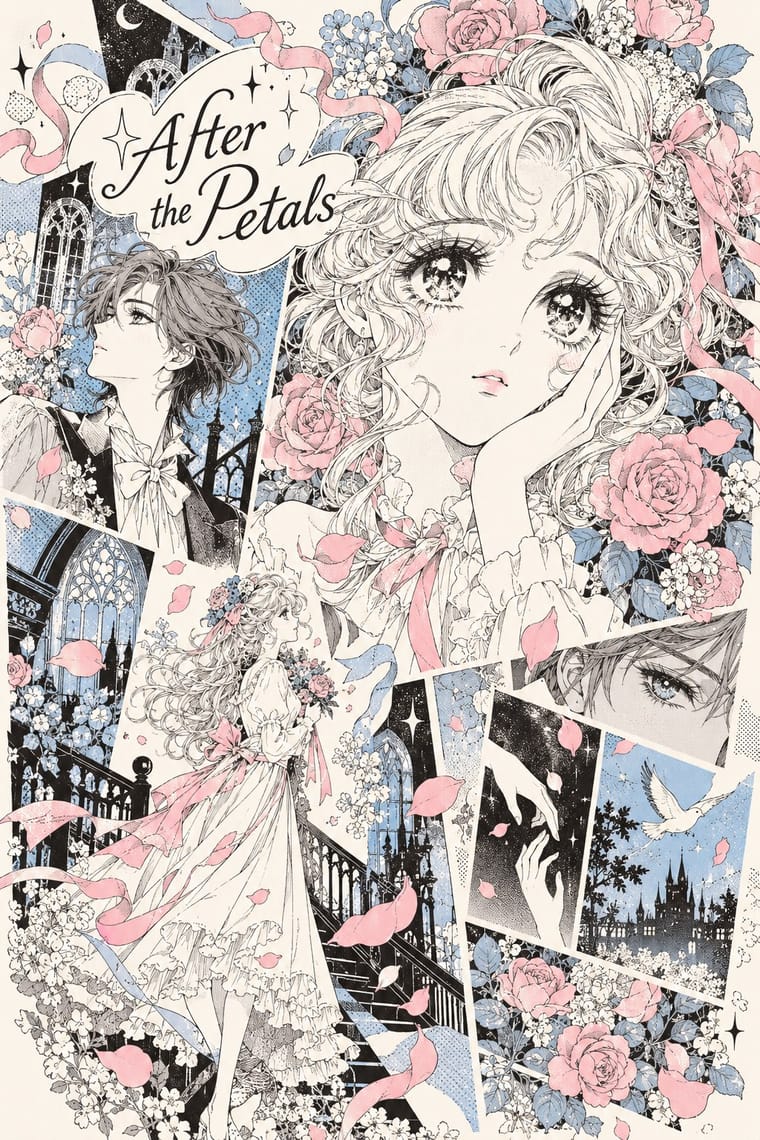
Decorative, soft, emotionally floating pages set against gekiga's hard black shadows make a deliberate tonal clash.
01
What each style brings
Each part of the design comes from the style with the stronger say in it, and each style gives at least two.
Gekiga (Dramatic Pictures) Shōjo Manga (Japanese Girls' Comics)
- Type from Shōjo Manga
- Colour from Shōjo Manga
-
Gekiga avoids pastel: this is where the two pull against each other, which is the point of the contrast.
- Form from Gekiga
- Composition from Gekiga
- Surface from Shōjo Manga
02
The type
Open fonts standing in for each style’s own type, which is often hand-drawn or commercial.
Display · Shōjo Manga
Bloom
Mochiy Pop One, standing in for Anchi-goshi balloon setting (gothic kanji mixed with bold antique kana, customary in major publishers' children's manga magazines from around 1960, set vertically in the balloons)
Text · Gekiga
Japanese comics for adult readers, a term coined by Yoshihiro Tatsumi in 1957 for work by artists who wanted consistently dramatic stories rather than comic children's manga, with aesthetics influenced by film noir and crime novels. Sharp contours, heavy hatching and gritty linework serve cinematic sequences and unglamorous figures in stories of crime, work, history and social unease. Unlike Argentine historieta, it grew from Japan's rental-manga industry and magazines such as Garo and Weekly Manga Action, and it leans on drawn sound-effect lettering.
Comic Neue; Gekiga used Hand-lettered sound effects (onomatopoeia) drawn into the art and Gothic (sans) and Mincho (serif) typeset dialogue in speech balloons
03
The colours
The ground and leading colours come from Shōjo Manga, with a counter-accent from Gekiga. The ink reads on the ground at 4.5:1 or more.
Gekiga (Dramatic Pictures) Shōjo Manga (Japanese Girls' Comics)
-
#fbf8f3ground · 36% -
#161214ink · 14% -
#a8cdeaaccent · 18% -
#8c2a21accent · 14% -
#f4b8caaccent · 10% -
#a9a49aaccent · 8%
As CSS
:root {
  --ground: #fbf8f3;
  --ink: #161214;
  --accent-1: #a8cdea;
  --accent-2: #8c2a21;
  --accent-3: #f4b8ca;
  --accent-4: #a9a49a;
  --font-display: "Mochiy Pop One", sans-serif;
  --font-text: "Comic Neue", cursive;
}
Use it with care
Shōjo Manga (Japanese Girls' Comics): Shōjo manga is the living work of named, mostly women artists, several of them still publishing, and its series and characters, from The Rose of Versailles to Sailor Moon, are in copyright: draw original characters in the shared idiom, never ask an image model for a named series, character or artist's hand, and label generated pages as AI-made rather than presenting them as a manga artist's work. Many heroines, and the boys of the 1970s boarding-school romances, are adolescents: keep the romance in mood, flowers and faces, and never sexualise characters who read as minors.
04
The two styles
05
More combinations
With Gekiga
- Argentine Adventure Historieta (Oesterheld–Breccia) Pairs well · Another realist black-and-white adult comics tradition; pair them to compare Japanese hatching and sound-effect lettering with Argentine brush chiaroscuro.
- Garo and Heta-uma (Japanese Underground Manga and 'Bad-Good' Illustration) Pairs well · Loosen the realism toward Garo's later personal, ironic line when a gekiga story needs an underground voice.
- Pulp Magazine Cover Pairs well · Add pulp's lurid crime and adventure staging for covers while keeping gekiga's hatching and sober faces.
With Shōjo Manga
- Fotoromanzo (Italian Photo-Romance) Contrasts · Both are romance told in pages for a mass readership of girls and women, with close-ups of faces carrying the drama; the photo-romance keeps staged photographs in a plain grid of ruled frames, while shōjo manga draws its figures and dissolves the grid into flowers, white space and drifting words.
- Art Nouveau Pairs well · Art Nouveau reached shōjo manga twice: through the prewar lyrical illustration of the girls' magazines, whose sentimental style drew on Art Nouveau and Nihonga, and directly, in the 1970s–80s shōjo artists influenced by Mucha's aestheticism whom the Mucha Foundation's 'Mucha to Manga' exhibition (Bunkamura, 2019) showed. Frame a shōjo title page in an Art Nouveau border with hand-drawn lettering for a romantic poster or book cover.
- Taishō Roman & Lyrical Illustration Pairs well · Its root: Takahashi Macoto took Nakahara Jun'ichi's large, doll-like eyes with highlights and long lashes and added dots, stars and colour to the iris. Borrow jojōga's single wistful figure, muted cream paper and hand lettering for a cover or title page with a period mood.
- Kawaii Design Contrasts · The otome-chikku manga of 1970s Ribon fed into kawaii, but kawaii reduces the figure to a rounded, minimal-faced mascot on a flat pastel ground; return to shōjo manga for slender full-length figures, detailed sparkling eyes and a page that tells a story.
- Story Manga (Postwar Japanese Comics) Pairs well · Its parent: the Tezuka-school page cuts like film between ruled panels, with speed lines, drawn sound effects and detailed backgrounds in perspective; shōjo manga slows the sequence, drops the borders and lets figures, flowers and floating monologue merge into one decorative spread. Switch to story manga for action, to shōjo for feeling.
- Korean Webtoon Graphics Contrasts · Romance webtoons tell a similar story in one full-colour column, one beat per screen with long empty gutters; shōjo manga layers several moments, flowers and monologue on one black-and-white spread at once.
- Purikura Photo-Sticker Decoration Pairs well · Borrow a small halo of flowers or sparkles to intensify a portrait's mood, but retain photographic faces and personal messages rather than turning the sticker into a drawn sequential story.
- Yami-Kawaii (Sick-Cute) Pairs well · Borrow shojo emotional intensity and sparkle ornament to deepen the melancholy.