Style combination · Pairs well
Shōjo Manga × Story Manga
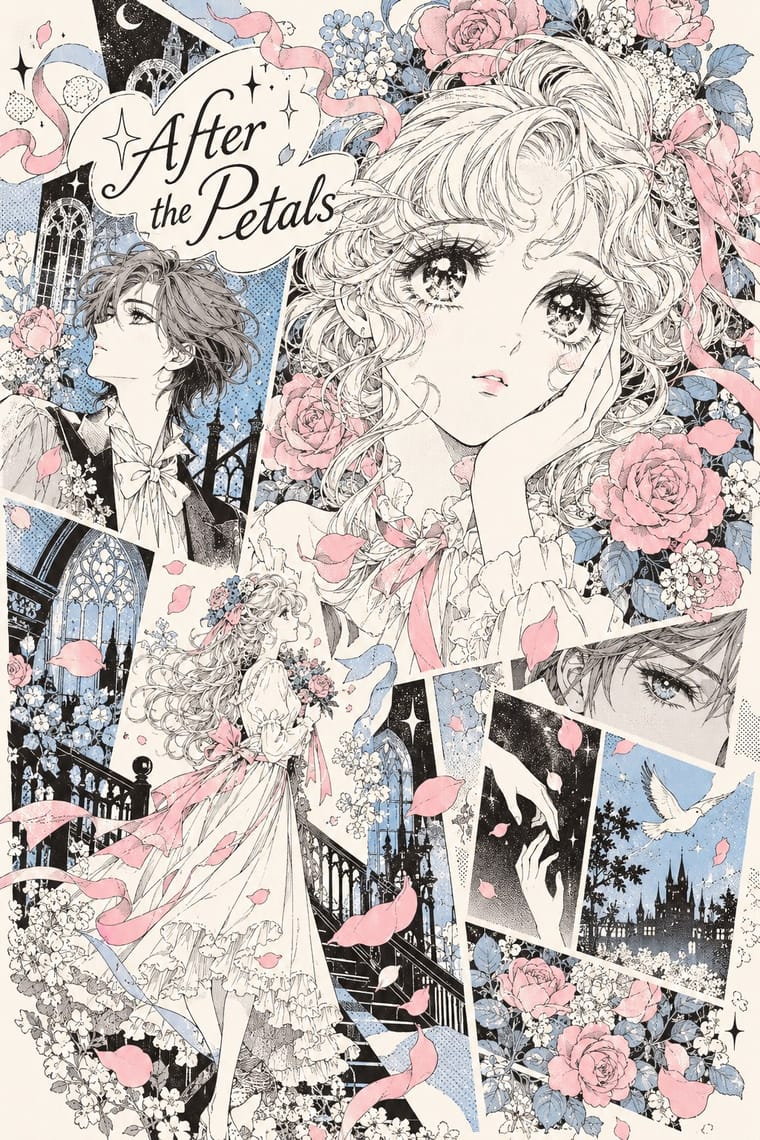
Girls' manga grew out of story manga from Tezuka's Princess Knight on and took its flowers, screentone moods and floating monologues furthest; borrow those when a story-manga page needs interior feeling rather than action.
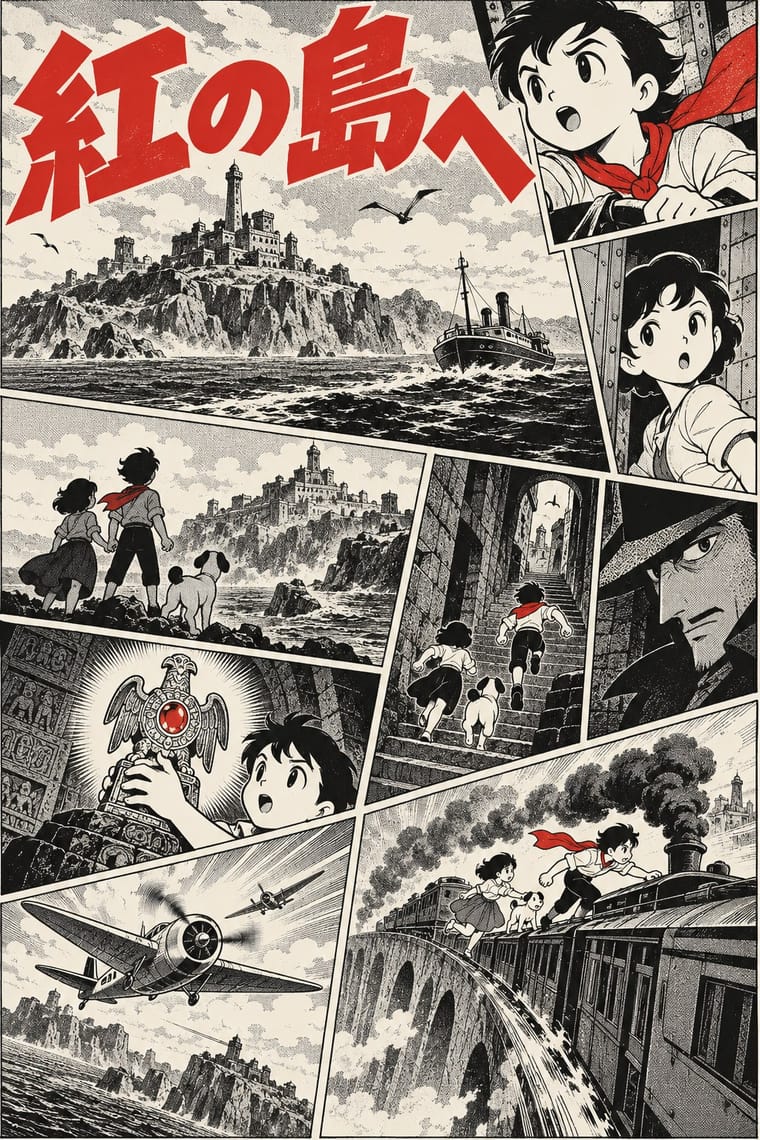
Its parent: the Tezuka-school page cuts like film between ruled panels, with speed lines, drawn sound effects and detailed backgrounds in perspective; shōjo manga slows the sequence, drops the borders and lets figures, flowers and floating monologue merge into one decorative spread. Switch to story manga for action, to shōjo for feeling.
01
What each style brings
Each part of the design comes from the style with the stronger say in it, and each style gives at least two.
Shōjo Manga (Japanese Girls' Comics) Story Manga (Postwar Japanese Comics)
- Type from Story Manga
- Colour from Shōjo Manga
- Form from Shōjo Manga
- Composition from Story Manga
- Surface from Shōjo Manga
02
The type
Open fonts standing in for each style’s own type, which is often hand-drawn or commercial.
Display · Story Manga
Reverie
Mochiy Pop One, standing in for Anchi-goshi balloon setting (gothic kanji with bold antique kana, アンチゴチ: the antique kana is a bold face of the 1890s from the kagomoji of Edo temple plaques, not a Mincho; the default for children’s manga by about 1960 and across commercial manga with desktop publishing)
Text · Shōjo Manga
The look of Japan's girls' comics (strictly a readership, not a style), which Takahashi Macoto fixed in 1958 from the lyrical illustration (jojōga) of Nakahara Jun'ichi and the Year 24 Group remade in the 1970s. The page is built for feeling, not action: panels overlap, slant or lose their borders, and slender full-length figures with huge, sparkling eyes merge with flowers, petals and pattern screentone into one layered spread, while inner monologue drifts free of the balloons through white space. Black and white inside; soft colour on covers and title pages.
Shippori Mincho; Shōjo Manga used Free-floating monologue lines and Words strung across the page
03
The colours
The ground and leading colours come from Shōjo Manga, with a counter-accent from Story Manga. The ink reads on the ground at 4.5:1 or more.
Shōjo Manga (Japanese Girls' Comics) Story Manga (Postwar Japanese Comics)
-
#fbf8f3ground · 36% -
#161214ink · 14% -
#a8cdeaaccent · 18% -
#d32f2faccent · 14% -
#f4b8caaccent · 10% -
#8c8c8caccent · 8%
As CSS
:root {
  --ground: #fbf8f3;
  --ink: #161214;
  --accent-1: #a8cdea;
  --accent-2: #d32f2f;
  --accent-3: #f4b8ca;
  --accent-4: #8c8c8c;
  --font-display: "Mochiy Pop One", sans-serif;
  --font-text: "Shippori Mincho", serif;
}
Use it with care
Shōjo Manga (Japanese Girls' Comics): Shōjo manga is the living work of named, mostly women artists, several of them still publishing, and its series and characters, from The Rose of Versailles to Sailor Moon, are in copyright: draw original characters in the shared idiom, never ask an image model for a named series, character or artist's hand, and label generated pages as AI-made rather than presenting them as a manga artist's work. Many heroines, and the boys of the 1970s boarding-school romances, are adolescents: keep the romance in mood, flowers and faces, and never sexualise characters who read as minors.
Story Manga (Postwar Japanese Comics): Manga characters and series, from Astro Boy to Dragon Ball and One Piece, are in copyright and belong to their creators and publishers, and manga is the living work of professional artists and assistants: draw original characters in the shared idiom, never ask an image model for a named series, character or artist's hand, and label generated pages as AI-made rather than presenting them as a manga artist's work. Some of Tezuka's own books drew foreigners, including Black Africans and Asians, in exaggerated caricature; after protests from September 1990 by the Osaka-based Association to Stop Racism Against Blacks, Tezuka Productions put a disclaimer slip into his books. Give every character the same drawing care, and never use skin, lips or dress as ethnic shorthand.
04
The two styles
05
More combinations
With Shōjo Manga
- Fotoromanzo (Italian Photo-Romance) Contrasts · Both are romance told in pages for a mass readership of girls and women, with close-ups of faces carrying the drama; the photo-romance keeps staged photographs in a plain grid of ruled frames, while shōjo manga draws its figures and dissolves the grid into flowers, white space and drifting words.
- Art Nouveau Pairs well · Art Nouveau reached shōjo manga twice: through the prewar lyrical illustration of the girls' magazines, whose sentimental style drew on Art Nouveau and Nihonga, and directly, in the 1970s–80s shōjo artists influenced by Mucha's aestheticism whom the Mucha Foundation's 'Mucha to Manga' exhibition (Bunkamura, 2019) showed. Frame a shōjo title page in an Art Nouveau border with hand-drawn lettering for a romantic poster or book cover.
- Taishō Roman & Lyrical Illustration Pairs well · Its root: Takahashi Macoto took Nakahara Jun'ichi's large, doll-like eyes with highlights and long lashes and added dots, stars and colour to the iris. Borrow jojōga's single wistful figure, muted cream paper and hand lettering for a cover or title page with a period mood.
- Kawaii Design Contrasts · The otome-chikku manga of 1970s Ribon fed into kawaii, but kawaii reduces the figure to a rounded, minimal-faced mascot on a flat pastel ground; return to shōjo manga for slender full-length figures, detailed sparkling eyes and a page that tells a story.
- Korean Webtoon Graphics Contrasts · Romance webtoons tell a similar story in one full-colour column, one beat per screen with long empty gutters; shōjo manga layers several moments, flowers and monologue on one black-and-white spread at once.
- Purikura Photo-Sticker Decoration Pairs well · Borrow a small halo of flowers or sparkles to intensify a portrait's mood, but retain photographic faces and personal messages rather than turning the sticker into a drawn sequential story.
- Yami-Kawaii (Sick-Cute) Pairs well · Borrow shojo emotional intensity and sparkle ornament to deepen the melancholy.
- Illustrated Rom-Com Book Cover (Cartoon Couple Cover) Pairs well · When the faces have to carry more feeling, as on the later, more detailed covers, borrow shōjo manga's expressive eyes and sparkle accents while keeping the flat ground and big lettering.
With Story Manga
- Korean Webtoon Graphics Contrasts · The Korean webtoon turned manhwa, Korean comics shaped in part by Japanese manga, into a single full-colour scroll column with long empty gutters, first on PC portals and then on phones; return to story manga for a printed spread of black-and-white panels read right to left, with screentone and panels that bleed and break.
- American Four-Colour Comic Book (Golden to Bronze Age) Contrasts · Both are mass-market pen-and-ink comics with balloons and sound effects; the American comic book reads left to right in four-colour dot tints with hand-lettered capitals in a steadier grid, while story manga stays black and white, reads right to left, greys with screentone and sets its dialogue vertically.
- Lianhuanhua Picture-Story Books Contrasts · Both are cheap, widely rented East Asian picture-story books; lianhuanhua gives each palm-sized page one framed drawing with a caption beneath and no balloons, while story manga packs a page with panels of changing size, balloons, speed lines and drawn sound effects.
- Superflat Contrasts · Murakami's Superflat lifts anime and manga figures out of the story onto one flat, glossy, polychrome plane for the gallery; story manga keeps the sequence, the depth of its backgrounds and its single black ink.
- Taishō Roman & Lyrical Illustration Pairs well · Jojōga's large, highlighted, long-lashed eyes passed from Nakahara Jun'ichi to Takahashi Macoto, who added stars and dots to the iris, and so into shōjo manga; add Taishō lyrical faces, kimono patterns and soft lines to a manga page for a period romance.
- Ligne Claire (Franco-Belgian Clear Line) Contrasts · Ligne claire closes every form with one even contour and flat colour, with no hatching or tone; story manga varies its line weight and builds grey and mood from screentone, solid blacks, speed lines and focus lines.
- Kawaii Design Pairs well · Kawaii takes manga's round faces and symbols but not its page; borrow its pastel mascots and rounded type for a comedy chapter, a character goods tie-in or a super-deformed aside, and keep the panels and screentone.
- Arab Independent Comics (Samandal, TokTok, Lab619, Skefkef) Contrasts · Manga is one codified visual language read right to left. The new wave of Arab comics counts it among its sources, beside European comics and American cartoons, and some artists build a style on it (Hanan al-Kararji, who drew the Cairo graphic novel 18 Days, calls hers 'a blend of manga and Arabness'), but these anthologies set it beside brush caricature and fine-art pages, and may run both reading directions in one issue.