Style combination · Pairs well
Ethiopian Ge'ez Manuscript × Islamic Geometric
Haräg interlace and Islamic strapwork share frame-and-band logic; compare them for headpieces, but keep the Ethiopian bands varied rather than strictly tiled.
Mix them and make something Ethiopian Ge'ez Manuscript Islamic Geometric
01
What each style brings
Each part of the design comes from the style with the stronger say in it, and each style gives at least two.
Ethiopian Ge'ez Manuscript & Haräg Illumination Islamic Geometric & Calligraphic Tradition
- Type from Islamic Geometric
- Colour from Ethiopian Ge'ez Manuscript
- Form from Islamic Geometric
- Composition from Ethiopian Ge'ez Manuscript
- Surface from Ethiopian Ge'ez Manuscript
02
The type
Open fonts standing in for each style’s own type, which is often hand-drawn or commercial.
Text · Islamic Geometric
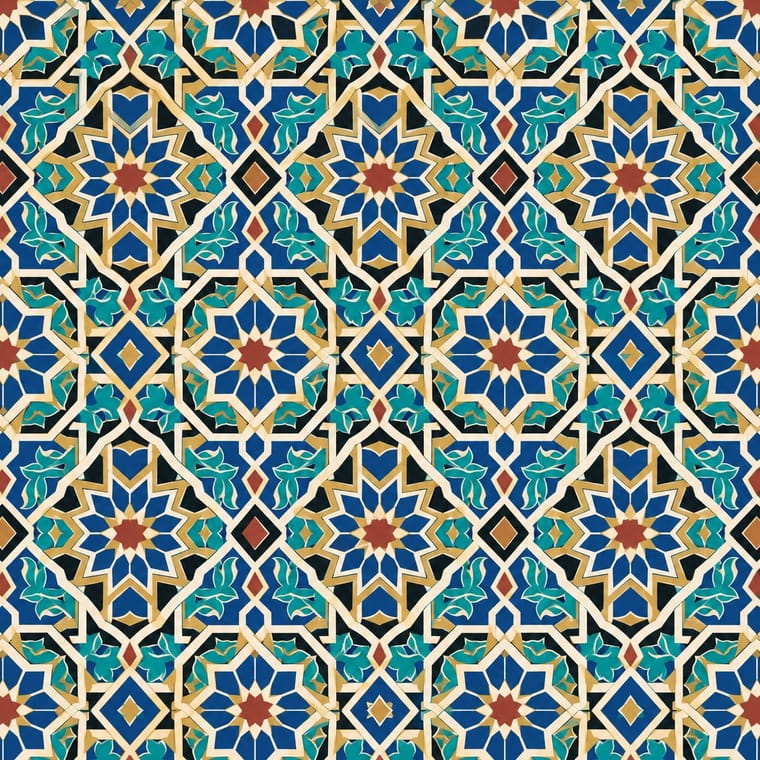
A visual system shared across the Islamic world in which proportioned calligraphy, compass-and-straightedge geometry and the vegetal arabesque carry meaning and beauty in place of figurative imagery. Star-and-polygon tilings repeat across whole surfaces as if continuing beyond the frame, while Kufic, Thuluth and Naskh inscriptions give hierarchy to buildings, manuscripts and objects.
Reem Kufi; Islamic Geometric used Kufic and Thuluth
03
The colours
The ground and leading colours come from Ethiopian Ge'ez Manuscript, with a counter-accent from Islamic Geometric. The ink reads on the ground at 4.5:1 or more.
Ethiopian Ge'ez Manuscript & Haräg Illumination Islamic Geometric & Calligraphic Tradition
-
#efe2c2ground · 36% -
#1b1a17ink · 14% -
#e07a1faccent · 18% -
#c8a046accent · 14% -
#a63d2faccent · 10% -
#2f6b3aaccent · 8%
As CSS
:root {
  --ground: #efe2c2;
  --ink: #1b1a17;
  --accent-1: #e07a1f;
  --accent-2: #c8a046;
  --accent-3: #a63d2f;
  --accent-4: #2f6b3a;
  --font-display: "Reem Kufi", cursive;
  --font-text: "Reem Kufi", cursive;
}
Use it with care
Ethiopian Ge'ez Manuscript & Haräg Illumination: These are liturgical and devotional books and protective objects still in use: rubricated holy names, prayers, icons of Christ, Mary and the saints, the protective eyes of haräg bands and the guardian figures of talismanic scrolls (made by dabtara clergy for a named owner) carry religious and apotropaic meaning. Do not use them as texture, logos or decoration on trivial products; have any Ge'ez text read by a fluent reader; and commission or collaborate with Ethiopian and Eritrean scribes, painters and designers rather than copying motifs. Many manuscripts in Western collections were looted (notably from Maqdala in 1868) and are subject to restitution claims.
Islamic Geometric & Calligraphic Tradition: Qur'anic verses, the names of God and the Prophet and other sacred phrases must not be cropped, distorted, mirrored, used as texture or printed on floors, footwear or throwaway packaging; have any Arabic-script text read and approved by a fluent reader or calligrapher. Abstract geometric pattern is far less sensitive than script, but credit the traditions and makers it comes from.
04
The two styles
05
More combinations
With Ethiopian Ge'ez Manuscript
- Minimalist Graphic Design Contrasts · Its restrained page of black, red and one headpiece already reads as minimal; set it against true minimalism to see how much rhythm red punctuation adds.
- Renaissance Book Typography Pairs well · Both run a two-colour black-and-red text hierarchy; borrow the rubric logic for an editorial system without copying sacred content.
- Thai Yantra (Yant) Diagrams Pairs well · Ethiopian talismanic scrolls are the closest counterpart: protective scripts, frames and guardian figures made by clergy for a named owner; compare how each turns a sacred script into a frame.
- Armenian Manuscript Illumination Pairs well · Another Eastern Christian Gospel tradition in two columns of its own script that opens with Eusebian canon tables under bird-topped arches; compare the Ethiopian black-and-red page and haräg bands with Armenian gold-and-ultramarine canon arcades when building a framed headpiece system.
- Rorke's Drift Linocut Pairs well · Another African Christian narrative art told in stacked registers; compare the two to set a Bible story in an African world, keeping Rorke's Drift to one ink and the carved line.
- Ancient Egyptian Hieroglyphic & Register Composition Contrasts · Both write black text with red rubrics in ruled columns, but Ethiopian books are Christian parchment codices in the Ge'ez abugida with haräg interlace bands, while Book of the Dead papyri are rolls of cursive hieroglyphs with framed vignettes set between the text columns.
- Celtic Revival Illumination & Lettering Pairs well · Another Christian manuscript tradition that marks its divisions with interlace: set a haräg band of interlace and chequers beside a Celtic knotwork frame to compare a varied headpiece with a closed, compartmented border.
With Islamic Geometric
- International Typographic Style Contrasts · Drop one tessellated panel into an asymmetric Swiss grid to make the tension between infinite pattern and white space the subject.
- Art Deco Pairs well · Borrow star polygons and stepped borders for Deco-style framing; both depend on strict symmetry and metallic accents.
- Iranian Modernist Graphic Design Pairs well · Set one calligraphic word or a fragment of girih against flat colour and a modernist grid instead of reproducing whole tile panels.
- Armenian Manuscript Illumination Contrasts · Horseshoe arches and vegetal and geometric ornament are shared, but the Islamic geometric tradition keeps its arches and fields aniconic, while Armenian books fill the same arches with birds, beasts and painted saints; choose whether a frame should carry figures or only pattern.
- Kamon (Japanese Family Crests) Contrasts · Both are built with compass and straight edge, but girih tiles the whole surface without end while a mon closes one motif inside a ring; borrow the tessellation for a ground and the crest for the single sign on it.
- Baghdad School of Arab Book Painting (Maqamat Illustration) Contrasts · Non-figural Islamic art is the contrast: this style puts people and satire where geometry would be. No descent is implied.
- Andean Woven Graphic Systems Contrasts · Islamic pattern interlaces stars around radial centres while Andean geometry is orthogonal, stepped and deliberately irregular; choose one as the structural logic rather than blending them.
- Batik Pattern Tradition Pairs well · Coastal batik already absorbs Arabic script and geometric lattices; combine the two for pattern that is both structured and hand-made.