Style combination · Pairs well
Ethiopian Ge'ez Manuscript × Rorke's Drift Linocut
Another African Christian narrative art told in stacked registers; compare the two to set a Bible story in an African world, keeping Rorke's Drift to one ink and the carved line.
Mix them and make something Ethiopian Ge'ez Manuscript Rorke's Drift Linocut
01
What each style brings
Each part of the design comes from the style with the stronger say in it, and each style gives at least two.
Ethiopian Ge'ez Manuscript & Haräg Illumination Rorke's Drift Linocut
- Type from Ethiopian Ge'ez Manuscript
- Colour from Ethiopian Ge'ez Manuscript
- Form from Ethiopian Ge'ez Manuscript
- Composition from Rorke's Drift Linocut
- Surface from Rorke's Drift Linocut
02
The type
Open fonts standing in for each style’s own type, which is often hand-drawn or commercial.
Display · Ethiopian Ge'ez Manuscript
Light
Reem Kufi; Ethiopian Ge'ez Manuscript used Ge'ez (Ethiopic) fidel syllabary written with a reed pen and Rubricated Ethiopic punctuation
Text · Rorke's Drift Linocut
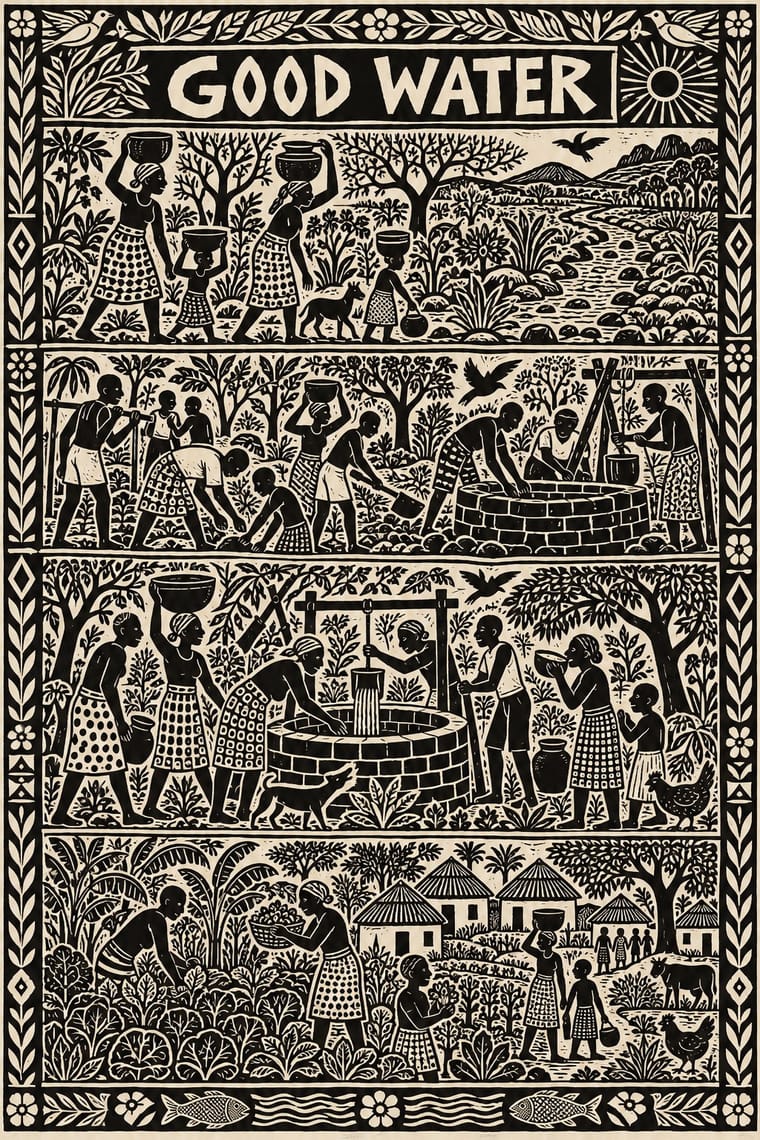
The prints of the Lutheran art centre that Swedish teachers Peder and Ulla Gowenius started at Ceza Hospital in 1962 and moved to Rorke's Drift in 1963: under apartheid, which denied Black South Africans formal fine-art education, the chief training ground for many Black artists. Azaria Mbatha, John Muafangejo, Charles Nkosi and others cut black-and-white linocuts of Bible stories, Zulu and Kwanyama history and daily life, often crowded into horizontal bands with every gap filled by figures, foliage and pattern. Muafangejo added titles, dedications and commentary in the print itself.
Archivo; Rorke's Drift Linocut used Hand-cut title in the block and Hand-cut captions and slogans
03
The colours
The ground and leading colours come from Ethiopian Ge'ez Manuscript, with a counter-accent from Rorke's Drift Linocut. The ink reads on the ground at 4.5:1 or more.
Ethiopian Ge'ez Manuscript & Haräg Illumination Rorke's Drift Linocut
-
#efe2c2ground · 39% -
#1b1a17ink · 15% -
#e07a1faccent · 20% -
#b3261eaccent · 15% -
#2f6b3aaccent · 11%
As CSS
:root {
  --ground: #efe2c2;
  --ink: #1b1a17;
  --accent-1: #e07a1f;
  --accent-2: #b3261e;
  --accent-3: #2f6b3a;
  --font-display: "Reem Kufi", cursive;
  --font-text: "Archivo", sans-serif;
}
Use it with care
Ethiopian Ge'ez Manuscript & Haräg Illumination: These are liturgical and devotional books and protective objects still in use: rubricated holy names, prayers, icons of Christ, Mary and the saints, the protective eyes of haräg bands and the guardian figures of talismanic scrolls (made by dabtara clergy for a named owner) carry religious and apotropaic meaning. Do not use them as texture, logos or decoration on trivial products; have any Ge'ez text read by a fluent reader; and commission or collaborate with Ethiopian and Eritrean scribes, painters and designers rather than copying motifs. Many manuscripts in Western collections were looted (notably from Maqdala in 1868) and are subject to restitution claims.
Rorke's Drift Linocut: These prints are the work of named Black South African and Namibian artists, many still in copyright with the artists or their estates, made under apartheid at a Lutheran mission centre. Rankin and Hobbs call the 'typical' Rorke's Drift print a construct that the market pushed artists to comply with; the centre also made etchings, aquatints, colour relief prints and screenprints, so treat this banded black-and-white linocut as one face of a diverse school, not the whole of it. Borrow the system (hand-cut black-and-white relief, banded narrative, words in the block), not a particular print, a named artist's figures or Muafangejo's lettering hand. Do not label generated work 'naive' or 'tribal' African art: when Clement Greenberg judged Art South Africa Today in 1975, Rorke's Drift artists were displayed in a 'catch all' section for representational and 'naive' works. Do not invent Zulu or Kwanyama ritual, Christian scenes or struggle martyrs as decoration: picture the subject the brief supplies in its own community's terms. Never add an artist's signature, edition number or a Rorke's Drift or ELC inscription to generated work, and never present a generated image as a Rorke's Drift print.
04
The two styles
05
More combinations
With Ethiopian Ge'ez Manuscript
- Islamic Geometric & Calligraphic Tradition Pairs well · Haräg interlace and Islamic strapwork share frame-and-band logic; compare them for headpieces, but keep the Ethiopian bands varied rather than strictly tiled.
- Minimalist Graphic Design Contrasts · Its restrained page of black, red and one headpiece already reads as minimal; set it against true minimalism to see how much rhythm red punctuation adds.
- Renaissance Book Typography Pairs well · Both run a two-colour black-and-red text hierarchy; borrow the rubric logic for an editorial system without copying sacred content.
- Thai Yantra (Yant) Diagrams Pairs well · Ethiopian talismanic scrolls are the closest counterpart: protective scripts, frames and guardian figures made by clergy for a named owner; compare how each turns a sacred script into a frame.
- Armenian Manuscript Illumination Pairs well · Another Eastern Christian Gospel tradition in two columns of its own script that opens with Eusebian canon tables under bird-topped arches; compare the Ethiopian black-and-red page and haräg bands with Armenian gold-and-ultramarine canon arcades when building a framed headpiece system.
- Ancient Egyptian Hieroglyphic & Register Composition Contrasts · Both write black text with red rubrics in ruled columns, but Ethiopian books are Christian parchment codices in the Ge'ez abugida with haräg interlace bands, while Book of the Dead papyri are rolls of cursive hieroglyphs with framed vignettes set between the text columns.
- Celtic Revival Illumination & Lettering Pairs well · Another Christian manuscript tradition that marks its divisions with interlace: set a haräg band of interlace and chequers beside a Celtic knotwork frame to compare a varied headpiece with a closed, compartmented border.
With Rorke's Drift Linocut
- South African Resistance Poster Contrasts · Same country, overlapping and then following it (1978–1994): screenprinted slogans and emblems for mass protest against small, hand-printed editions that tell a story; use the poster to mobilise and the linocut to bear witness.
- Expressionist Woodcut Graphics Contrasts · Both gouge black relief prints, but the Brücke woodcut distorts one anguished figure on tilted axes, while Rorke's Drift spreads a whole story across calm, packed bands; pick by whether the image should confess or narrate.
- Literatura de Cordel Woodcut Pairs well · Two traditions of small black relief pictures of devotional and popular stories; add cordel's letterpress title block when a banded Rorke's Drift-style narrative must sit on a booklet cover.
- Lubok Popular Print Pairs well · Close to it in the atlas, after cordel: the Russian popular print also cuts words and pictures into one block and tells devotional and folk stories; take lubok's hand colouring when a Rorke's Drift-style narrative needs warmth beyond black and white.
- Taller de Gráfica Popular Pairs well · Both made the black-and-white relief print a workshop art of social witness; borrow TGP's single legible image when a Rorke's Drift-style band of scenes needs one headline picture.
- Kinngait (Cape Dorset) Inuit Printmaking Contrasts · Two mid-century workshops where a community with no printmaking tradition began cutting blocks with an outside teacher: Rorke's Drift crowds a black-and-white story into banded scenes, Kinngait usually isolates one figure in colour on open paper; choose by whether the image should narrate or present.
- Torres Strait Islander Linocut Contrasts · Both pack a black linocut to the edges and grew from a teaching studio, but Rorke's Drift stacks Bible and history scenes in horizontal bands, while Torres Strait prints let sea beings and stars interlock in one field of minaral; pick bands to narrate in order, the open field to show a cosmos.
- Tingatinga Painting Contrasts · Rorke's Drift cuts dense black-and-white narrative bands; Tingatinga floats a few glossy, many-coloured animals on one ground. Use the contrast between carved monochrome story and painted colour field.