Style combination · Pairs well
Celtic Revival Illumination × Ethiopian Ge'ez Manuscript
Another Christian manuscript tradition that marks its divisions with interlace: set a haräg band of interlace and chequers beside a Celtic knotwork frame to compare a varied headpiece with a closed, compartmented border.
Mix them and make something Celtic Revival Illumination Ethiopian Ge'ez Manuscript
01
What each style brings
Each part of the design comes from the style with the stronger say in it, and each style gives at least two.
Celtic Revival Illumination & Lettering Ethiopian Ge'ez Manuscript & Haräg Illumination
- Type from Celtic Revival Illumination
- Colour from Ethiopian Ge'ez Manuscript
- Form from Ethiopian Ge'ez Manuscript
- Composition from Celtic Revival Illumination
- Surface from Celtic Revival Illumination
02
The type
Open fonts standing in for each style’s own type, which is often hand-drawn or commercial.
Display · Celtic Revival Illumination
Halo
Uncial Antiqua; Celtic Revival Illumination used Hand-drawn lettering after the majuscule and half-uncial of the Insular manuscripts, drawn into the ornament and Archibald Knox's interlaced Celtic lettering, drawn so densely into the ornament that it must be studied to be read
Text · Ethiopian Ge'ez Manuscript
The manuscript art of the Ethiopian and Eritrean Orthodox Tewahedo Church, written in the Ge'ez syllabary on parchment from the Garima Gospels (radiocarbon-dated to roughly the 4th–7th centuries) to the present. Carbon-black text is punctuated by red headings, names and dotted word-dividers, haräg bands of interlace, chequers and protective eyes mark the main divisions, and miniatures show flat, frontal figures with large almond eyes in hot mineral colours.
Reem Kufi; Ethiopian Ge'ez Manuscript used Ge'ez (Ethiopic) fidel syllabary written with a reed pen and Rubricated Ethiopic punctuation
03
The colours
The ground and leading colours come from Ethiopian Ge'ez Manuscript, with a counter-accent from Celtic Revival Illumination. The ink reads on the ground at 4.5:1 or more.
Celtic Revival Illumination & Lettering Ethiopian Ge'ez Manuscript & Haräg Illumination
-
#efe2c2ground · 36% -
#1b1a17ink · 14% -
#e07a1faccent · 18% -
#b8902eaccent · 14% -
#a12a2aaccent · 10% -
#2f6b3aaccent · 8%
As CSS
:root {
  --ground: #efe2c2;
  --ink: #1b1a17;
  --accent-1: #e07a1f;
  --accent-2: #b8902e;
  --accent-3: #a12a2a;
  --accent-4: #2f6b3a;
  --font-display: "Uncial Antiqua", sans-serif;
  --font-text: "Reem Kufi", cursive;
}
Use it with care
Celtic Revival Illumination & Lettering: Its models are Christian gospel books and crosses, and many of its emblems are national and partisan: Leabhar na hAiséirghe is a memorial to the republican dead of 1916–23, including the Civil War, and the Celtic Cross stamp was adapted from a Sinn Féin label, so do not use these as neutral 'Irish' decoration where nationalist imagery is contested, as in Northern Ireland. The 1922 Map of Ireland stamp left out the border, and some in Northern Ireland and Britain read it as a claim to the northern counties, so an undivided map of the island is itself a political statement. A square cross interlocked with or surrounded by a circle is a widespread white-supremacist symbol, while the traditional Celtic cross has a long vertical shaft, so draw the cross accordingly and check knotwork marks in context. 'Celtic' and 'Irish' are not exclusive labels for Kells-type ornament: Insular art was made across Britain and Ireland, the Lindisfarne Gospels in Northumbria, and Kells itself possibly begun on Iona. George Bain died in 1968, so his drawings remain in copyright in the UK until the end of 2038: construct new knots by his methods rather than tracing his plates, and have any Irish or Scottish Gaelic text checked by a fluent reader.
Ethiopian Ge'ez Manuscript & Haräg Illumination: These are liturgical and devotional books and protective objects still in use: rubricated holy names, prayers, icons of Christ, Mary and the saints, the protective eyes of haräg bands and the guardian figures of talismanic scrolls (made by dabtara clergy for a named owner) carry religious and apotropaic meaning. Do not use them as texture, logos or decoration on trivial products; have any Ge'ez text read by a fluent reader; and commission or collaborate with Ethiopian and Eritrean scribes, painters and designers rather than copying motifs. Many manuscripts in Western collections were looted (notably from Maqdala in 1868) and are subject to restitution claims.
04
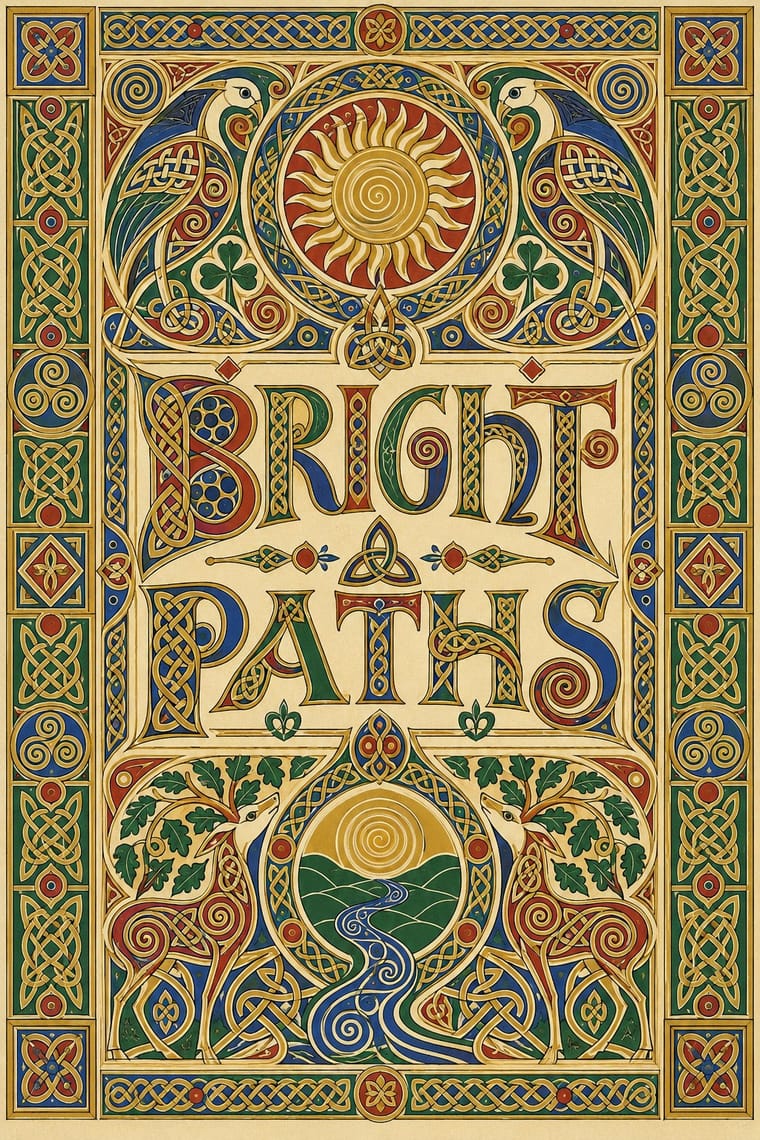
The two styles
05
More combinations
With Celtic Revival Illumination
- Mir iskusstva Book Art Pairs well · A parallel national revival of the same decades: both turned medieval and folk ornament into the borders and initials of a modern book; combine for a heritage storybook framed in old ornament.
- Bezalel School Pairs well · Another national illumination of the 1900s–1920s, with hand-drawn national letters, jewel colours and gold inside heavy symmetrical frames; compare how each built a national art from ancient ornament.
- Gothic Blackletter & Fraktur Tradition Contrasts · The other national script of the same decades: Fraktur set German text until its ban in 1941, as Gaelic type set Irish until the mid-twentieth century; set the dark, broken gothic weave against the round, open insular letter.
- International Typographic Style Contrasts · Its exact opposite: hand-built, symmetrical, ornament-filled national pages against an asymmetric grid, neutral sans-serif and white space; borrow one knotted initial to warm a strict grid.
- Islamic Geometric & Calligraphic Tradition Pairs well · Both build sacred pages from interlaced strapwork constructed geometrically and framed symmetrically; set a Celtic knot border beside a girih panel to compare closed knotwork with an endless star tiling.
- Glasgow Style Contrasts · Scotland in the same years, but Glasgow stretched space, emptied it and set a few rosebuds on long verticals, while the Celtic Revival fills its compartments densely with knotwork; choose air or density.
- Armenian Manuscript Illumination Pairs well · Both build letters out of animals and interlace; set a bird-letter initial beside a knotted Celtic one to compare an initial made of whole birds with one made of interlaced beasts.
- Norwegian and Finnish National Romantic Graphics (Munthe & Karelianism) Pairs well · Both turned medieval interlace and beast heads into the ornament of a national book; set Norse dragon-head vignettes beside Insular knotwork for a North Sea saga cycle.
With Ethiopian Ge'ez Manuscript
- Islamic Geometric & Calligraphic Tradition Pairs well · Haräg interlace and Islamic strapwork share frame-and-band logic; compare them for headpieces, but keep the Ethiopian bands varied rather than strictly tiled.
- Minimalist Graphic Design Contrasts · Its restrained page of black, red and one headpiece already reads as minimal; set it against true minimalism to see how much rhythm red punctuation adds.
- Renaissance Book Typography Pairs well · Both run a two-colour black-and-red text hierarchy; borrow the rubric logic for an editorial system without copying sacred content.
- Thai Yantra (Yant) Diagrams Pairs well · Ethiopian talismanic scrolls are the closest counterpart: protective scripts, frames and guardian figures made by clergy for a named owner; compare how each turns a sacred script into a frame.
- Armenian Manuscript Illumination Pairs well · Another Eastern Christian Gospel tradition in two columns of its own script that opens with Eusebian canon tables under bird-topped arches; compare the Ethiopian black-and-red page and haräg bands with Armenian gold-and-ultramarine canon arcades when building a framed headpiece system.
- Rorke's Drift Linocut Pairs well · Another African Christian narrative art told in stacked registers; compare the two to set a Bible story in an African world, keeping Rorke's Drift to one ink and the carved line.
- Ancient Egyptian Hieroglyphic & Register Composition Contrasts · Both write black text with red rubrics in ruled columns, but Ethiopian books are Christian parchment codices in the Ge'ez abugida with haräg interlace bands, while Book of the Dead papyri are rolls of cursive hieroglyphs with framed vignettes set between the text columns.