Style combination · Pairs well
Armenian Manuscript Illumination × Ethiopian Ge'ez Manuscript
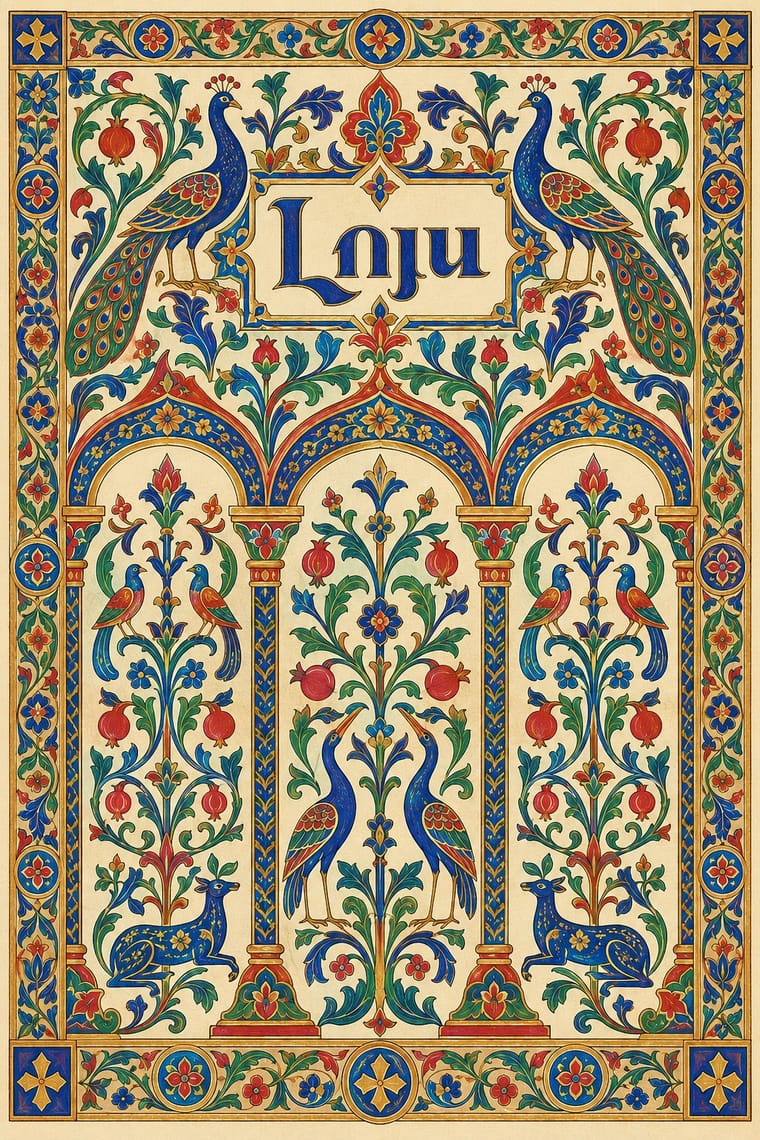
Another Eastern Christian Gospel tradition in two columns of its own script that opens with Eusebian canon tables under bird-topped arches; compare the Ethiopian black-and-red page and haräg bands with Armenian gold-and-ultramarine canon arcades when building a framed headpiece system.
Mix them and make something Armenian Manuscript Illumination Ethiopian Ge'ez Manuscript
01
What each style brings
Each part of the design comes from the style with the stronger say in it, and each style gives at least two.
Armenian Manuscript Illumination Ethiopian Ge'ez Manuscript & Haräg Illumination
- Type from Armenian Manuscript Illumination
- Colour from Ethiopian Ge'ez Manuscript
- Form from Armenian Manuscript Illumination
- Composition from Armenian Manuscript Illumination
- Surface from Ethiopian Ge'ez Manuscript
02
The type
Open fonts standing in for each style’s own type, which is often hand-drawn or commercial.
Display · Armenian Manuscript Illumination
Grace
Uncial Antiqua, standing in for Erkatagir ('iron letters'), the uncial held to be Mesrop Mashtots's original form of the alphabet of 405, used for manuscript text from the 5th to the 13th century and still preferred for inscriptions
Text · Ethiopian Ge'ez Manuscript
The manuscript art of the Ethiopian and Eritrean Orthodox Tewahedo Church, written in the Ge'ez syllabary on parchment from the Garima Gospels (radiocarbon-dated to roughly the 4th–7th centuries) to the present. Carbon-black text is punctuated by red headings, names and dotted word-dividers, haräg bands of interlace, chequers and protective eyes mark the main divisions, and miniatures show flat, frontal figures with large almond eyes in hot mineral colours.
Reem Kufi; Ethiopian Ge'ez Manuscript used Ge'ez (Ethiopic) fidel syllabary written with a reed pen and Rubricated Ethiopic punctuation
03
The colours
The ground and leading colours come from Ethiopian Ge'ez Manuscript, with a counter-accent from Armenian Manuscript Illumination. The ink reads on the ground at 4.5:1 or more.
Armenian Manuscript Illumination Ethiopian Ge'ez Manuscript & Haräg Illumination
-
#efe2c2ground · 36% -
#1b1a17ink · 14% -
#e07a1faccent · 18% -
#c0392baccent · 14% -
#c8a03aaccent · 10% -
#2f6b3aaccent · 8%
As CSS
:root {
  --ground: #efe2c2;
  --ink: #1b1a17;
  --accent-1: #e07a1f;
  --accent-2: #c0392b;
  --accent-3: #c8a03a;
  --accent-4: #2f6b3a;
  --font-display: "Uncial Antiqua", sans-serif;
  --font-text: "Reem Kufi", cursive;
}
Use it with care
Armenian Manuscript Illumination: These are Gospel books, lectionaries and Bibles of the Armenian Apostolic Church, and their crosses, evangelist symbols, portraits of Christ and the saints and holy names keep their sacred meaning; do not use them as texture, logos or decoration on trivial products. Armenian letter art, including ornamental letters made of birds, animals and people, is living heritage (UNESCO Representative List, 2019) practised by calligraphers, carpet weavers, embroiderers and jewellers, so commission or collaborate with Armenian artists rather than lifting motifs, and have any Armenian text written or checked by a fluent reader instead of assembling letters as pseudo-script. Manuscripts were seized, scattered or lost in the Armenian Genocide of 1915, the Zeyt'un Gospels among them (its canon tables were removed and sold to the J. Paul Getty Museum in 1994; a 2015 agreement acknowledged the Armenian Church as their owner while the leaves stayed at the Getty), and several of the scriptoria (Vaspurakan, Cilicia) now lie outside Armenia: credit the work as Armenian, naming its Byzantine models, and the Syriac ones of the earliest books, where they matter, and do not fold it into a generic 'Byzantine' or 'Oriental' style.
Ethiopian Ge'ez Manuscript & Haräg Illumination: These are liturgical and devotional books and protective objects still in use: rubricated holy names, prayers, icons of Christ, Mary and the saints, the protective eyes of haräg bands and the guardian figures of talismanic scrolls (made by dabtara clergy for a named owner) carry religious and apotropaic meaning. Do not use them as texture, logos or decoration on trivial products; have any Ge'ez text read by a fluent reader; and commission or collaborate with Ethiopian and Eritrean scribes, painters and designers rather than copying motifs. Many manuscripts in Western collections were looted (notably from Maqdala in 1868) and are subject to restitution claims.
04
The two styles
05
More combinations
With Armenian Manuscript Illumination
- Islamic Geometric & Calligraphic Tradition Contrasts · Horseshoe arches and vegetal and geometric ornament are shared, but the Islamic geometric tradition keeps its arches and fields aniconic, while Armenian books fill the same arches with birds, beasts and painted saints; choose whether a frame should carry figures or only pattern.
- Mir iskusstva Book Art Pairs well · Bilibin's circle turned medieval ornament into the borders and initials of a modern book; follow that route to use canon-table arcades as a frame for new text rather than copying a sacred page.
- Celtic Revival Illumination & Lettering Pairs well · Both build letters out of animals and interlace; set a bird-letter initial beside a knotted Celtic one to compare an initial made of whole birds with one made of interlaced beasts.
- International Typographic Style Contrasts · Its opposite: symmetrical, gilded, ornament-filled arcades against an asymmetric grid, neutral sans-serif and open white space; a single bird letter can warm a strict grid.
- Persian Miniature (Ilkhanid, Timurid and Safavid Book Painting) Contrasts · Both frame jewel-coloured paintings with gold and ornament, but Armenian Gospel books build symmetrical arcades, canon tables and bird letters for sacred text, while Persian pages crowd secular epic and lyric scenes into an asymmetric, climbing space; decide whether the frame or the story leads.
- Gothic Book of Hours (Illuminated Devotional Book) Contrasts · Compare how distinct Christian book traditions organise sacred reading: this entry centres the lay prayer cycle and Gothic text block, rather than Armenian Gospel incipits and canon-table arcades; retain each tradition's own scripts and context.
- Vyaz (Ornamental Slavonic Lettering) Pairs well · Another Eastern Christian book culture in which titles and initials carry the ornament; set a vyaz title in gold and azurite beside a canon-table arcade to compare a heading built from joined letters with an initial built from birds.
With Ethiopian Ge'ez Manuscript
- Islamic Geometric & Calligraphic Tradition Pairs well · Haräg interlace and Islamic strapwork share frame-and-band logic; compare them for headpieces, but keep the Ethiopian bands varied rather than strictly tiled.
- Minimalist Graphic Design Contrasts · Its restrained page of black, red and one headpiece already reads as minimal; set it against true minimalism to see how much rhythm red punctuation adds.
- Renaissance Book Typography Pairs well · Both run a two-colour black-and-red text hierarchy; borrow the rubric logic for an editorial system without copying sacred content.
- Thai Yantra (Yant) Diagrams Pairs well · Ethiopian talismanic scrolls are the closest counterpart: protective scripts, frames and guardian figures made by clergy for a named owner; compare how each turns a sacred script into a frame.
- Rorke's Drift Linocut Pairs well · Another African Christian narrative art told in stacked registers; compare the two to set a Bible story in an African world, keeping Rorke's Drift to one ink and the carved line.
- Ancient Egyptian Hieroglyphic & Register Composition Contrasts · Both write black text with red rubrics in ruled columns, but Ethiopian books are Christian parchment codices in the Ge'ez abugida with haräg interlace bands, while Book of the Dead papyri are rolls of cursive hieroglyphs with framed vignettes set between the text columns.
- Celtic Revival Illumination & Lettering Pairs well · Another Christian manuscript tradition that marks its divisions with interlace: set a haräg band of interlace and chequers beside a Celtic knotwork frame to compare a varied headpiece with a closed, compartmented border.