Style combination · Contrasts
Chinese Paper-Cut × Guna Mola
Molas cut through stacked layers of cloth and stitch the edges, so colour builds in echo bands; paper-cut stays one flat layer of colour seen against light.
01
What each style brings
Each part of the design comes from the style with the stronger say in it, and each style gives at least two.
Chinese Paper-Cut (Jianzhi) Guna Mola
- Type from Chinese Paper-Cut
- Colour from Guna Mola
- Form from Chinese Paper-Cut
- Composition from Chinese Paper-Cut
- Surface from Guna Mola
02
The type
Open fonts standing in for each style’s own type, which is often hand-drawn or commercial.
Display · Chinese Paper-Cut
Square
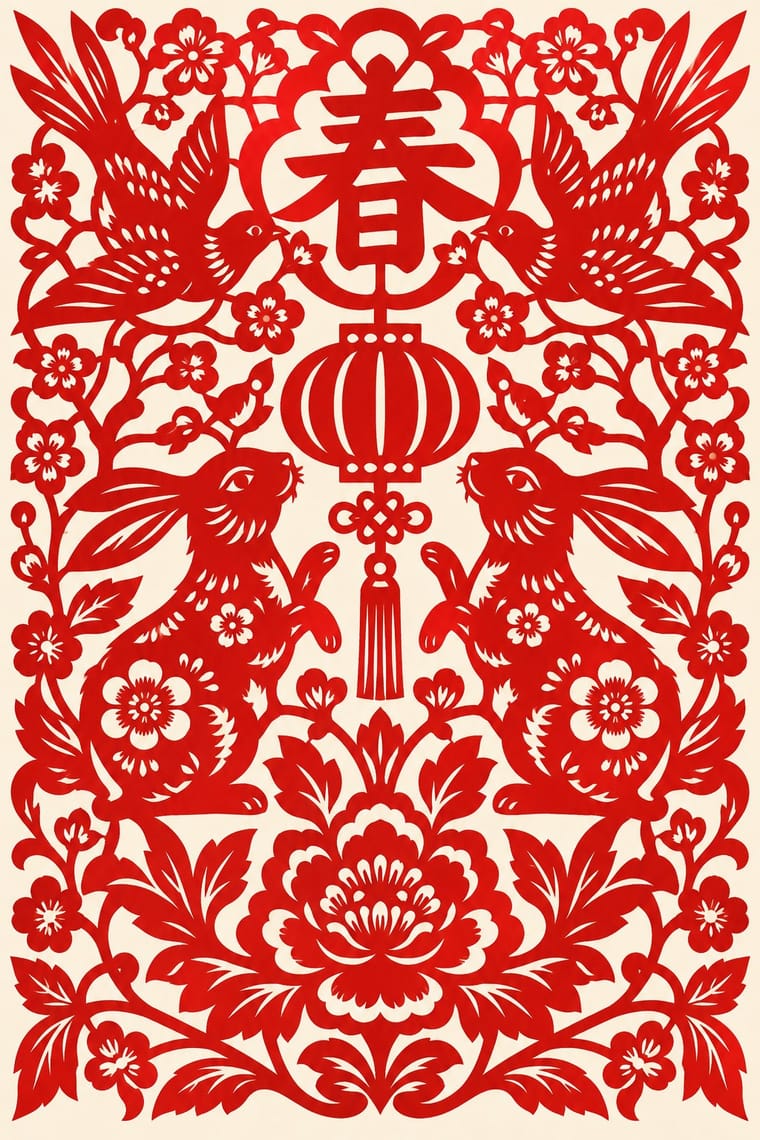
Shippori Mincho; Chinese Paper-Cut used Double happiness (囍) cut from folded red paper for weddings, the doubled character mirrored across the fold and Fu (福) and other auspicious characters cut as solid, bridged glyphs for the New Year
Text · Guna Mola
The reverse-appliqué blouse panels of Guna women in Panama, made by cutting through two to seven stacked layers of cotton so that every shape is ringed by echoing bands of the colours beneath. Fields are packed with filler slits, sawtooth edges and mazes. The imagery runs from abstract ancestral designs and animals to Bible stories, cartoon characters, brand logos and party slogans, all redrawn in the same contour-echo idiom.
Archivo; Guna Mola used Letters cut through the cloth layers and outlined by echo bands, as in political and lettered mola panels and Brand wordmarks and cartoon lettering redrawn in reverse appliqué
03
The colours
The ground and leading colours come from Guna Mola, with a counter-accent from Chinese Paper-Cut. The ink reads on the ground at 4.5:1 or more.
Chinese Paper-Cut (Jianzhi) Guna Mola
-
#121212ground · 36% -
#f2c12eink · 14% -
#ee7a1faccent · 18% -
#c9a227accent · 14% -
#c8262eaccent · 10% -
#e0558aaccent · 8%
As CSS
:root {
  --ground: #121212;
  --ink: #f2c12e;
  --accent-1: #ee7a1f;
  --accent-2: #c9a227;
  --accent-3: #c8262e;
  --accent-4: #e0558a;
  --font-display: "Shippori Mincho", serif;
  --font-text: "Archivo", sans-serif;
}
Use it with care
Chinese Paper-Cut (Jianzhi): Paper-cutting is a living craft, practised mostly by rural women who learn it from their mothers, and some cuts serve ritual ends, from invoking rain and warding off evil to calling back the spirit of the dead at funerals. Commission, buy from or credit named cutters and regional workshops rather than tracing their designs, keep auspicious characters correct and legible, do not use funerary or ritual cuts as festive decoration, and treat Miao embroidery-pattern cuts as part of a minority community's dress rather than a free motif bank. Use 囍 (double happiness) only for weddings, not as a generic Chinese luck motif; a 福 hung upside down at New Year is deliberate (倒福, a pun on 'fortune arrives'), so do not correct it, and do not flip other characters.
Guna Mola: The mola is the everyday and ceremonial dress of Guna women and an emblem of Guna identity and autonomy, defended in the 1925 revolution against a Panamanian ban on Guna dress; many motifs draw on Guna cosmology and oral history, and early sergan designs have been studied and reclaimed by Guna representatives. Treat it as a community's living dress, not a decorative print: buy or commission molas from Guna makers and cooperatives, credit them, keep paired panels together, and do not print imitation 'mola' patterns on merchandise. In Panama, Law 20 of 2000 protects Guna dress as collective intellectual property and bars its industrial reproduction, in whole or in part, without official authorisation and the prior consent of the Guna general congresses.
04
The two styles
05
More combinations
With Chinese Paper-Cut
- Stencil Street Art Pairs well · Both depend on bridges that hold every island of the design to the sheet; give a spray stencil the paper-cut's folded symmetry and saw-tooth texture.
- Kamon (Japanese Family Crests) Contrasts · Kamon reduce an emblem to a spare roundel silhouette; paper-cut fills the same roundel with saw-tooth texture and pierced pattern, so set restraint against abundance.
- Nianhua & Chinese Folk Print Pairs well · Both dress the home for the New Year; hang a single red window cut beside a dense, keylined door-god print so flat void and crowded colour work together.
- Guochao (China-Chic National Trend) Pairs well · Guochao packaging borrows red cut-paper silhouettes; keep the real cut logic (joined lines, folded symmetry, correct auspicious characters) instead of a generic filigree texture.
- Swedish Painted Wall Hangings (Dalmålning, Bonadsmålning and Kurbits) Pairs well · A looser parallel: domestic wall decoration filled with symbolic flora, though cut paper rather than painted.
- Mithila (Madhubani) Painting Contrasts · Both are folk arts made mostly by rural women for weddings and other rites, with fish and lotus among their auspicious signs, but paper-cut is a silhouette, usually red, cut from one sheet and folded for mirror symmetry, while Mithila draws an outline and fills it with colour, hatching or rings until no ground is left. Use one of them, not a blend of the two.
- Javanese Wayang Kulit (Tatah Sungging) Contrasts · Both draw with holes cut through a flat sheet, but paper-cuts are usually folded, symmetrical and one-coloured, while a wayang figure is in profile, painted and gilded on both faces, and made to move.
- Kinngait (Cape Dorset) Inuit Printmaking Contrasts · Both are flat silhouettes with notches and cut patterns inside; paper-cut folds the sheet for exact mirror symmetry and fills the shape with lace, while Kinngait draws freehand, keeps a few incised marks and lets stencil colour grade inside the shape, often darkest at its tips.
With Guna Mola
- Batik Pattern Tradition Contrasts · Batik builds pattern by resist-dyeing, molas by cutting and sewing; never render a mola as a printed texture, because the stepped, stitched edge is the whole point.
- Psychedelic Poster Pairs well · Wrap a headline in concentric echo bands of flat colour, the mola principle, to get psychedelic vibration from stacked layers instead of melting line.
- Pop Art Graphics Pairs well · Like Pop, molas absorb brand logos and cartoons; borrow that omnivorous attitude for a campaign, but commission Guna makers rather than faking the cut-cloth look.
- Kanga (Swahili Message Cloth) Contrasts · Both are women's dress that takes in party slogans, logos and portraits, but a mola is hand-cut reverse appliqué packed edge to edge with echoing contour bands, while a kanga is a factory print with flat fields, an open, centred motif and its message in one plain box.
- Fante Asafo Flags (Frankaa) Contrasts · Both are hand-cut cotton appliqué in saturated colour that absorbs foreign images, but a mola packs every gap with slits and echoing contour bands, while an asafo flag leaves a plain ground around a few silhouettes so the scene reads from across a street.