Style combination · Contrasts
Fante Asafo Flags × Guna Mola
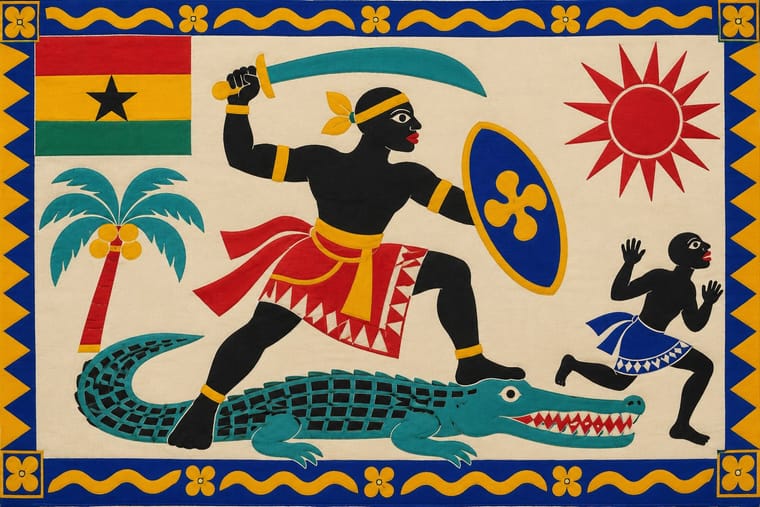
Both are hand-cut cotton appliqué in saturated colour that absorbs foreign images, but a mola packs every gap with slits and echoing contour bands, while an asafo flag leaves a plain ground around a few silhouettes so the scene reads from across a street.
01
What each style brings
Each part of the design comes from the style with the stronger say in it, and each style gives at least two.
Fante Asafo Flags (Frankaa) Guna Mola
- Type from Fante Asafo Flags
-
- Colour from Fante Asafo Flags
- Form from Guna Mola
- Composition from Guna Mola
- Surface from Guna Mola
02
The type
Open fonts standing in for each style’s own type, which is often hand-drawn or commercial.
Display · Fante Asafo Flags
Together
Londrina Solid; Fante Asafo Flags used Embroidered block capitals and numerals naming the company and Company numbers such as 'Nº1' and 'Nº2' in a contrasting cloth or thread, set in the field or along an arm of a large cross that divides the field ('NºI' in red on the bottom arm of a wide golden-yellow cross, Flags of the World 'Crocodiles and moon' flag)
Text · Guna Mola
The reverse-appliqué blouse panels of Guna women in Panama, made by cutting through two to seven stacked layers of cotton so that every shape is ringed by echoing bands of the colours beneath. Fields are packed with filler slits, sawtooth edges and mazes. The imagery runs from abstract ancestral designs and animals to Bible stories, cartoon characters, brand logos and party slogans, all redrawn in the same contour-echo idiom.
Archivo; Guna Mola used Letters cut through the cloth layers and outlined by echo bands, as in political and lettered mola panels and Brand wordmarks and cartoon lettering redrawn in reverse appliqué
03
The colours
The ground and leading colours come from Fante Asafo Flags, with a counter-accent from Guna Mola. The ink reads on the ground at 4.5:1 or more.
Fante Asafo Flags (Frankaa) Guna Mola
-
#f0e9d8ground · 36% -
#1b1b1bink · 14% -
#f2b31baccent · 18% -
#ee7a1faccent · 14% -
#c62a2faccent · 10% -
#1e3a8aaccent · 8%
As CSS
:root {
  --ground: #f0e9d8;
  --ink: #1b1b1b;
  --accent-1: #f2b31b;
  --accent-2: #ee7a1f;
  --accent-3: #c62a2f;
  --accent-4: #1e3a8a;
  --font-display: "Londrina Solid", cursive;
  --font-text: "Archivo", sans-serif;
}
Use it with care
Fante Asafo Flags (Frankaa): Asafo companies are living institutions of Fante towns: each flag belongs to its company, is commissioned when a new captain takes office, is danced at festivals and members' funerals and hung at the company shrine, and its image is often a taunt aimed at a particular rival company. Do not copy a company's flag or emblem for branding, learn what a motif says as a proverb before using it, since a scene can boast or insult, and do not pass off a new flag sewn with a Union Jack as a colonial-era piece: workshops have made flags for collectors and tourists in record numbers since the mid-1990s, including new flags made to look pre-independence. Company imagery has carried political stakes: under colonial rule the British administration imposed strict regulations on asafo companies and their arts. Commission and credit Fante flag-makers' workshops rather than printing imitations.
Guna Mola: The mola is the everyday and ceremonial dress of Guna women and an emblem of Guna identity and autonomy, defended in the 1925 revolution against a Panamanian ban on Guna dress; many motifs draw on Guna cosmology and oral history, and early sergan designs have been studied and reclaimed by Guna representatives. Treat it as a community's living dress, not a decorative print: buy or commission molas from Guna makers and cooperatives, credit them, keep paired panels together, and do not print imitation 'mola' patterns on merchandise. In Panama, Law 20 of 2000 protects Guna dress as collective intellectual property and bars its industrial reproduction, in whole or in part, without official authorisation and the prior consent of the Guna general congresses.
04
The two styles
05
More combinations
With Fante Asafo Flags
- Adinkra & Kente Symbol Systems Contrasts · Both put Akan proverbs on cloth, but adinkra stamps abstract named signs in a ruled grid and kente weaves blocks of pattern, while an asafo flag spells the proverb out as one pictorial scene of appliquéd figures on an open ground.
- Ghanaian Movie Poster Pairs well · Both are Ghanaian popular images that sell a confrontation at a glance: the movie poster paints it in lurid brushwork, the asafo flag cuts it in flat cloth, so pair them for a loud, local announcement with one cut-out emblem against a painted scene.
- European Heraldry Contrasts · Asafo flag-makers took the canton from European flags, the griffin from English imagery and many-headed dragons probably inspired by the mythical creatures of heraldry, but a coat of arms is a symmetrical, rule-bound mark of a bearer, while an asafo flag is an asymmetrical picture of a boast or taunt; borrow heraldry's flat colours and borders, not its symmetry.
- Kanga (Swahili Message Cloth) Pairs well · Both carry proverbs and barbs aimed at rivals on cloth shown in public; pair the asafo's pictorial taunt with the kanga's written saying in a box when an image needs its caption.
- Ultras Graphics (Curva Banners and Tifo) Contrasts · Another fighting group's cloth: the Fante company flag tells a proverb in appliquéd figures for one company, while the ultras banner states one name in painted capitals to a whole stadium.
With Guna Mola
- Batik Pattern Tradition Contrasts · Batik builds pattern by resist-dyeing, molas by cutting and sewing; never render a mola as a printed texture, because the stepped, stitched edge is the whole point.
- Psychedelic Poster Pairs well · Wrap a headline in concentric echo bands of flat colour, the mola principle, to get psychedelic vibration from stacked layers instead of melting line.
- Pop Art Graphics Pairs well · Like Pop, molas absorb brand logos and cartoons; borrow that omnivorous attitude for a campaign, but commission Guna makers rather than faking the cut-cloth look.
- Chinese Paper-Cut (Jianzhi) Contrasts · Molas cut through stacked layers of cloth and stitch the edges, so colour builds in echo bands; paper-cut stays one flat layer of colour seen against light.
- Kanga (Swahili Message Cloth) Contrasts · Both are women's dress that takes in party slogans, logos and portraits, but a mola is hand-cut reverse appliqué packed edge to edge with echoing contour bands, while a kanga is a factory print with flat fields, an open, centred motif and its message in one plain box.