Style combination · Contrasts
Batik Pattern Tradition × Guna Mola
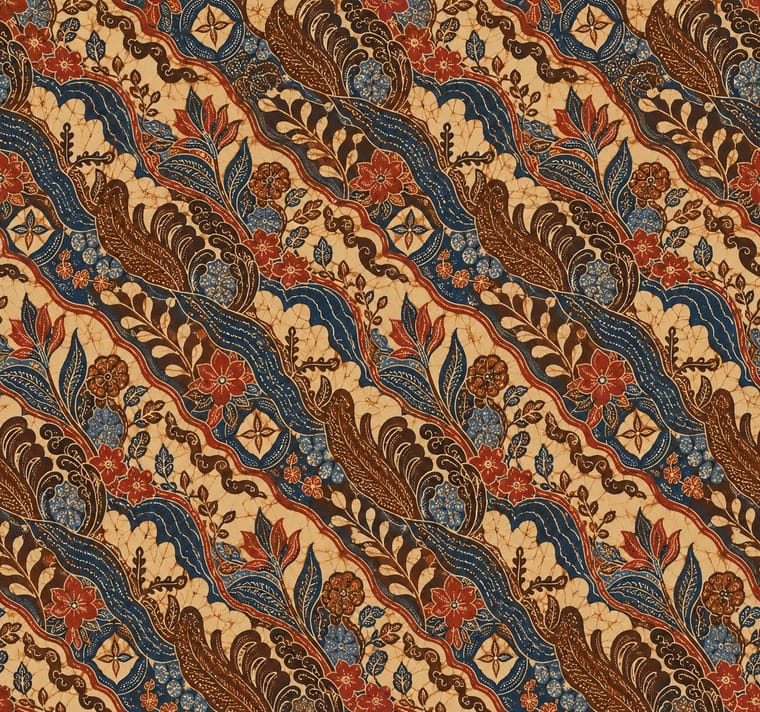
Batik builds pattern by resist-dyeing, molas by cutting and sewing; never render a mola as a printed texture, because the stepped, stitched edge is the whole point.
Mix them and make something Batik Pattern Tradition Guna Mola
01
What each style brings
Each part of the design comes from the style with the stronger say in it, and each style gives at least two.
Batik Pattern Tradition Guna Mola
- Type from Batik Pattern Tradition
-
- Colour from Guna Mola
- Form from Guna Mola
- Composition from Batik Pattern Tradition
- Surface from Guna Mola
02
The type
Open fonts standing in for each style’s own type, which is often hand-drawn or commercial.
Display · Batik Pattern Tradition
Ours
Rakkas, standing in for Arabic calligraphy of batik besurek (Bengkulu) and Cirebon
Text · Guna Mola
The reverse-appliqué blouse panels of Guna women in Panama, made by cutting through two to seven stacked layers of cotton so that every shape is ringed by echoing bands of the colours beneath. Fields are packed with filler slits, sawtooth edges and mazes. The imagery runs from abstract ancestral designs and animals to Bible stories, cartoon characters, brand logos and party slogans, all redrawn in the same contour-echo idiom.
Archivo; Guna Mola used Letters cut through the cloth layers and outlined by echo bands, as in political and lettered mola panels and Brand wordmarks and cartoon lettering redrawn in reverse appliqué
03
The colours
The ground and leading colours come from Guna Mola, with a counter-accent from Batik Pattern Tradition. The ink reads on the ground at 4.5:1 or more.
Batik Pattern Tradition Guna Mola
-
#121212ground · 36% -
#f2c12eink · 14% -
#ee7a1faccent · 18% -
#a6322baccent · 14% -
#2c6aa0accent · 10% -
#2e8b4aaccent · 8%
As CSS
:root {
  --ground: #121212;
  --ink: #f2c12e;
  --accent-1: #ee7a1f;
  --accent-2: #a6322b;
  --accent-3: #2c6aa0;
  --accent-4: #2e8b4a;
  --font-display: "Rakkas", cursive;
  --font-text: "Archivo", sans-serif;
}
Use it with care
Batik Pattern Tradition: Batik is inscribed by UNESCO as Indonesian intangible cultural heritage (2009), and some court motifs such as parang rusak were historically reserved for royalty and carry philosophical meanings. Learn a motif's meaning before using it, credit the region and makers, and do not market printed batik-look fabric as hand-drawn or stamped batik.
Guna Mola: The mola is the everyday and ceremonial dress of Guna women and an emblem of Guna identity and autonomy, defended in the 1925 revolution against a Panamanian ban on Guna dress; many motifs draw on Guna cosmology and oral history, and early sergan designs have been studied and reclaimed by Guna representatives. Treat it as a community's living dress, not a decorative print: buy or commission molas from Guna makers and cooperatives, credit them, keep paired panels together, and do not print imitation 'mola' patterns on merchandise. In Panama, Law 20 of 2000 protects Guna dress as collective intellectual property and bars its industrial reproduction, in whole or in part, without official authorisation and the prior consent of the Guna general congresses.
04
The two styles
05
More combinations
With Batik Pattern Tradition
- Islamic Geometric & Calligraphic Tradition Pairs well · Coastal batik already absorbs Arabic script and geometric lattices; combine the two for pattern that is both structured and hand-made.
- Minimalist Graphic Design Contrasts · Crop a single batik motif onto a large empty field to show its line quality instead of drowning a minimal layout in pattern.
- Art Nouveau Pairs well · Dutch Nieuwe Kunst designers such as Chris Lebeau worked in batik; pair its vegetal repeats with Art Nouveau linework for book covers and textiles.
- Psychedelic Poster Pairs well · Crackle texture and layered dyes suit psychedelic colour; keep batik's dense all-over repeat as the structure underneath.
- Nieuwe Kunst (Dutch Art Nouveau) Pairs well · Its direct source: Dutch designers used wax-resist dyeing for covers in cotton, velvet and parchment; pair a constructed Nieuwe Kunst repeat with real batik colour layering, and credit the Javanese craft.
- Javanese Wayang Kulit (Tatah Sungging) Pairs well · Both are court arts of Yogyakarta and Surakarta; set one coded figure against batik's all-over repeat to pair a single focus with a patterned field.
- Mithila (Madhubani) Painting Contrasts · Batik spreads a resist-dyed repeat evenly across cloth; Mithila builds a unique, hand-drawn composition around a centre and closes it with borders. Borrow one or the other, not both, to keep pattern and picture distinct.
- African Wax & Fancy Print Pairs well · Set hand-drawn Javanese batik beside its industrial descendant to show resist turning into mass repeat, crackle and giant scale.
With Guna Mola
- Psychedelic Poster Pairs well · Wrap a headline in concentric echo bands of flat colour, the mola principle, to get psychedelic vibration from stacked layers instead of melting line.
- Pop Art Graphics Pairs well · Like Pop, molas absorb brand logos and cartoons; borrow that omnivorous attitude for a campaign, but commission Guna makers rather than faking the cut-cloth look.
- Chinese Paper-Cut (Jianzhi) Contrasts · Molas cut through stacked layers of cloth and stitch the edges, so colour builds in echo bands; paper-cut stays one flat layer of colour seen against light.
- Kanga (Swahili Message Cloth) Contrasts · Both are women's dress that takes in party slogans, logos and portraits, but a mola is hand-cut reverse appliqué packed edge to edge with echoing contour bands, while a kanga is a factory print with flat fields, an open, centred motif and its message in one plain box.
- Fante Asafo Flags (Frankaa) Contrasts · Both are hand-cut cotton appliqué in saturated colour that absorbs foreign images, but a mola packs every gap with slits and echoing contour bands, while an asafo flag leaves a plain ground around a few silhouettes so the scene reads from across a street.