Style combination · Pairs well
Celtic Revival Illumination × Seiz Breur
Use Insular interlace sparingly as accents on a flat folk-figure base to keep a Celtic reference without pastiche.
Mix them and make something Celtic Revival Illumination Seiz Breur
01
What each style brings
Each part of the design comes from the style with the stronger say in it, and each style gives at least two.
Celtic Revival Illumination & Lettering Seiz Breur (Breton Modernised Folk Design)
- Type from Celtic Revival Illumination
- Colour from Seiz Breur
- Form from Celtic Revival Illumination
-
Seiz Breur avoids abundant decoration: this is where the two pull against each other.
- Composition from Celtic Revival Illumination
- Surface from Seiz Breur
02
The type
Open fonts standing in for each style’s own type, which is often hand-drawn or commercial.
Display · Celtic Revival Illumination
Souvenir
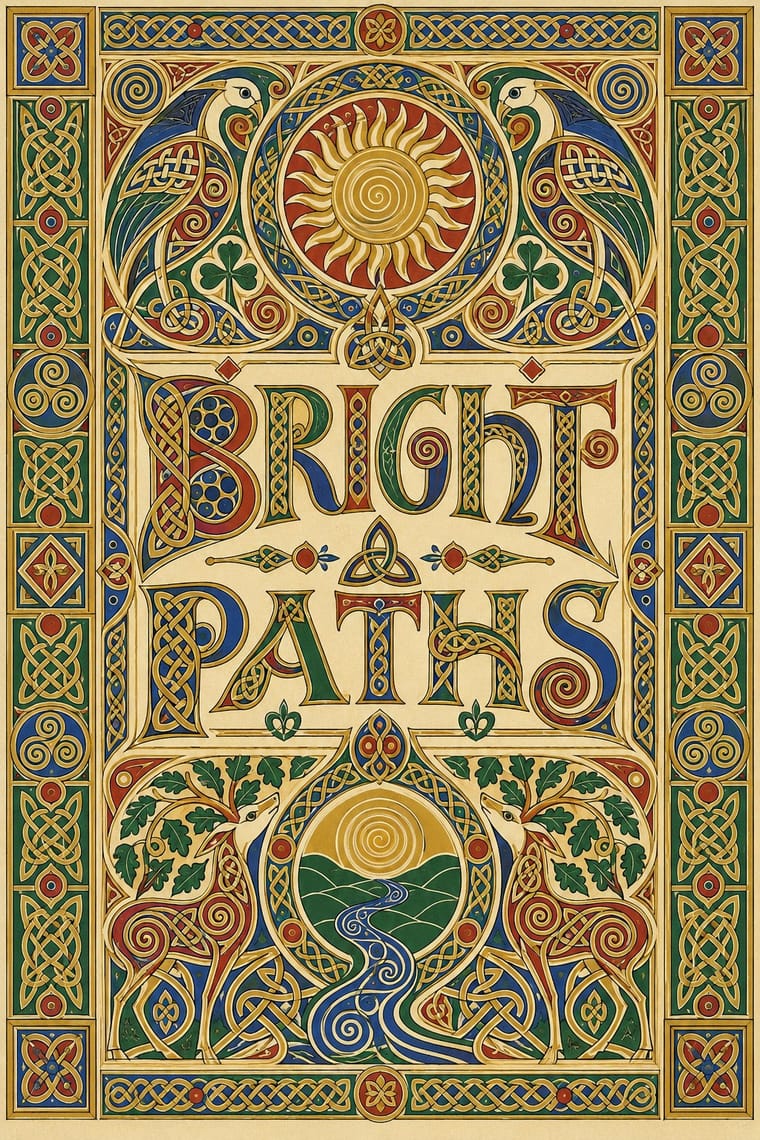
Uncial Antiqua; Celtic Revival Illumination used Hand-drawn lettering after the majuscule and half-uncial of the Insular manuscripts, drawn into the ornament and Archibald Knox's interlaced Celtic lettering, drawn so densely into the ornament that it must be studied to be read
Text · Seiz Breur
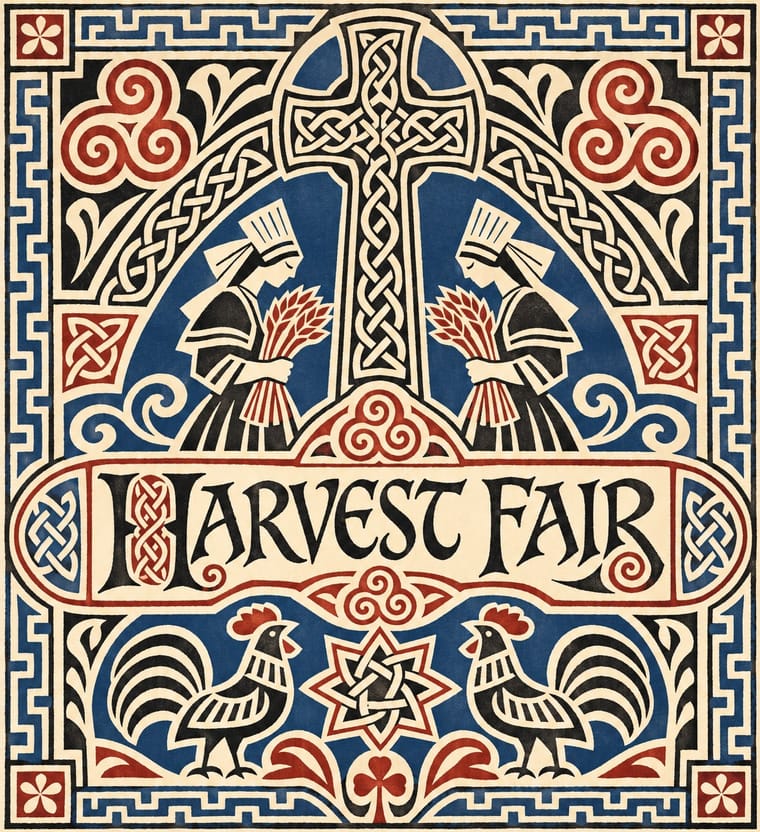
A Breton artists' and craftspeople's association that set out to build a modern Breton art by recasting regional folk motifs in simplified, flat, deco-adjacent form. Wood engraving, stamps, posters, ceramics, embroidery and furniture shared one vocabulary of stylised figures and folk ornament. About fifty members at its height. The period follows the group's last activity to 1947-48; Wikipedia also records its closure in 1944. Unlike celtic-revival it avoids Insular interlace pastiche, and unlike art-deco it starts from Breton folk sources.
Archivo; Seiz Breur used Hand-cut wood-engraved lettering and Deco-influenced hand-drawn capitals
03
The colours
The ground and leading colours come from Seiz Breur, with a counter-accent from Celtic Revival Illumination. The ink reads on the ground at 4.5:1 or more.
Celtic Revival Illumination & Lettering Seiz Breur (Breton Modernised Folk Design)
-
#f1e9d6ground · 36% -
#1c1a18ink · 14% -
#c9a24aaccent · 18% -
#a8322aaccent · 14% -
#2b4a7aaccent · 10% -
#1f5a3daccent · 8%
As CSS
:root {
  --ground: #f1e9d6;
  --ink: #1c1a18;
  --accent-1: #c9a24a;
  --accent-2: #a8322a;
  --accent-3: #2b4a7a;
  --accent-4: #1f5a3d;
  --font-display: "Uncial Antiqua", sans-serif;
  --font-text: "Archivo", sans-serif;
}
Use it with care
Celtic Revival Illumination & Lettering: Its models are Christian gospel books and crosses, and many of its emblems are national and partisan: Leabhar na hAiséirghe is a memorial to the republican dead of 1916–23, including the Civil War, and the Celtic Cross stamp was adapted from a Sinn Féin label, so do not use these as neutral 'Irish' decoration where nationalist imagery is contested, as in Northern Ireland. The 1922 Map of Ireland stamp left out the border, and some in Northern Ireland and Britain read it as a claim to the northern counties, so an undivided map of the island is itself a political statement. A square cross interlocked with or surrounded by a circle is a widespread white-supremacist symbol, while the traditional Celtic cross has a long vertical shaft, so draw the cross accordingly and check knotwork marks in context. 'Celtic' and 'Irish' are not exclusive labels for Kells-type ornament: Insular art was made across Britain and Ireland, the Lindisfarne Gospels in Northumbria, and Kells itself possibly begun on Iona. George Bain died in 1968, so his drawings remain in copyright in the UK until the end of 2038: construct new knots by his methods rather than tracing his plates, and have any Irish or Scottish Gaelic text checked by a fluent reader.
Seiz Breur (Breton Modernised Folk Design): Seiz Breur worked from a living regional folk culture and the Breton language movement, and the community's own heritage should be credited rather than treated as a decorative style. Some members, notably Olier Mordrel and Yann Goulet, turned to nationalism and collaboration with Nazi Germany during the occupation. Under the name Eost Breiziz the group exhibited until 1944, when sources record its closure; its chronology also gives 1947-48 as the end, which the period follows. Many members were not tied to the far right. Breton emblems such as Gwenn ha Du carry that contested history.
04
The two styles
05
More combinations
With Celtic Revival Illumination
- Mir iskusstva Book Art Pairs well · A parallel national revival of the same decades: both turned medieval and folk ornament into the borders and initials of a modern book; combine for a heritage storybook framed in old ornament.
- Bezalel School Pairs well · Another national illumination of the 1900s–1920s, with hand-drawn national letters, jewel colours and gold inside heavy symmetrical frames; compare how each built a national art from ancient ornament.
- Gothic Blackletter & Fraktur Tradition Contrasts · The other national script of the same decades: Fraktur set German text until its ban in 1941, as Gaelic type set Irish until the mid-twentieth century; set the dark, broken gothic weave against the round, open insular letter.
- International Typographic Style Contrasts · Its exact opposite: hand-built, symmetrical, ornament-filled national pages against an asymmetric grid, neutral sans-serif and white space; borrow one knotted initial to warm a strict grid.
- Ethiopian Ge'ez Manuscript & Haräg Illumination Pairs well · Another Christian manuscript tradition that marks its divisions with interlace: set a haräg band of interlace and chequers beside a Celtic knotwork frame to compare a varied headpiece with a closed, compartmented border.
- Islamic Geometric & Calligraphic Tradition Pairs well · Both build sacred pages from interlaced strapwork constructed geometrically and framed symmetrically; set a Celtic knot border beside a girih panel to compare closed knotwork with an endless star tiling.
- Glasgow Style Contrasts · Scotland in the same years, but Glasgow stretched space, emptied it and set a few rosebuds on long verticals, while the Celtic Revival fills its compartments densely with knotwork; choose air or density.
- Armenian Manuscript Illumination Pairs well · Both build letters out of animals and interlace; set a bird-letter initial beside a knotted Celtic one to compare an initial made of whole birds with one made of interlaced beasts.
With Seiz Breur
- Art Deco Pairs well · Borrow deco angularity and symmetry to modernise folk figures.
- Estado Novo Folk Modernism (SPN) Contrasts · Also modernises vernacular motifs, but under state sponsorship; a useful comparison for regional versus official folk modernism.
- Contemporary Folk Botanical Illustration (Elemental Folk) Contrasts · Separate these curving botanical commercial pictures from the Breton association's regional programme, angular forms and carved-line print vocabulary.