Style combination · Contrasts
Contemporary Folk Botanical Illustration × Seiz Breur
Separate these curving botanical commercial pictures from the Breton association's regional programme, angular forms and carved-line print vocabulary.
Mix them and make something Contemporary Folk Botanical Illustration Seiz Breur
01
What each style brings
Each part of the design comes from the style with the stronger say in it, and each style gives at least two.
Contemporary Folk Botanical Illustration (Elemental Folk) Seiz Breur (Breton Modernised Folk Design)
- Type from Seiz Breur
- Colour from Contemporary Folk Botanical Illustration
- Form from Contemporary Folk Botanical Illustration
- Composition from Contemporary Folk Botanical Illustration
- Surface from Seiz Breur
02
The type
Open fonts standing in for each style’s own type, which is often hand-drawn or commercial.
Text · Contemporary Folk Botanical Illustration
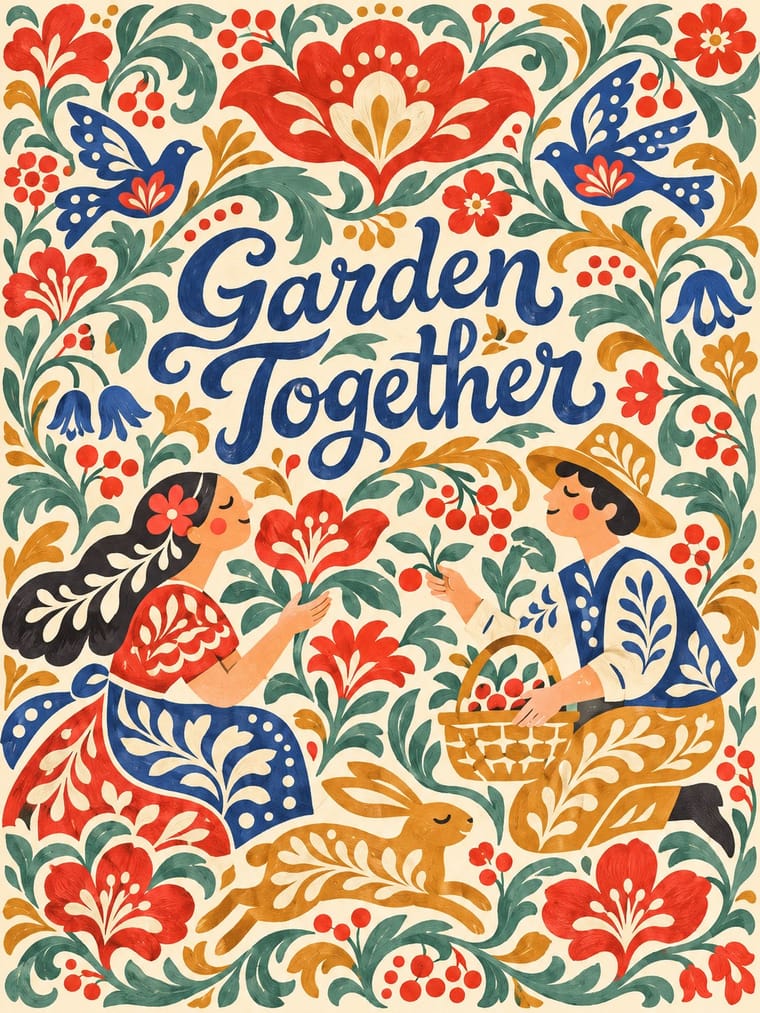
A contemporary packaging and book-cover idiom that turns flowers, berries, branching stems and birds into flattened decorative silhouettes, often filled with tiny petals, dots and veins. Freely arranged plants surround a title or spread across the surface. It overlaps the broader Elemental Folk trend, but is not a catch-all for folk cultures or scientific botanical illustration.
Zen Maru Gothic; Contemporary Folk Botanical Illustration used Irregular monoline hand-drawn title lettering, as visible on How to Love the World; lettering authorship unverified and Spaced sans-serif commercial capitals, as visible on Lycka Till / Morozoff packaging; no exact font identified
03
The colours
The ground and leading colours come from Contemporary Folk Botanical Illustration, with a counter-accent from Seiz Breur. The ink reads on the ground at 4.5:1 or more.
Contemporary Folk Botanical Illustration (Elemental Folk) Seiz Breur (Breton Modernised Folk Design)
-
#f5edd9ground · 36% -
#1c1b20ink · 14% -
#e63b32accent · 18% -
#c9a24aaccent · 14% -
#a8322aaccent · 10% -
#284d95accent · 8%
As CSS
:root {
  --ground: #f5edd9;
  --ink: #1c1b20;
  --accent-1: #e63b32;
  --accent-2: #c9a24a;
  --accent-3: #a8322a;
  --accent-4: #284d95;
  --font-display: "Londrina Solid", cursive;
  --font-text: "Zen Maru Gothic", sans-serif;
}
Use it with care
Contemporary Folk Botanical Illustration (Elemental Folk): Folk is a commercial umbrella here, not a single culture or permission to pool unrelated traditions. Distinguish each illustrator's authored work from the living regional practices it may reference, and name a specific cultural source only when documented. Do not copy a maker's compositions or turn sacred, ceremonial, clan-owned or otherwise restricted signs into decorative filler. For a culturally specific commission, work with and credit practitioners of that tradition, agree permission and compensation, and do not claim generic botanical ornament is authentic community work. Inventing ordinary plants and animals does not require borrowing restricted imagery. Museum, agency and portfolio publication does not establish a reuse licence; the inspected images are research references only, with no open image rights confirmed. The forecast label does not establish a shared ancestry, and no six-part botanical/pixel/psychedelic/Mexican/future/Slavic taxonomy is claimed.
Seiz Breur (Breton Modernised Folk Design): Seiz Breur worked from a living regional folk culture and the Breton language movement, and the community's own heritage should be credited rather than treated as a decorative style. Some members, notably Olier Mordrel and Yann Goulet, turned to nationalism and collaboration with Nazi Germany during the occupation. Under the name Eost Breiziz the group exhibited until 1944, when sources record its closure; its chronology also gives 1947-48 as the end, which the period follows. Many members were not tied to the far right. Breton emblems such as Gwenn ha Du carry that contested history.
04
The two styles
05
More combinations
With Contemporary Folk Botanical Illustration
- Botanical Specimen-Plate Illustration Contrasts · Choose invented patterned petals and ornamental density rather than diagnostic plant detail, numbered dissections and small identification captions.
- Swedish Painted Wall Hangings (Dalmålning, Bonadsmålning and Kurbits) Contrasts · Keep the floral surround distinct from Swedish wall-hanging narrative: do not import biblical friezes or claim its kurbits tradition as this idiom's verified ancestor.
- Josef Frank and Svenskt Tenn Botanical Prints Contrasts · The closest genome neighbour: distinguish a title-bearing package or cover with filled decorative silhouettes from Frank's long, densely populated furnishing repeats; all-over floral ornament alone cannot separate them.
- Estado Novo Folk Modernism (SPN) Contrasts · Do not confuse decorative commercial flora with the Portuguese regime's pastoral national imagery, state emblems and official persuasion.
- minä perhonen (Hand-Drawn Textile Graphics, Akira Minagawa) Contrasts · Use this entry for image-led packaging and covers with larger decorative plants, not as a synonym for the label's quiet, small-scale textile and embroidered repeats.
- Global Village Coffeehouse Contrasts · Choose flower-filled silhouettes and distinct colour fields here rather than the coffeehouse register's scratchboard line, celestial emblems and mottled grounds.
- Naive Scribble Branding Contrasts · Build a worked floral surround or ornamental field instead of isolating one scribbled mascot or making an awkward wordmark the main event.
With Seiz Breur
- Art Deco Pairs well · Borrow deco angularity and symmetry to modernise folk figures.
- Celtic Revival Illumination & Lettering Pairs well · Use Insular interlace sparingly as accents on a flat folk-figure base to keep a Celtic reference without pastiche.
- Estado Novo Folk Modernism (SPN) Contrasts · Also modernises vernacular motifs, but under state sponsorship; a useful comparison for regional versus official folk modernism.