Style combination · Contrasts
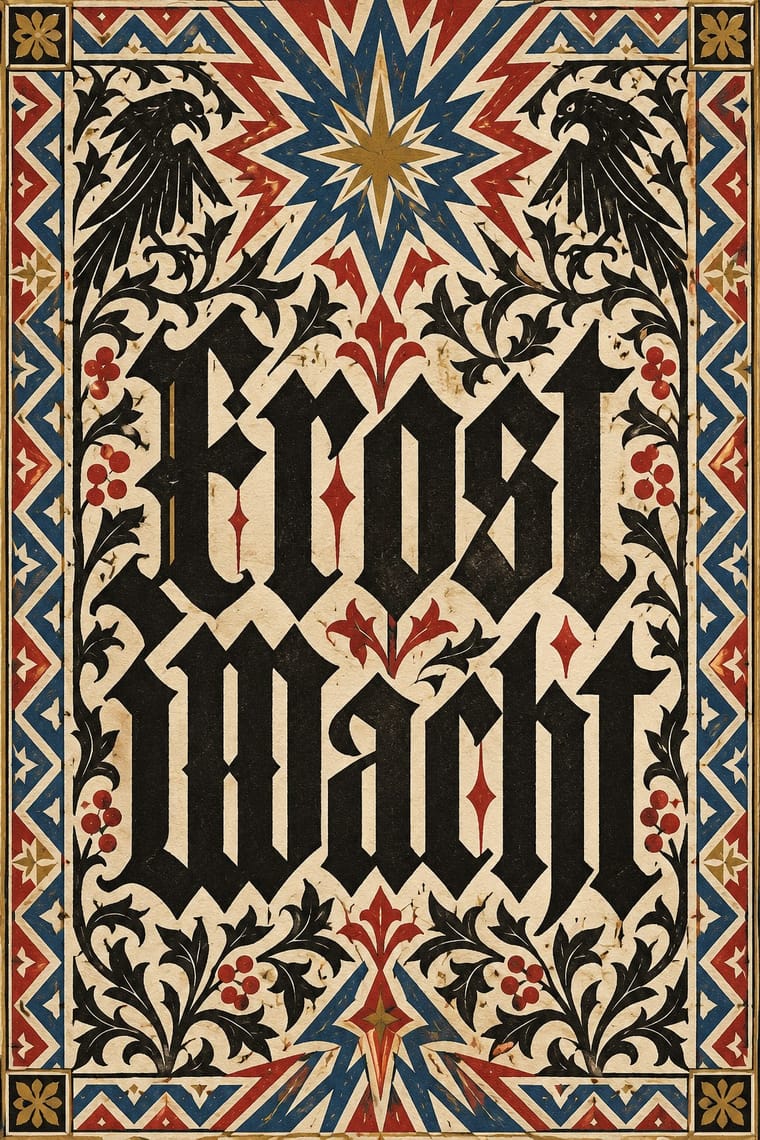
Gothic Blackletter × Tibetan Woodblock Print Culture
Textura and Uchen both turn scripture into an even horizontal weave of letters. Set beside the tall Gothic page, the pecha's long oblong leaf of a few headed lines shows how much the page format, not only the letterform, decides the texture.
Mix them and make something Gothic Blackletter Tibetan Woodblock Print Culture
01
What each style brings
Each part of the design comes from the style with the stronger say in it, and each style gives at least two.
Gothic Blackletter & Fraktur Tradition Tibetan Woodblock Print Culture (Pecha & Prayer Flags)
- Type from Gothic Blackletter
- Colour from Gothic Blackletter
- Form from Gothic Blackletter
- Composition from Tibetan Woodblock Print Culture
- Surface from Tibetan Woodblock Print Culture
02
The type
Open fonts standing in for each style’s own type, which is often hand-drawn or commercial.
Display · Gothic Blackletter
Civic
UnifrakturMaguntia, standing in for Gutenberg's 42-line Bible textura (Mainz, c. 1454–55)
Text · Tibetan Woodblock Print Culture
Tibetan Buddhist and Bön woodblock printing, from the first printed Kangyur (1410, cut in China) and the 15th-century presses of Gungthang to the great printing houses of Narthang, Derge and Lhasa. Books take the pecha form of Indian palm-leaf pothis: long, unbound oblong leaves of headed Uchen script, justified with syllable dots, cut in reverse from a calligrapher's copy and printed in black, or in cinnabar red for the Buddha's word. The same workshops cut icons, mandalas and prayer flags: a wind horse ringed by mantras, printed on cloth in five element colours and left to fade in the wind.
Caveat; Tibetan Woodblock Print Culture used Uchen (dbu can, 'with a head'), the headed script of print, written out by monk calligraphers as master copies for the block cutters and Umê (dbu med), the headless cursive of everyday handwriting
03
The colours
The ground and leading colours come from Gothic Blackletter, with a counter-accent from Tibetan Woodblock Print Culture. The ink reads on the ground at 4.5:1 or more.
Gothic Blackletter & Fraktur Tradition Tibetan Woodblock Print Culture (Pecha & Prayer Flags)
-
#efe6cfground · 36% -
#1b1714ink · 14% -
#b0302aaccent · 18% -
#e3b02eaccent · 14% -
#b8913aaccent · 10% -
#2c4a8caccent · 8%
As CSS
:root {
  --ground: #efe6cf;
  --ink: #1b1714;
  --accent-1: #b0302a;
  --accent-2: #e3b02e;
  --accent-3: #b8913a;
  --accent-4: #2c4a8c;
  --font-display: "UnifrakturMaguntia", serif;
  --font-text: "Caveat", cursive;
}
Use it with care
Gothic Blackletter & Fraktur Tradition: Blackletter carries political weight in German-speaking countries: the Nazi regime pushed Fraktur as the German script in its first years before banning it in January 1941 as supposed 'Schwabacher Jewish letters', and neo-Nazis still use broken scripts. In the United States, too, certain blackletter faces are associated with hate groups, on tattoos and clothing. Check how a blackletter wordmark will read, especially for anything German, national or political. Cholo placas are territorial inscriptions of Los Angeles Latino street writing with their own codes: do not copy a real neighbourhood's placa or roll call, and commission or credit Chicano letterers (such as Chaz Bojórquez) rather than borrowing their menace as decoration.
Tibetan Woodblock Print Culture (Pecha & Prayer Flags): Pecha, icon prints and prayer flags are sacred objects in living Tibetan Buddhist and Bön practice. The Kangyur is the Buddha's word (hence its cinnabar ink), icon prints guide the painting of deities, and flags carry mantras, the four dignities and prayers for a named sponsor. By tradition flags are not put on the ground or worn as clothing, and old ones are burned rather than thrown away. Do not use real or imitation pages, mantras or flags as texture, party bunting, fashion prints or logos, do not crop or mirror them, and have any Tibetan written or checked by a fluent reader. Image models cannot write Uchen and invent letters, so leave text areas blank in generated images and never present one as a real text or flag. Derge still prints by hand from its historic blocks, while Narthang's main halls were razed in 1966: credit and commission Tibetan calligraphers, carvers and printers, in Tibet and in exile, rather than tracing their blocks.
04
The two styles
05
More combinations
With Gothic Blackletter
- Arts & Crafts Movement Pairs well · Morris's Kelmscott Press revived gothic type (Troy and Chaucer) inside dense woodcut borders; join the broken letter to foliate frames and handmade paper for a medieval, hand-made book.
- Die Neue Typographie Contrasts · Its flush-left sans-serif page on an asymmetric axis is everything the centred, justified blackletter block is not; set the two side by side to stage the argument between tradition and modernity.
- Graffiti & Hip-Hop Graphics Pairs well · Old English letters run through Los Angeles cholo writing into later street lettering; give a hand-drawn textura wordmark aerosol fills, outlines and drop shadows for street weight.
- Renaissance Book Typography Contrasts · Its historical rival: the light, round, open humanist roman page against the dark, broken, woven gothic one. Drop one blackletter title or initial into an Aldine-style page for a deliberate clash of eras.
- Acid Graphics / New Ugly Pairs well · Its club-poster revival: acid graphics mixes blackletter with liquid chrome, ultra-wide grotesques and pixel faces. Render one broken-letter wordmark in chrome on black and leave the parchment, rubrics and justified page behind.
- Victorian Letterpress & Wood Type Pairs well · English proclamations and notices kept black letter for gravity; set one blackletter line among slab and Tuscan wood type to lend a playbill or notice an official, old-world voice.
- Gothic Book of Hours (Illuminated Devotional Book) Pairs well · Compare the shared Gothic text block, then distinguish the book-of-hours page by its coordinated miniatures, graded initials and marginal programme; a blackletter wordmark alone does not reproduce this system.
- Pixação (São Paulo Tag Reto) Pairs well · Tag reto descends from gothic and runic forms by way of metal logos; set a textura line above a row of straight, pointed tag-reto letters, both in black, to show the lineage from the book page to the façade.
With Tibetan Woodblock Print Culture
- Nianhua & Chinese Folk Print Contrasts · Both are popular devotional woodblock prints pasted or hung for good fortune. Nianhua floods the paper with saturated figure scenes, whereas the Tibetan print keeps to one ink and lets the dyed cloth or the lines of script carry the effect.
- Mongol Bichig Calligraphy & Ugalz Ornament Pairs well · Mongolian Buddhism printed Tibetan books (the Urga Kangyur, 1908–1910) and keeps the wind horse as khiimori; Mongolian vertical calligraphy and Tibetan horizontal lines can share a bilingual Buddhist page or emblem, with fluent readers of both.
- Thai Yantra (Yant) Diagrams Pairs well · Both are consecrated Buddhist signs printed in one ink on paper and cloth and hung up for protection and fortune. The yantra's grid of cells and the flag's field of mantras round a central figure share a logic, so they suit a calm, devotional layout of text-as-pattern, made only with practitioners.
- Song–Ming Woodblock Book Typography (Songti / Mincho) Contrasts · Both are woodblock canons cut from a calligrapher's copy, but the Chinese page runs in vertical columns of square cells on a folded, sewn leaf, while the pecha runs horizontal lines across loose oblong leaves descended from Indian palm-leaf books.
- Nirnaya Sagar Devanagari Typography (Bombay Metal Type) Contrasts · Set against the carved, oblong pecha page, it shows what cast metal type did to an Indic script: repeatable sorts, sizes and tiers of commentary instead of one carved block per page.
- Burmese Parabaik Painting (Konbaung Folding Books) Contrasts · Tibetan pecha are loose horizontal leaves printed from carved blocks in many copies; the parabaik is a single hand-painted book that unfolds into one strip.