Style combination · Pairs well
Mongol Bichig Calligraphy × Tibetan Woodblock Print Culture
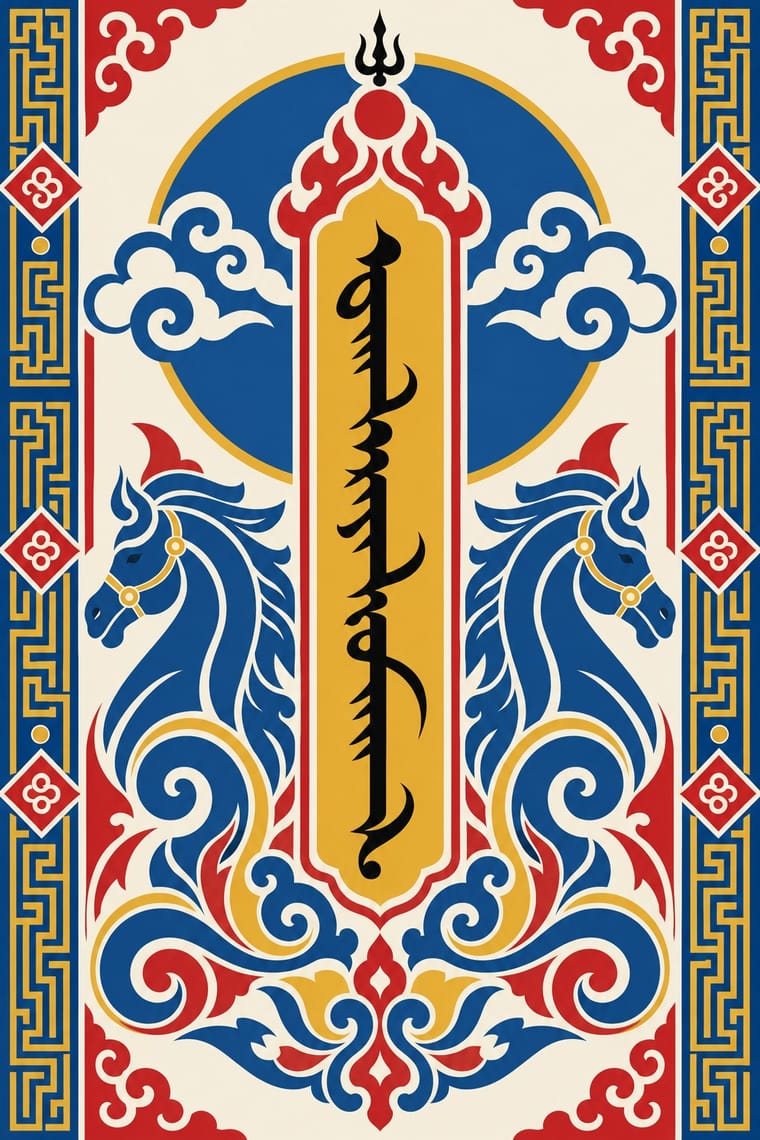
Mongolian Buddhism printed Tibetan books (the Urga Kangyur, 1908–1910) and keeps the wind horse as khiimori; Mongolian vertical calligraphy and Tibetan horizontal lines can share a bilingual Buddhist page or emblem, with fluent readers of both.
Mix them and make something Mongol Bichig Calligraphy Tibetan Woodblock Print Culture
01
What each style brings
Each part of the design comes from the style with the stronger say in it, and each style gives at least two.
Mongol Bichig Calligraphy & Ugalz Ornament Tibetan Woodblock Print Culture (Pecha & Prayer Flags)
- Type from Mongol Bichig Calligraphy
-
Tibetan Woodblock Print Culture avoids rotated & vertical setting: this is where the two pull against each other.
- Colour from Mongol Bichig Calligraphy
- Form from Mongol Bichig Calligraphy
- Composition from Tibetan Woodblock Print Culture
- Surface from Tibetan Woodblock Print Culture
02
The type
Open fonts standing in for each style’s own type, which is often hand-drawn or commercial.
Display · Mongol Bichig Calligraphy
Public
Kaushan Script; Mongol Bichig Calligraphy used Classical Mongolian (Uyghur-Mongolian) script, ninety letter forms joined vertically by continuous strokes, written with a reed pen until the 18th century and with the brush after it and 'Folded' condensed forms of the script, drawn to fill emblems, logos, coins and stamps, as in the 'Mongol Uls' of the State Seal
Text · Tibetan Woodblock Print Culture
Tibetan Buddhist and Bön woodblock printing, from the first printed Kangyur (1410, cut in China) and the 15th-century presses of Gungthang to the great printing houses of Narthang, Derge and Lhasa. Books take the pecha form of Indian palm-leaf pothis: long, unbound oblong leaves of headed Uchen script, justified with syllable dots, cut in reverse from a calligrapher's copy and printed in black, or in cinnabar red for the Buddha's word. The same workshops cut icons, mandalas and prayer flags: a wind horse ringed by mantras, printed on cloth in five element colours and left to fade in the wind.
Caveat; Tibetan Woodblock Print Culture used Uchen (dbu can, 'with a head'), the headed script of print, written out by monk calligraphers as master copies for the block cutters and Umê (dbu med), the headless cursive of everyday handwriting
03
The colours
The ground and leading colours come from Mongol Bichig Calligraphy, with a counter-accent from Tibetan Woodblock Print Culture. The ink reads on the ground at 4.5:1 or more.
Mongol Bichig Calligraphy & Ugalz Ornament Tibetan Woodblock Print Culture (Pecha & Prayer Flags)
-
#f4efe3ground · 36% -
#16130fink · 14% -
#e0a526accent · 18% -
#c4272faccent · 14% -
#1d4f91accent · 10% -
#3d8a4caccent · 8%
As CSS
:root {
  --ground: #f4efe3;
  --ink: #16130f;
  --accent-1: #e0a526;
  --accent-2: #c4272f;
  --accent-3: #1d4f91;
  --accent-4: #3d8a4c;
  --font-display: "Kaushan Script", cursive;
  --font-text: "Caveat", cursive;
}
Use it with care
Mongol Bichig Calligraphy & Ugalz Ornament: Mongol bichig is the living script of Mongols in Mongolia and in Inner Mongolia, where in 2020 China moved three school subjects in Mongolian-medium schools into Mandarin, met by protests and school boycotts; UNESCO lists Mongolian calligraphy as heritage in need of urgent safeguarding, and at inscription in 2013 only three scholars were training just over twenty young calligraphers. Have every word written or checked by a fluent reader or calligrapher: letters change shape by position, so pseudo-script, mirrored text, text rotated the wrong way and letters broken up as texture read as nonsense. The Soyombo is a state symbol on the flag and emblem, and Mongolia regulates the use of its state symbols by law (Constitution, Article 12(7)): the Law on State Symbols (1994) forbids disparaging them and imitating the State Seal. The endless knot, wishing jewel and lotus are Buddhist auspicious signs; keep them and the state symbols out of trivial or demeaning uses. The khas (swastika) is an old Mongolian sign of good fortune but reads as the Nazi swastika to many audiences, so avoid it outside a context that explains it, and commission or credit Mongolian calligraphers and craftspeople rather than tracing their work.
Tibetan Woodblock Print Culture (Pecha & Prayer Flags): Pecha, icon prints and prayer flags are sacred objects in living Tibetan Buddhist and Bön practice. The Kangyur is the Buddha's word (hence its cinnabar ink), icon prints guide the painting of deities, and flags carry mantras, the four dignities and prayers for a named sponsor. By tradition flags are not put on the ground or worn as clothing, and old ones are burned rather than thrown away. Do not use real or imitation pages, mantras or flags as texture, party bunting, fashion prints or logos, do not crop or mirror them, and have any Tibetan written or checked by a fluent reader. Image models cannot write Uchen and invent letters, so leave text areas blank in generated images and never present one as a real text or flag. Derge still prints by hand from its historic blocks, while Narthang's main halls were razed in 1966: credit and commission Tibetan calligraphers, carvers and printers, in Tibet and in exile, rather than tracing their blocks.
04
The two styles
05
More combinations
With Mongol Bichig Calligraphy
- Early Turkish Republican Graphic Design Contrasts · Both make the state's alphabet part of its official graphics, by opposite moves: Turkish Republican posters hand-letter the new Latin alphabet at display size to promote it, while Mongolia sets its revived old script beside Cyrillic on seals, signboards and letterheads as a national mark.
- Contemporary Arabic & Dual-Script Type Design Pairs well · Its dual-script matchmaking methods fit the Cyrillic and bichig signboards and documents Mongolia's state bodies are moving to: match weight and colour across a horizontal and a vertical script.
- Song–Ming Woodblock Book Typography (Songti / Mincho) Contrasts · Both set text in vertical columns, but Song–Ming fills square cells in columns that advance from right to left, while bichig joins its letters down a spine and reads from left to right.
- Kamon (Japanese Family Crests) Pairs well · Both reduce a name or a lineage to a symmetric emblem; set a folded bichig word inside a kamon-style monochrome roundel for a seal or mark.
- Baybayin Revival Graphics Contrasts · Both revive an old script as a national mark beside a dominant one, Cyrillic in Mongolia and Latin in the Philippines, but bichig runs in vertical columns framed by ugalz ornament, while baybayin stands as one bare horizontal character or word; choose between a framed ornamental seal and a single unadorned sign.
With Tibetan Woodblock Print Culture
- Nianhua & Chinese Folk Print Contrasts · Both are popular devotional woodblock prints pasted or hung for good fortune. Nianhua floods the paper with saturated figure scenes, whereas the Tibetan print keeps to one ink and lets the dyed cloth or the lines of script carry the effect.
- Thai Yantra (Yant) Diagrams Pairs well · Both are consecrated Buddhist signs printed in one ink on paper and cloth and hung up for protection and fortune. The yantra's grid of cells and the flag's field of mantras round a central figure share a logic, so they suit a calm, devotional layout of text-as-pattern, made only with practitioners.
- Gothic Blackletter & Fraktur Tradition Contrasts · Textura and Uchen both turn scripture into an even horizontal weave of letters. Set beside the tall Gothic page, the pecha's long oblong leaf of a few headed lines shows how much the page format, not only the letterform, decides the texture.
- Song–Ming Woodblock Book Typography (Songti / Mincho) Contrasts · Both are woodblock canons cut from a calligrapher's copy, but the Chinese page runs in vertical columns of square cells on a folded, sewn leaf, while the pecha runs horizontal lines across loose oblong leaves descended from Indian palm-leaf books.
- Nirnaya Sagar Devanagari Typography (Bombay Metal Type) Contrasts · Set against the carved, oblong pecha page, it shows what cast metal type did to an Indic script: repeatable sorts, sizes and tiers of commentary instead of one carved block per page.
- Burmese Parabaik Painting (Konbaung Folding Books) Contrasts · Tibetan pecha are loose horizontal leaves printed from carved blocks in many copies; the parabaik is a single hand-painted book that unfolds into one strip.