Style combination · Pairs well
Batik Pattern Tradition × Bògòlanfini Mud Cloth
Both reserve the motif against a dyed ground (wax resist versus painted mud); combine the two for earthy negative-pattern surfaces.
Mix them and make something Batik Pattern Tradition Bògòlanfini Mud Cloth
01
What each style brings
Each part of the design comes from the style with the stronger say in it, and each style gives at least two.
Batik Pattern Tradition Bògòlanfini Mud Cloth
- Type from Batik Pattern Tradition
-
- Colour from Bògòlanfini Mud Cloth
- Form from Batik Pattern Tradition
- Composition from Batik Pattern Tradition
- Surface from Bògòlanfini Mud Cloth
02
The type
Open fonts standing in for each style’s own type, which is often hand-drawn or commercial.
Display · Batik Pattern Tradition
Fiesta
Rakkas, standing in for Arabic calligraphy of batik besurek (Bengkulu) and Cirebon
Text · Bògòlanfini Mud Cloth
The mud-dyed cotton cloth of the Bamana and other Malian peoples, in which the ground rather than the motif is painted: cloth dyed yellow with n'gallama leaves is covered around each sign with fermented iron-rich mud, and the unpainted signs are then bleached pale. Worn by hunters and by women after initiation and childbirth, it became a national emblem of Mali from about 1980 and spread through Groupe Bogolan Kasobané, Chris Seydou's fashion and stencilled export cloth.
Archivo; Bògòlanfini Mud Cloth used Bògòlan sign repertoire used as a glyph set and Irregular hand-painted sans capitals when text must accompany bògòlan-derived graphics
03
The colours
The ground and leading colours come from Bògòlanfini Mud Cloth, with a counter-accent from Batik Pattern Tradition. The ink reads on the ground at 4.5:1 or more.
Batik Pattern Tradition Bògòlanfini Mud Cloth
-
#2b1d14ground · 36% -
#e9dcc0ink · 14% -
#c99a3baccent · 18% -
#a6322baccent · 14% -
#2c6aa0accent · 10% -
#6b3e1eaccent · 8%
As CSS
:root {
  --ground: #2b1d14;
  --ink: #e9dcc0;
  --accent-1: #c99a3b;
  --accent-2: #a6322b;
  --accent-3: #2c6aa0;
  --accent-4: #6b3e1e;
  --font-display: "Rakkas", cursive;
  --font-text: "Archivo", sans-serif;
}
Use it with care
Batik Pattern Tradition: Batik is inscribed by UNESCO as Indonesian intangible cultural heritage (2009), and some court motifs such as parang rusak were historically reserved for royalty and carry philosophical meanings. Learn a motif's meaning before using it, credit the region and makers, and do not market printed batik-look fabric as hand-drawn or stamped batik.
Bògòlanfini Mud Cloth: Bògòlan motifs carry named references to Bamana history, proverbs, myths and animals such as the crocodile, and cloths worn by hunters and by women after initiation or childbirth were believed to protect and to absorb dangerous forces. Learn what a pattern refers to before using it, do not sell printed 'mudcloth' pattern as hand-made bògòlan, and commission, credit or collaborate with Malian makers (for example in Kolokani and Bamako workshops) rather than copying their cloths.
04
The two styles
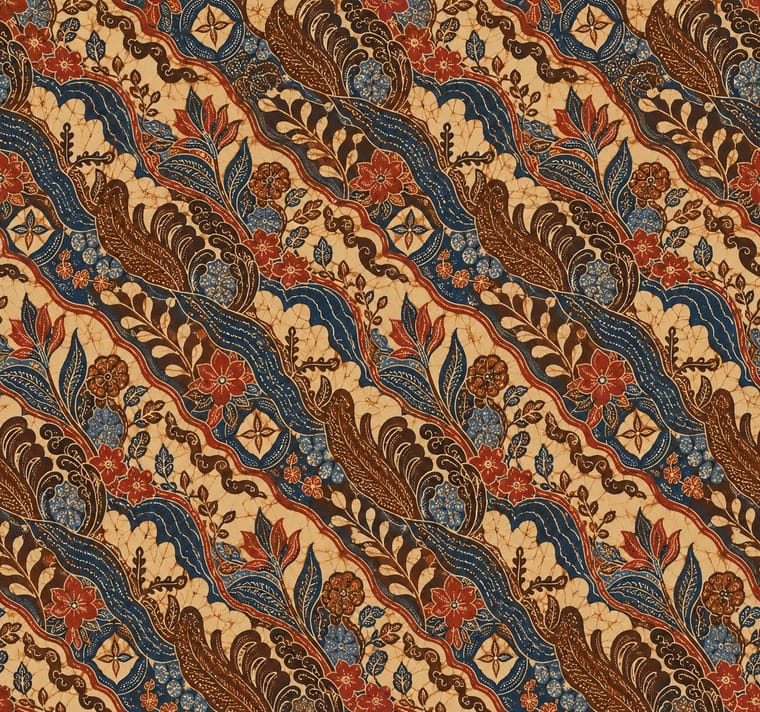
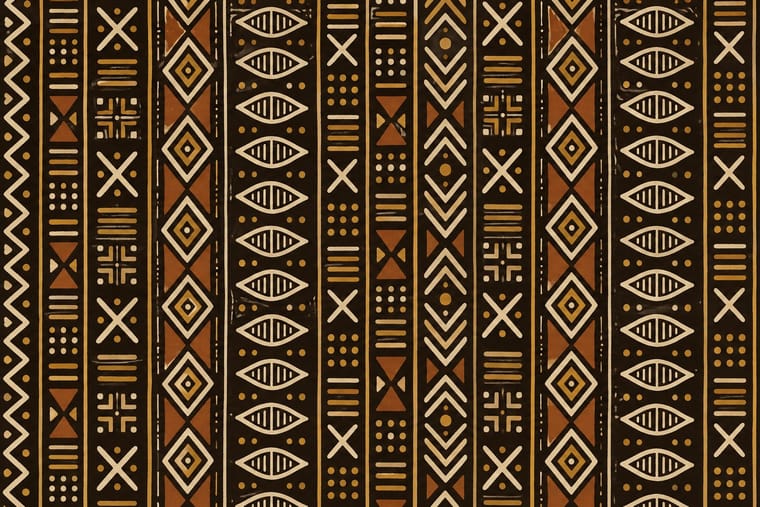
05
More combinations
With Batik Pattern Tradition
- Islamic Geometric & Calligraphic Tradition Pairs well · Coastal batik already absorbs Arabic script and geometric lattices; combine the two for pattern that is both structured and hand-made.
- Minimalist Graphic Design Contrasts · Crop a single batik motif onto a large empty field to show its line quality instead of drowning a minimal layout in pattern.
- Art Nouveau Pairs well · Dutch Nieuwe Kunst designers such as Chris Lebeau worked in batik; pair its vegetal repeats with Art Nouveau linework for book covers and textiles.
- Psychedelic Poster Pairs well · Crackle texture and layered dyes suit psychedelic colour; keep batik's dense all-over repeat as the structure underneath.
- Guna Mola Contrasts · Batik builds pattern by resist-dyeing, molas by cutting and sewing; never render a mola as a printed texture, because the stepped, stitched edge is the whole point.
- Nieuwe Kunst (Dutch Art Nouveau) Pairs well · Its direct source: Dutch designers used wax-resist dyeing for covers in cotton, velvet and parchment; pair a constructed Nieuwe Kunst repeat with real batik colour layering, and credit the Javanese craft.
- Javanese Wayang Kulit (Tatah Sungging) Pairs well · Both are court arts of Yogyakarta and Surakarta; set one coded figure against batik's all-over repeat to pair a single focus with a patterned field.
- Mithila (Madhubani) Painting Contrasts · Batik spreads a resist-dyed repeat evenly across cloth; Mithila builds a unique, hand-drawn composition around a centre and closes it with borders. Borrow one or the other, not both, to keep pattern and picture distinct.
With Bògòlanfini Mud Cloth
- Adinkra & Kente Symbol Systems Pairs well · Both are West African sign cloths in a grid of compartments; flip adinkra's dark-on-light stamping into bògòlan's pale-on-dark negative for a two-part system.
- Ma & Wabi-sabi Aesthetics Pairs well · Share an earth palette and a respect for irregular, hand-made repeats; use them together for calm, tactile brand surfaces.
- Amazigh Sign System & Tifinagh Contrasts · Bògòlan leaves pale signs in a dark mud-painted ground, while Beni Ouarain rugs and Kabyle pots draw dark signs on cream wool or white slip. Black-ground Amazigh weavings, such as Middle Atlas tent bands and the akhnif cape, are the exception; there, tell the two apart by the stepped, woven construction rather than by the ground.
- Uli & Nsibidi Line and Sign Tradition Pairs well · Both leave pale signs in a dark-dyed ground, bògòlan by painting mud around them and ukara by stitching raffia to resist indigo; ukara itself is restricted to Ekpe, so borrow the light-on-dark idea with public signs placed freely, credit each source and keep each motif's meaning.
- Warli Painting Pairs well · Both set pale marks on an earth-dark ground in a hand-made, slightly irregular repeat; bògòlan reserves mostly abstract signs in strip compartments, while Warli's signs depict people, animals, trees, the sun and the moon. Borrow the shared light-on-earth principle, but do not mix bògòlan signs and Warli figures into one generic 'tribal' surface; keep each set of motifs, its meaning and its makers apart.