Style combination · Contrasts
Fante Asafo Flags × European Heraldry
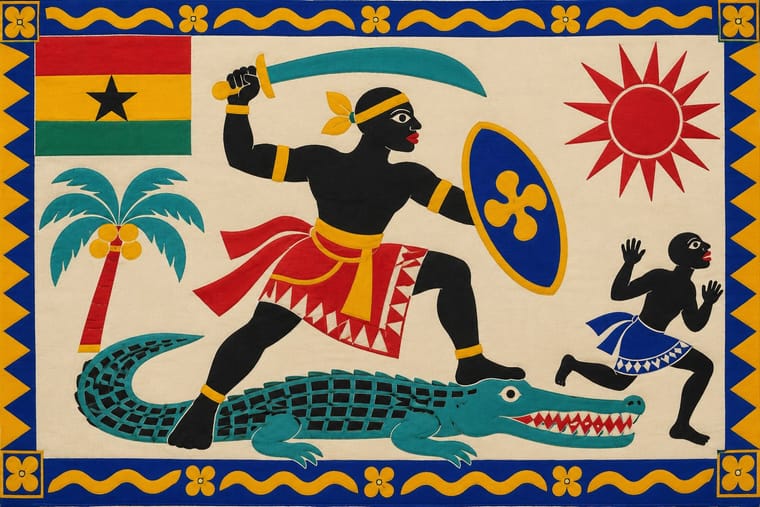
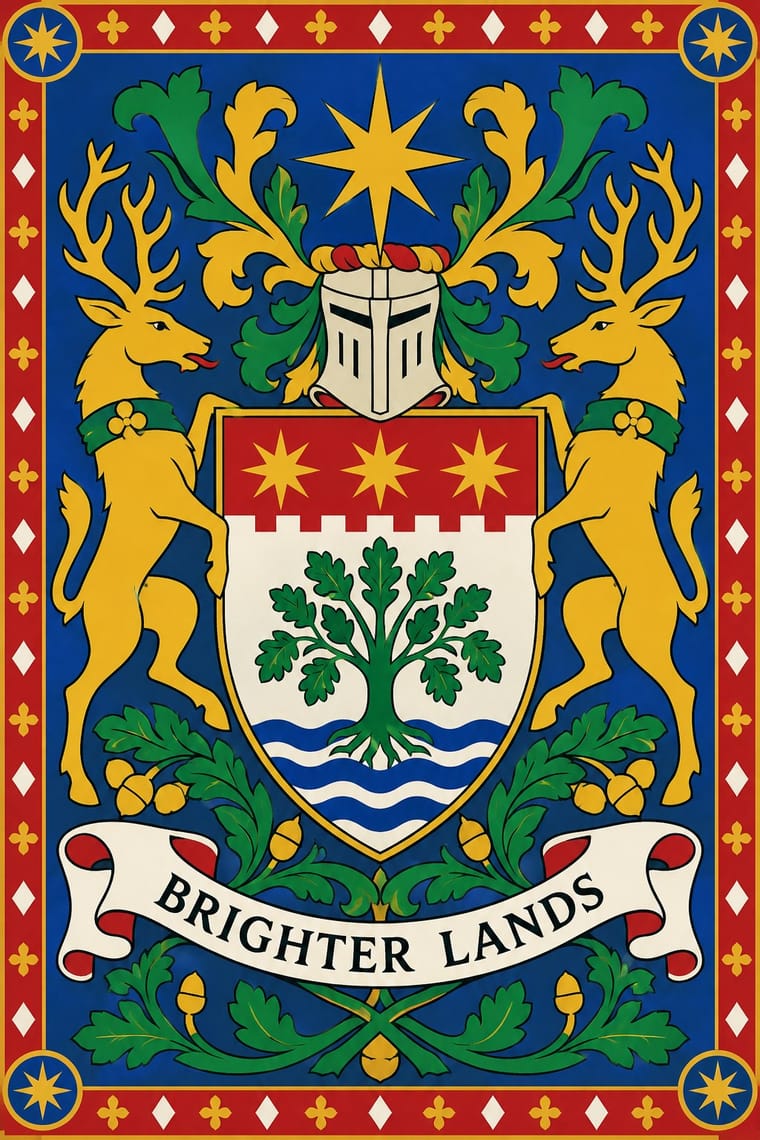
Asafo flag-makers took the canton from European flags, the griffin from English imagery and many-headed dragons probably inspired by the mythical creatures of heraldry, but a coat of arms is a symmetrical, rule-bound mark of a bearer, while an asafo flag is an asymmetrical picture of a boast or taunt; borrow heraldry's flat colours and borders, not its symmetry.
Mix them and make something Fante Asafo Flags European Heraldry
01
What each style brings
Each part of the design comes from the style with the stronger say in it, and each style gives at least two.
Fante Asafo Flags (Frankaa) European Heraldry
- Type from Fante Asafo Flags
-
- Colour from Fante Asafo Flags
- Form from European Heraldry
- Composition from European Heraldry
- Surface from European Heraldry
02
The type
Open fonts standing in for each style’s own type, which is often hand-drawn or commercial.
Display · Fante Asafo Flags
Civic
Londrina Solid; Fante Asafo Flags used Embroidered block capitals and numerals naming the company and Company numbers such as 'Nº1' and 'Nº2' in a contrasting cloth or thread, set in the field or along an arm of a large cross that divides the field ('NºI' in red on the bottom arm of a wide golden-yellow cross, Flags of the World 'Crocodiles and moon' flag)
Text · European Heraldry
The hereditary identifying devices of medieval Europe's knights and seals, codified into a rule-bound grammar still used by states, cities, churches, universities and families. A coat of arms is defined by its written blazon, not by a drawing: a few flat tinctures (two metals, five colours and the furs) that keep metal off metal and colour off colour, a shield divided by bold ordinaries, and stylised charges in fixed poses, redrawn by every age in its own idiom and combined by impalement and quartering.
Libre Caslon Text; European Heraldry used Gothic book and cursive hands naming the bearer above or beside each shield in medieval rolls of arms and armorials, as 'die coninc van denmarke' beside the Danish flag in the Gelre Armorial and Mottoes lettered on a scroll beneath the shield
03
The colours
The ground and leading colours come from Fante Asafo Flags, with a counter-accent from European Heraldry. The ink reads on the ground at 4.5:1 or more.
Fante Asafo Flags (Frankaa) European Heraldry
-
#f0e9d8ground · 36% -
#1b1b1bink · 14% -
#f2b31baccent · 18% -
#c62a2faccent · 14% -
#1e3a8aaccent · 10% -
#3a9a9aaccent · 8%
As CSS
:root {
  --ground: #f0e9d8;
  --ink: #1b1b1b;
  --accent-1: #f2b31b;
  --accent-2: #c62a2f;
  --accent-3: #1e3a8a;
  --accent-4: #3a9a9a;
  --font-display: "Londrina Solid", cursive;
  --font-text: "Libre Caslon Text", serif;
}
Use it with care
Fante Asafo Flags (Frankaa): Asafo companies are living institutions of Fante towns: each flag belongs to its company, is commissioned when a new captain takes office, is danced at festivals and members' funerals and hung at the company shrine, and its image is often a taunt aimed at a particular rival company. Do not copy a company's flag or emblem for branding, learn what a motif says as a proverb before using it, since a scene can boast or insult, and do not pass off a new flag sewn with a Union Jack as a colonial-era piece: workshops have made flags for collectors and tourists in record numbers since the mid-1990s, including new flags made to look pre-independence. Company imagery has carried political stakes: under colonial rule the British administration imposed strict regulations on asafo companies and their arts. Commission and credit Fante flag-makers' workshops rather than printing imitations.
European Heraldry: A coat of arms belongs to a particular bearer, lineage or (in Polish heraldry) clan, not to everyone with a surname: in Scotland it can belong to only one person at a time and the Court of the Lord Lyon can fine those who usurp arms and have the offending items removed or destroyed, state arms are protected against unauthorised registration and use as trademarks under Article 6ter of the Paris Convention, and many European cities and universities protect their arms as trademarks. Design new arms by the rules of the tradition rather than copying a real family's, city's or state's arms for decoration or branding, and do not present invented arms as a family's historic coat of arms. Crusader and Templar shields and knights with crosses on their chests or shields have also become far-right insignia (Charlottesville 2017, the US Capitol 2021), and neo-Nazis use an eagle loosely based on German coats of arms, though not every eagle derives from it; check how a cross, an eagle or a crusading knight will read before using it, and avoid pairing them with militant or ethnic-nationalist themes.
04
The two styles
05
More combinations
With Fante Asafo Flags
- Adinkra & Kente Symbol Systems Contrasts · Both put Akan proverbs on cloth, but adinkra stamps abstract named signs in a ruled grid and kente weaves blocks of pattern, while an asafo flag spells the proverb out as one pictorial scene of appliquéd figures on an open ground.
- Guna Mola Contrasts · Both are hand-cut cotton appliqué in saturated colour that absorbs foreign images, but a mola packs every gap with slits and echoing contour bands, while an asafo flag leaves a plain ground around a few silhouettes so the scene reads from across a street.
- Ghanaian Movie Poster Pairs well · Both are Ghanaian popular images that sell a confrontation at a glance: the movie poster paints it in lurid brushwork, the asafo flag cuts it in flat cloth, so pair them for a loud, local announcement with one cut-out emblem against a painted scene.
- Kanga (Swahili Message Cloth) Pairs well · Both carry proverbs and barbs aimed at rivals on cloth shown in public; pair the asafo's pictorial taunt with the kanga's written saying in a box when an image needs its caption.
- Ultras Graphics (Curva Banners and Tifo) Contrasts · Another fighting group's cloth: the Fante company flag tells a proverb in appliquéd figures for one company, while the ultras banner states one name in painted capitals to a whole stadium.
With European Heraldry
- Hipster Artisanal Revival Contrasts · The craft badge borrows heraldry's air of lineage with an 'Est.' date and crossed arrows on kraft paper, while a real coat of arms is a granted or inherited, blazoned identity in strong tinctures; set the two side by side to show the difference between quoting heritage and holding it.
- Corporate Identity Modernism Pairs well · A coat of arms already is an identity defined by a specification rather than one drawing, applied to seals, banners, buildings and documents; Finnish municipal arms of the 1950s show how its flat two-tincture discipline reads as a modern mark, so use blazon-like rules to write a logo that can be redrawn without losing itself.
- Gothic Blackletter & Fraktur Tradition Pairs well · Medieval armorials name their shields in Gothic hands and German heraldic artists such as Otto Hupp also drew Fraktur; pair a flat Gothic shield with a blackletter name or motto for a certificate, diploma or civic document, checking how the broken script will read politically.
- Kamon (Japanese Family Crests) Contrasts · Both are hereditary emblem systems that began in the twelfth century and mark kinship by small codified variations, but a mon is a single-colour silhouette drawn round a centre while a coat of arms is a shield of contrasting tinctures read by the rule of tincture; compare them to choose between a one-ink crest and a coloured, partitioned one.
- Ultras Graphics (Curva Banners and Tifo) Contrasts · Both raise colours and emblems over a fighting company, but heraldry codifies one bearer's arms by rule, while a curva borrows the city's arms, a skull or a film villain for one afternoon and paints it the size of a stand; choose between a fixed blazon and a crowd-made, temporary emblem.
- Tarot de Marseille Woodcut Cards Pairs well · The Emperor's and Empress's eagle shields and the maker's escutcheon on the 2 of Coupes come from armory; pair heraldic tinctures and charges with a tarot figure for a crest-like card or label.
- Natural Wine Label Art Contrasts · The crest is the device of the classic château label that natural wine replaced with a face or an animal; put one heraldic charge beside a doodle to show which side of the wine world a bottle stands on.
- Emblem Book (Motto, Picture & Epigram) Contrasts · Alciato's book opens with the arms of the Duchy of Milan, but a coat of arms identifies a bearer by the rules of blazon, while an emblem is a freely invented moral riddle that needs its motto and verse; use arms to identify and an emblem to argue.