Style combination · Pairs well
Fante Asafo Flags × Kanga
Both carry proverbs and barbs aimed at rivals on cloth shown in public; pair the asafo's pictorial taunt with the kanga's written saying in a box when an image needs its caption.
01
What each style brings
Each part of the design comes from the style with the stronger say in it, and each style gives at least two.
Fante Asafo Flags (Frankaa) Kanga (Swahili Message Cloth)
- Type from Kanga
- Colour from Fante Asafo Flags
- Form from Fante Asafo Flags
- Composition from Kanga
- Surface from Kanga
02
The type
Open fonts standing in for each style’s own type, which is often hand-drawn or commercial.
Text · Fante Asafo Flags
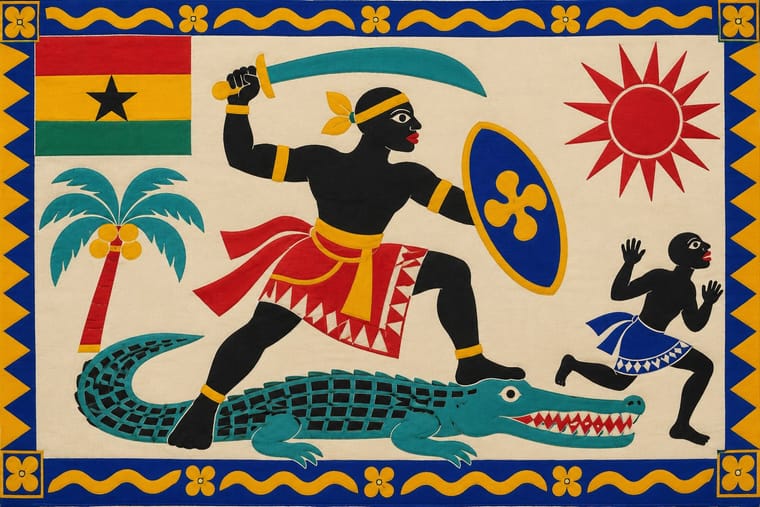
The company flags (frankaa) of the Fante asafo, the old warrior companies of Ghana's central coast, widely adopted from the mid-nineteenth century. Flag-makers cut flat silhouettes of animals, people and objects from coloured cotton and sew them onto a plain ground, often inside a border of checks or triangles, with a national flag in the upper hoist corner: a Union Jack until 1957, then Ghana's. Each flag stages one proverb, boast or taunt aimed at rival companies, and is danced, paraded and hung at the company shrine.
Archivo; Fante Asafo Flags used Embroidered block capitals and numerals naming the company and Company numbers such as 'Nº1' and 'Nº2' in a contrasting cloth or thread, set in the field or along an arm of a large cross that divides the field ('NºI' in red on the bottom arm of a wide golden-yellow cross, Flags of the World 'Crocodiles and moon' flag)
03
The colours
The ground and leading colours come from Fante Asafo Flags, with a counter-accent from Kanga. The ink reads on the ground at 4.5:1 or more.
Fante Asafo Flags (Frankaa) Kanga (Swahili Message Cloth)
-
#f0e9d8ground · 36% -
#1b1b1bink · 14% -
#f2b31baccent · 18% -
#c62a2faccent · 14% -
#1e3a8aaccent · 10% -
#3a9a9aaccent · 8%
As CSS
:root {
  --ground: #f0e9d8;
  --ink: #1b1b1b;
  --accent-1: #f2b31b;
  --accent-2: #c62a2f;
  --accent-3: #1e3a8a;
  --accent-4: #3a9a9a;
  --font-display: "Agbalumo", cursive;
  --font-text: "Archivo", sans-serif;
}
Use it with care
Fante Asafo Flags (Frankaa): Asafo companies are living institutions of Fante towns: each flag belongs to its company, is commissioned when a new captain takes office, is danced at festivals and members' funerals and hung at the company shrine, and its image is often a taunt aimed at a particular rival company. Do not copy a company's flag or emblem for branding, learn what a motif says as a proverb before using it, since a scene can boast or insult, and do not pass off a new flag sewn with a Union Jack as a colonial-era piece: workshops have made flags for collectors and tourists in record numbers since the mid-1990s, including new flags made to look pre-independence. Company imagery has carried political stakes: under colonial rule the British administration imposed strict regulations on asafo companies and their arts. Commission and credit Fante flag-makers' workshops rather than printing imitations.
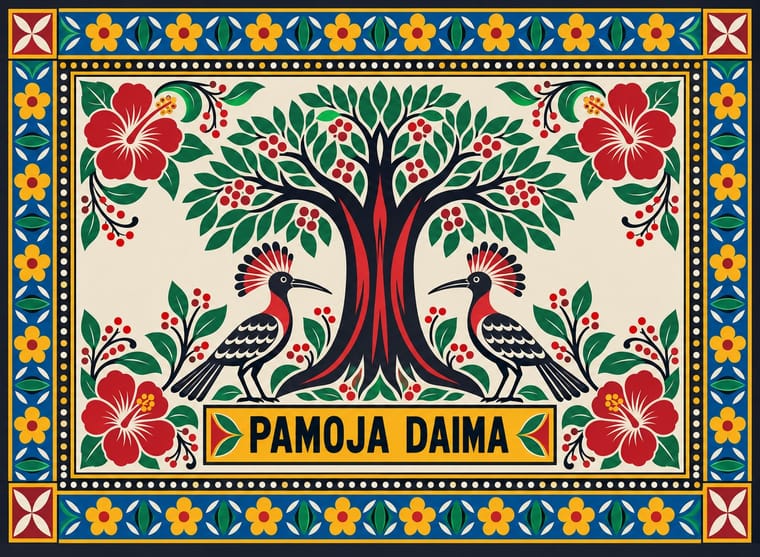
Kanga (Swahili Message Cloth): Kanga is the living dress of East African, especially Swahili, women: it wraps newborns, shrouds the dead and carries messages between neighbours, spouses and rivals, so its words matter more than its pattern. Never fill the text box with invented pseudo-Swahili or decorative Arabic letters (set Arabic script only when it spells a real, checked saying); use the brief's own words, or a real saying checked by a Swahili speaker with its translation, because a careless phrase can insult and some sayings invoke God. Some designs carry meanings of their own: the kisutu is bridal wear, in green or blue for a second or third marriage. Do not reuse portraits of real politicians or party emblems from campaign kangas out of context, and credit and commission East African designers and mills rather than presenting a generic 'African print'.
04
The two styles
05
More combinations
With Fante Asafo Flags
- Adinkra & Kente Symbol Systems Contrasts · Both put Akan proverbs on cloth, but adinkra stamps abstract named signs in a ruled grid and kente weaves blocks of pattern, while an asafo flag spells the proverb out as one pictorial scene of appliquéd figures on an open ground.
- Guna Mola Contrasts · Both are hand-cut cotton appliqué in saturated colour that absorbs foreign images, but a mola packs every gap with slits and echoing contour bands, while an asafo flag leaves a plain ground around a few silhouettes so the scene reads from across a street.
- Ghanaian Movie Poster Pairs well · Both are Ghanaian popular images that sell a confrontation at a glance: the movie poster paints it in lurid brushwork, the asafo flag cuts it in flat cloth, so pair them for a loud, local announcement with one cut-out emblem against a painted scene.
- European Heraldry Contrasts · Asafo flag-makers took the canton from European flags, the griffin from English imagery and many-headed dragons probably inspired by the mythical creatures of heraldry, but a coat of arms is a symmetrical, rule-bound mark of a bearer, while an asafo flag is an asymmetrical picture of a boast or taunt; borrow heraldry's flat colours and borders, not its symmetry.
- Ultras Graphics (Curva Banners and Tifo) Contrasts · Another fighting group's cloth: the Fante company flag tells a proverb in appliquéd figures for one company, while the ultras banner states one name in painted capitals to a whole stadium.
With Kanga
- African Wax & Fancy Print Contrasts · Both are factory-printed cotton wrappers, and the atlas's wax and fancy print already includes commemorative fancy cloth with portrait medallions, flags and ribbon slogans. But wax and fancy print is yardage repeated along the bolt and named by traders by word of mouth, carrying a slogan only on commemorative designs, while every kanga, commemorative or not, is one bordered, symmetrical piece sold in pairs that prints its own sentence in a box at the foot.
- Guna Mola Contrasts · Both are women's dress that takes in party slogans, logos and portraits, but a mola is hand-cut reverse appliqué packed edge to edge with echoing contour bands, while a kanga is a factory print with flat fields, an open, centred motif and its message in one plain box.
- Dazibao (Big-Character Posters) Contrasts · Both make a short sentence public, but the big-character poster pastes it on a wall in brush characters as the whole design, while the kanga prints it small in a box and lets the wearer carry it from house to house.
- Finnish Bold Print (Marimekko Modernism) Contrasts · Both are flat, few-colour printed cotton for the body, but Marimekko runs one enlarged shape edge to edge with no frame and no words, while the kanga closes every cloth in a border and centres a motif above a written message.
- Adinkra & Kente Symbol Systems Pairs well · Both make cloth carry proverbs; adinkra encodes the proverb in a named stamped symbol, the kanga spells it out in words, so pair a symbol with its saying when a message must be read by insiders and outsiders alike.
- Lotería Card Imagery (Mexican Lotería) Contrasts · Both centre one motif in a frame above a line of capitals, but a kanga is a cloth whose printed Swahili saying is its message, while a lotería card prints only the emblem's name and leaves the verse to the caller's voice.
- Latin American Feminist Protest Graphics (Ni Una Menos and the Green Wave) Pairs well · Both put a sentence on a cloth worn on the body so that the wearer speaks through it; borrow the kanga's framed field and boxed saying to give a protest scarf a composed layout without losing the one-colour code.
- Tingatinga Painting Pairs well · Both belong to the Swahili coast of Dar es Salaam; frame a Tingatinga animal in a kanga border with a real, checked Swahili saying for an East African identity that feels local rather than safari-generic.