Style combination · Contrasts
Fante Asafo Flags × Ultras Graphics
Another fighting group's cloth: the Fante company flag tells a proverb in appliquéd figures for one company, while the ultras banner states one name in painted capitals to a whole stadium.
Mix them and make something Fante Asafo Flags Ultras Graphics
01
What each style brings
Each part of the design comes from the style with the stronger say in it, and each style gives at least two.
Fante Asafo Flags (Frankaa) Ultras Graphics (Curva Banners and Tifo)
- Type from Ultras Graphics
- Colour from Fante Asafo Flags
- Form from Fante Asafo Flags
- Composition from Ultras Graphics
- Surface from Ultras Graphics
02
The type
Open fonts standing in for each style’s own type, which is often hand-drawn or commercial.
Display · Ultras Graphics
Together
Big Shoulders; Ultras Graphics used The 'Ultras Liberi' genre and Set display faces enlarged and painted by hand
Text · Fante Asafo Flags
The company flags (frankaa) of the Fante asafo, the old warrior companies of Ghana's central coast, widely adopted from the mid-nineteenth century. Flag-makers cut flat silhouettes of animals, people and objects from coloured cotton and sew them onto a plain ground, often inside a border of checks or triangles, with a national flag in the upper hoist corner: a Union Jack until 1957, then Ghana's. Each flag stages one proverb, boast or taunt aimed at rival companies, and is danced, paraded and hung at the company shrine.
Archivo; Fante Asafo Flags used Embroidered block capitals and numerals naming the company and Company numbers such as 'Nº1' and 'Nº2' in a contrasting cloth or thread, set in the field or along an arm of a large cross that divides the field ('NºI' in red on the bottom arm of a wide golden-yellow cross, Flags of the World 'Crocodiles and moon' flag)
03
The colours
The ground and leading colours come from Fante Asafo Flags, with a counter-accent from Ultras Graphics. The ink reads on the ground at 4.5:1 or more.
Fante Asafo Flags (Frankaa) Ultras Graphics (Curva Banners and Tifo)
-
#f0e9d8ground · 36% -
#1b1b1bink · 14% -
#f2b31baccent · 18% -
#c62a2faccent · 14% -
#1e3a8aaccent · 10% -
#3a9a9aaccent · 8%
As CSS
:root {
  --ground: #f0e9d8;
  --ink: #1b1b1b;
  --accent-1: #f2b31b;
  --accent-2: #c62a2f;
  --accent-3: #1e3a8a;
  --accent-4: #3a9a9a;
  --font-display: "Big Shoulders", sans-serif;
  --font-text: "Archivo", sans-serif;
}
Use it with care
Fante Asafo Flags (Frankaa): Asafo companies are living institutions of Fante towns: each flag belongs to its company, is commissioned when a new captain takes office, is danced at festivals and members' funerals and hung at the company shrine, and its image is often a taunt aimed at a particular rival company. Do not copy a company's flag or emblem for branding, learn what a motif says as a proverb before using it, since a scene can boast or insult, and do not pass off a new flag sewn with a Union Jack as a colonial-era piece: workshops have made flags for collectors and tourists in record numbers since the mid-1990s, including new flags made to look pre-independence. Company imagery has carried political stakes: under colonial rule the British administration imposed strict regulations on asafo companies and their arts. Commission and credit Fante flag-makers' workshops rather than printing imitations.
Ultras Graphics (Curva Banners and Tifo): Ultras graphics belong to living, often closed supporters' groups whose banner, name and emblem stand for the group itself, so do not lift a real group's name, logo or lettering for a brand, campaign or fashion line as if it were anonymous street style. The language carries the political baggage of both extremes of 1970s street politics: Vice and Scalcione trace the 'Ultras Liberi' lettering to French and Italian far-right lettering, and some curve, such as S.S. Lazio's Ultras (1974), are known for fascist slogans, but group names such as Commando, Brigate and Fedayn were borrowed from political marches, and many 1970s ultras came from the extra-parliamentary left, Lotta Continua above all, so the same sign can mean opposite things in two curve; check what a borrowed symbol or slogan has meant in that curva before using it. Fare's guide to discriminatory practices in European football lists the SS Totenkopf skull, Sig and Odal runes, the Wolfsangel, the Celtic cross (often in place of an 'O') and the code '88' among the far-right symbols seen in stadiums on banners, stickers and shirts: never use them, and keep a borrowed skull clearly apart from the Totenkopf, as the guide does. Nazi symbols are banned by law in Germany, Austria, Poland and other countries, and UEFA fined Germany's football association after its fans showed a neo-Nazi flag at Euro 2012. Memorial displays and murals, for the 74 dead of Port Said in 2012, 72 of them Al Ahly supporters, or the Superga air crash of 1949, are acts of mourning, not decoration. In Egypt a Cairo court banned all ultras groups in May 2015 and members have been arrested since; do not attribute new work to Egyptian ultras groups or their members. Flares and smoke are dangerous and banned in many stadiums; do not present pyrotechnics as a device to imitate.
04
The two styles
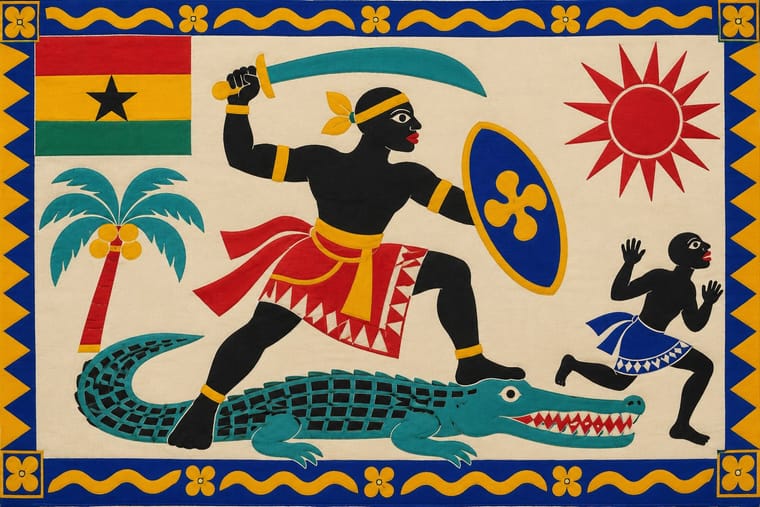
05
More combinations
With Fante Asafo Flags
- Adinkra & Kente Symbol Systems Contrasts · Both put Akan proverbs on cloth, but adinkra stamps abstract named signs in a ruled grid and kente weaves blocks of pattern, while an asafo flag spells the proverb out as one pictorial scene of appliquéd figures on an open ground.
- Guna Mola Contrasts · Both are hand-cut cotton appliqué in saturated colour that absorbs foreign images, but a mola packs every gap with slits and echoing contour bands, while an asafo flag leaves a plain ground around a few silhouettes so the scene reads from across a street.
- Ghanaian Movie Poster Pairs well · Both are Ghanaian popular images that sell a confrontation at a glance: the movie poster paints it in lurid brushwork, the asafo flag cuts it in flat cloth, so pair them for a loud, local announcement with one cut-out emblem against a painted scene.
- European Heraldry Contrasts · Asafo flag-makers took the canton from European flags, the griffin from English imagery and many-headed dragons probably inspired by the mythical creatures of heraldry, but a coat of arms is a symmetrical, rule-bound mark of a bearer, while an asafo flag is an asymmetrical picture of a boast or taunt; borrow heraldry's flat colours and borders, not its symmetry.
- Kanga (Swahili Message Cloth) Pairs well · Both carry proverbs and barbs aimed at rivals on cloth shown in public; pair the asafo's pictorial taunt with the kanga's written saying in a box when an image needs its caption.
With Ultras Graphics
- Egyptian Revolutionary Street Art (Mohamed Mahmoud Murals) Pairs well · The Mohamed Mahmoud murals painted the faces of Port Said's dead, most of them Ultras Ahlawy fans; pair the curva's collective name and colours with memorial portraits when a group mourns its own.
- European Heraldry Contrasts · Both raise colours and emblems over a fighting company, but heraldry codifies one bearer's arms by rule, while a curva borrows the city's arms, a skull or a film villain for one afternoon and paints it the size of a stand; choose between a fixed blazon and a crowd-made, temporary emblem.
- Atelier Populaire (May '68 Screenprint Poster) Pairs well · The type designer Alessio D'Ellena, quoted by Vice, places ultras' vernacular letters 'more in the tradition of' the Atelier Populaire's anonymous May '68 posters; borrow their single brushed slogan and anonymous signature for a banner with something to say.
- Graffiti & Hip-Hop Graphics Pairs well · Ginhoux compares ultras' tag and sticker wars to graffiti crews; add a writer's tags, throw-ups and wall murals to carry a group's name from the banner into the street.