Style combination · Contrasts
Andean Woven Graphic Systems × Square Kufic
T'oqapu also fill square cells on a grid, but with signs of rank rather than legible words; compare them to see how a grid can carry writing or emblem, and never blend the two sacred systems into a generic 'geometric' pattern.
Mix them and make something Andean Woven Graphic Systems Square Kufic
01
What each style brings
Each part of the design comes from the style with the stronger say in it, and each style gives at least two.
Andean Woven Graphic Systems Square Kufic (Bannāʾī)
- Type from Square Kufic
- Colour from Square Kufic
- Form from Andean Woven Graphic Systems
- Composition from Andean Woven Graphic Systems
- Surface from Andean Woven Graphic Systems
02
The type
Open fonts standing in for each style’s own type, which is often hand-drawn or commercial.
Display · Square Kufic
Atlas
Reem Kufi, standing in for Bannāʾī (maʿqilī): square Kufic laid in glazed and unglazed bricks or tiles, one brick or tile per grid unit, with stroke and gap of equal width
Text · Andean Woven Graphic Systems
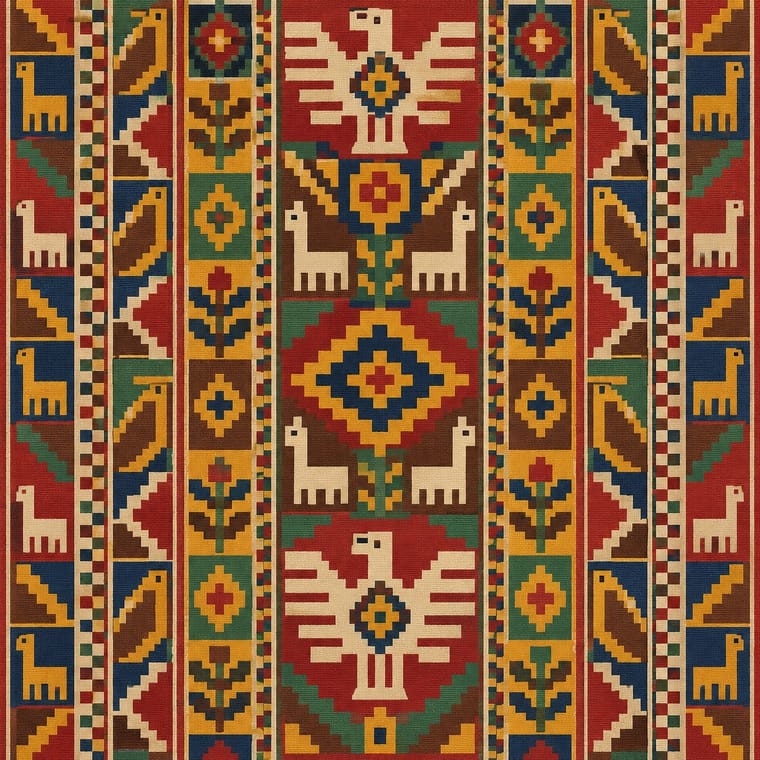
The graphic systems of Andean cloth, the region's most prestigious medium, in which every motif is built on the warp-and-weft grid. Wari tapestry tunics repeat staff-bearers and profile heads in columns, compressing and rotating them toward the edges until figure turns into geometry. Inca state cloth reduced design to t'oqapu, square cells of geometric signs granted as marks of rank, and living Quechua and Aymara weaving bands named pallay motifs between stripes.
Fira Sans; Andean Woven Graphic Systems used T'oqapu cells as a sign set standing where lettering would and Grid-built letterforms that share the woven cell, such as bitmap faces like Silkscreen
03
The colours
The ground and leading colours come from Square Kufic, with a counter-accent from Andean Woven Graphic Systems. The ink reads on the ground at 4.5:1 or more.
Andean Woven Graphic Systems Square Kufic (Bannāʾī)
-
#f3eee3ground · 36% -
#161616ink · 14% -
#2a9ea6accent · 18% -
#d9a62eaccent · 14% -
#1e3d8faccent · 10% -
#a3262aaccent · 8%
As CSS
:root {
  --ground: #f3eee3;
  --ink: #161616;
  --accent-1: #2a9ea6;
  --accent-2: #d9a62e;
  --accent-3: #1e3d8f;
  --accent-4: #a3262a;
  --font-display: "Reem Kufi", cursive;
  --font-text: "Fira Sans", sans-serif;
}
Use it with care
Andean Woven Graphic Systems: Andean textile motifs are living cultural property: pallay designs are named and taught within particular Quechua and Aymara communities, regional styles such as Jalq'a and Tarabuco mark community identity, and Inca t'oqapu were state-controlled insignia of rank. Do not lift motifs from museum tunics or market weavings onto products as generic 'Inca pattern'. Commission weavers through community-run organisations such as the Center for Traditional Textiles of Cusco, pay and credit them, and record which community each motif comes from.
Square Kufic (Bannāʾī): Square-Kufic panels almost always spell sacred words: the names of God, Muhammad and ʿAli, the shahada, the takbir or Qur'anic phrases. Never crop, mirror or scramble them, never fill a surface with invented pseudo-Kufic as a pixel texture, and keep such text off floors, footwear, packaging and other throwaway surfaces. Some formulas belong to one community, such as the Shiʿi addition 'ʿAli is the friend of God', so have every composition read and approved by a fluent reader or a square-Kufic calligrapher, and commission or credit living calligraphers rather than tracing panels from buildings. The square-Kufic takbir band belongs to the flag of the Islamic Republic of Iran (since July 1980), and many Iranian opposition groups and diaspora communities fly the Lion and Sun flag or a plain tricolour instead, so do not quote the band as decorative Persian shorthand. Do not treat the names Muhammad and ʿAli together as neutral filler either: they interlock on the minarets of the Shah Mosque in Isfahan, and they also appear in the blue brickwork of the Timurid shrine of the Sunni Sufi Khoja Ahmed Yasavi, so check how the community commissioning the work reads them.
04
The two styles
05
More combinations
With Andean Woven Graphic Systems
- Bitmap & Pixel Graphics Pairs well · Woven cells and pixels are the same constraint; build icons and letters on a strict square grid with stepped diagonals, and credit the weaving source when you borrow its logic.
- Adinkra & Kente Symbol Systems Contrasts · Adinkra stamps named symbols into ruled squares and kente joins woven strips, whereas Andean cells are woven into one garment and distorted toward its edges; keep the two languages distinct.
- Brazilian Concrete Design Pairs well · Both vary a single module serially; apply the Wari rule of rotating and compressing one unit across a field to a systematic poster or identity.
- Islamic Geometric & Calligraphic Tradition Contrasts · Islamic pattern interlaces stars around radial centres while Andean geometry is orthogonal, stepped and deliberately irregular; choose one as the structural logic rather than blending them.
- Diné (Navajo) Weaving Design Contrasts · Both build stepped geometry on the thread grid. Andean cloth repeats and distorts a figure across cells and columns, while a Diné rug is one planned symmetrical field around a centre, so choose one structural logic.
- Mixteca-Puebla Codex Painting Contrasts · Andean signs are built on the thread grid and repeated as pattern, while codex signs are painted freely in contour and strung along a narrative path; do not merge the two as generic 'pre-Columbian'.
With Square Kufic
- Islamic Geometric & Calligraphic Tradition Contrasts · The parent tradition mixes cursive Thuluth and Naskh, girih stars and arabesque, while square Kufic keeps only the orthogonal grid; choose square Kufic when a design needs one rigid two-tone module, and the wider tradition when it needs curves, interlace and polychrome hierarchy.
- Bitmap & Pixel Graphics Pairs well · Both build letters from square units, and Sakkal compares building bricks to large pixels; set a bitmap Latin wordmark on the same cell size as a square-Kufic mark for a bilingual identity, but keep sacred formulas out of jokey, game-like pixel contexts.
- Iranian Modernist Graphic Design Pairs well · Persian Wikipedia records bannāʾī in modern posters, logos and letterheads, and the atlas's Iranian modernist entry counts it among its Persian scripts; pair a square-Kufic title block with a Nastaʿlīq line and one flat figure for a Persian cultural poster.
- Soviet Central Asian Ornamental Modernism Contrasts · The atlas's Soviet Central Asian entry recommends display capitals built on its mosaic or panjara module after the bannāʾī principle of tiles as pixels, for Cyrillic and Latin names only and with no Arabic script or pseudo-Kufic; use that route when a grid-built wordmark must stay secular, and square Kufic only for Arabic-script words read and approved by a fluent reader.
- Contemporary Arabic & Dual-Script Type Design Pairs well · Set reading text in a low-contrast Kufi-derived Arabic sans matched to its Latin companion, and keep square Kufic for the emblem or panel, where legibility may give way to pattern.
- Turkish Modernist Poster & Graphic Design Pairs well · Erkmen set the Latin initials TİEM on a square-Kufic grid for the Türk ve İslam Eserleri Müzesi logo, and Ertel drew on Kufic for a Ministry of Culture logo; borrow the bannāʾī grid as a structure for a mark, but check what any Kufic letters spell before using them.
- Vyaz (Ornamental Slavonic Lettering) Contrasts · Both turn sacred words into a dense band that reads first as pattern, but square Kufic snaps letters to an orthogonal grid of equal stroke and gap, while vyaz stretches free pen-drawn letters upward and plugs the gaps with plant filler; choose the grid or the calligraphic interlace, and never blend the two sacred scripts into a generic 'ancient' texture.
- Ottoman Tughra & Dîvânî Chancery Calligraphy Contrasts · Square Kufic binds Arabic letters to a square grid of straight strokes; the tughra frees them into sweeping loops and tall shafts. Use the grid for a modular, tiled emblem and the tughra for a single flourishing signature.