Style combination · Contrasts
Amar Chitra Katha Comics × Bonelli Fumetto
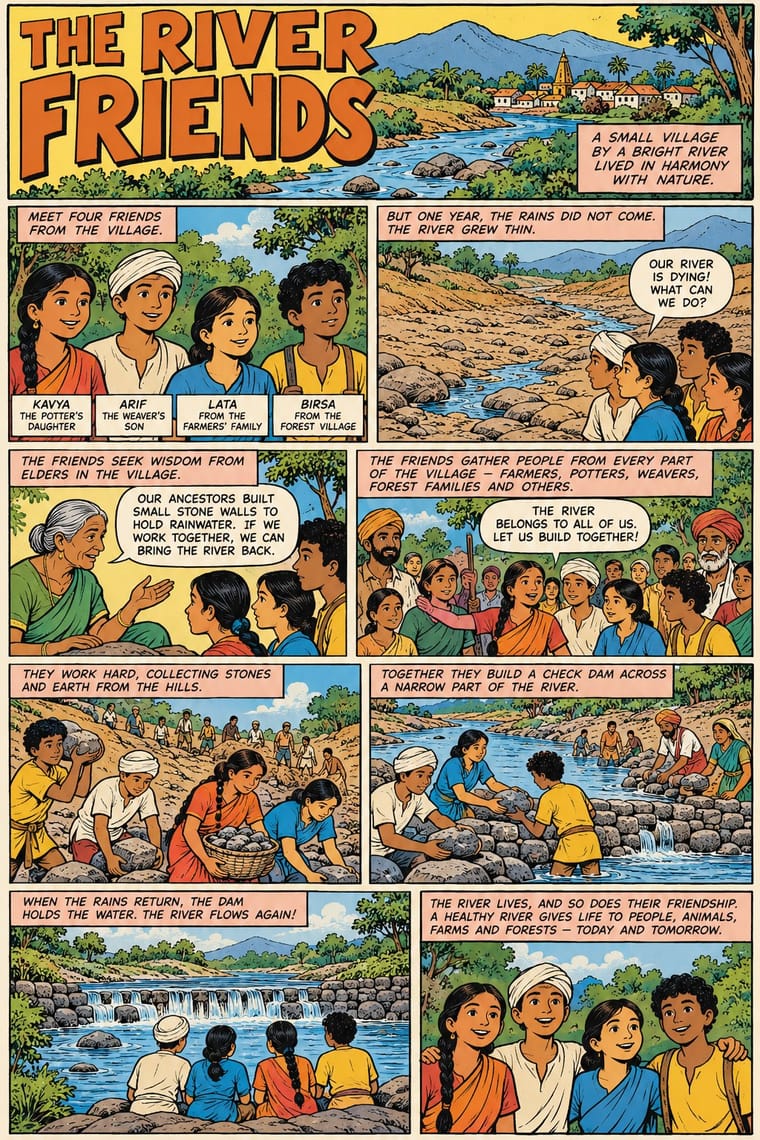
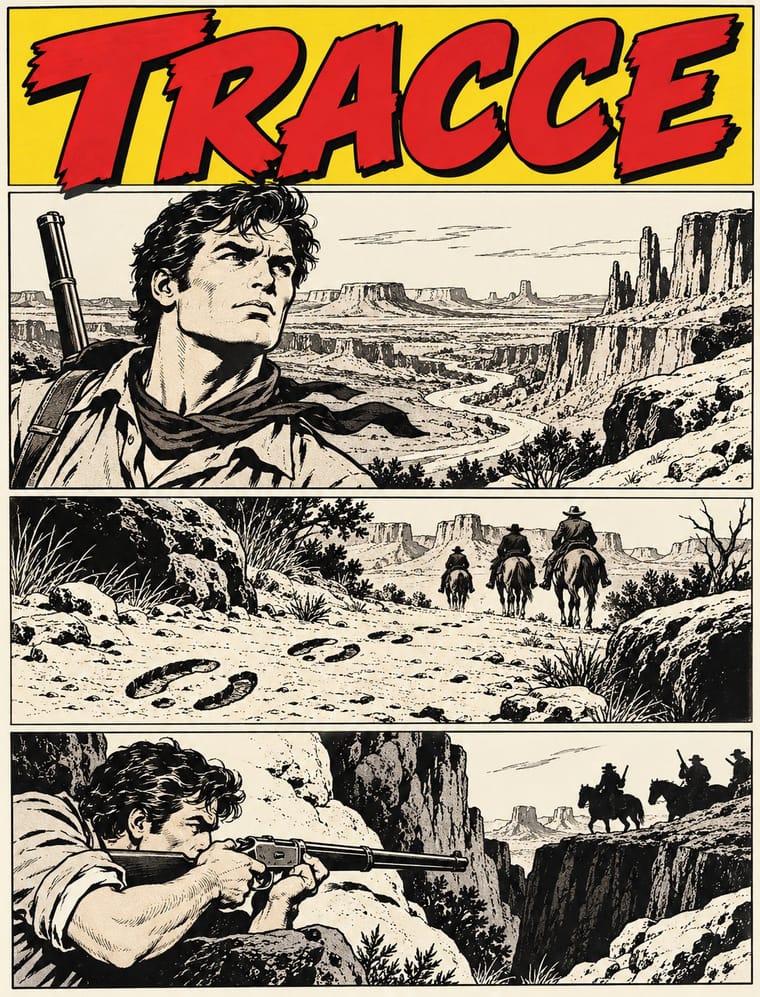
Both lay out regular tiers of ruled panels with white gutters and hand-lettered capitals. Amar Chitra Katha fills every page with flat colour and teaches myth and history in about 32 pages in an authoritative voice; a Bonelli issue keeps about a hundred interior pages in black ink and tells a serial hero's adventure for entertainment.
Mix them and make something Amar Chitra Katha Comics Bonelli Fumetto
01
What each style brings
Each part of the design comes from the style with the stronger say in it, and each style gives at least two.
Amar Chitra Katha Comics Bonelli Fumetto (Italian Popular Adventure Comics)
- Type from Bonelli Fumetto
- Colour from Amar Chitra Katha Comics
- Form from Bonelli Fumetto
- Composition from Amar Chitra Katha Comics
- Surface from Amar Chitra Katha Comics
02
The type
Open fonts standing in for each style’s own type, which is often hand-drawn or commercial.
Display · Bonelli Fumetto
Together
Londrina Solid, standing in for Typeset capitals, not hand lettering, for the episode title on a band at the foot of the cover and for straplines: heavy sans reversed out of black for I VAMPIRI (Dylan Dog no. 62) and AGENTE SPECIALE ALFA (Nathan Never no. 1), beside the price in a roundel (L. 2300); serif for CON LA CODA DELL'OCCHIO and the straplines I GRANDI ENIGMI DI and DETECTIVE DELL'IMPOSSIBILE (Martin Mystère no. 315)
Text · Amar Chitra Katha Comics
The Bombay comic-book series that from 1967 retold Hindu myth and epic, Buddhist and Jain tales, saints, folk legends, the jests of the court wits Birbal and Tenali Raman, and Indian history for children, in English and Indian languages, with well over 500 titles by the early 1990s. Each issue of about 32 pages tells one story, or a few short tales, in regular grids of ruled panels: brush-inked, idealised figures in flat colour, narration in tinted caption boxes, hand-lettered capitals, an iconography fixed from book to book, and a painted cover, often in the idiom of Indian calendar art.
Comic Neue; Amar Chitra Katha Comics used Heavy hand-drawn display title and Upright hand-lettered capitals
03
The colours
The ground and leading colours come from Amar Chitra Katha Comics, with a counter-accent from Bonelli Fumetto. The ink reads on the ground at 4.5:1 or more.
Amar Chitra Katha Comics Bonelli Fumetto (Italian Popular Adventure Comics)
-
#f3ecd4ground · 36% -
#1e1c1aink · 14% -
#e8772eaccent · 18% -
#f2cf1daccent · 14% -
#6fa3d8accent · 10% -
#d3242baccent · 8%
As CSS
:root {
  --ground: #f3ecd4;
  --ink: #1e1c1a;
  --accent-1: #e8772e;
  --accent-2: #f2cf1d;
  --accent-3: #6fa3d8;
  --accent-4: #d3242b;
  --font-display: "Londrina Solid", cursive;
  --font-text: "Comic Neue", cursive;
}
Use it with care
Amar Chitra Katha Comics: The series, its covers, characters and sunburst logo belong to its publisher (Amar Chitra Katha Pvt Ltd) and its artists: draw your own figures, covers and badge, never ask an image model for an ACK title or a named artist's hand, and never present a generated page as an ACK comic. Many of its subjects are deities whom readers worship, so do not mock, crop or deface them. Scholars have criticised the series for giving heroes extremely fair skin while coding dark skin with violence, brutality and low caste, for casting Muslims as either secular heroes or zealous villains, for drawing the British as ugly caricatures, and for leaving women, Muslims and lower castes out of its history: give gods, demons, villains, Muslims, Dalit and Adivasi characters the same drawing care, never use skin colour, features or dress as markers of evil, caste or religion, draw people across the real range of South Asian skin tones rather than one pale, uniform type, and do not present one Hindu reading as the whole of India's past.
Bonelli Fumetto (Italian Popular Adventure Comics): Tex, Zagor, Dylan Dog, Nathan Never, Julia and their mastheads belong to Sergio Bonelli Editore and are still published and licensed: draw your own hero, masthead and cover bands in the shared format, never ask an image model for these characters or for a named artist's hand (Galep, Ferri, Villa, Stano), nor for a real person's likeness (Dylan Dog was drawn after Rupert Everett, Julia after Audrey Hepburn), and label generated pages as AI-made, never as vintage Bonelli issues. Tex is 'supreme chief of all the Navajo tribes' under the name Aquila della Notte, and his blood brother Tiger Jack is a Navajo warrior: these are an Italian western's inventions, not Diné culture. The Diné (Navajo) are a living nation; do not borrow their ceremonial imagery, sandpaintings or weaving designs as western decor, and do not dress a page's generic 'Indians' as Diné.
04
The two styles
05
More combinations
With Amar Chitra Katha Comics
- Lianhuanhua Picture-Story Books Contrasts · Both are didactic picture-story series of classical and historical tales; lianhuanhua gives each page one black-ink picture over a printed caption, Amar Chitra Katha puts several coloured panels with balloons on every page.
- Indian Calendar & Bazaar Art Pairs well · Borrow the calendar print's frontal, haloed deity and saturated jewel colour for a cover or a single full-page epiphany panel, and keep the pages around it to flat colour and ruled panels.
- American Four-Colour Comic Book (Golden to Bronze Age) Contrasts · The same ruled panels, balloons and hand-lettered capitals; the newsstand comic shouts with slanted panels, dot tints and sound effects, while Amar Chitra Katha keeps a calm regular grid, long narration captions and an edifying voice.
- Hand-Painted Bollywood Poster Pairs well · Painted Hindi-film publicity from the same Bombay decades; its floating star heads, melodramatic colour and hand-drawn title logos suit an Amar Chitra Katha cover pushed louder.
- Ligne Claire (Franco-Belgian Clear Line) Contrasts · Both fill clean contours with flat colour; ligne claire draws one even, unhatched line around caricatural figures, Amar Chitra Katha a swelling brush contour with heavy blacks around idealised, near-naturalistic bodies.
- Javanese Wayang Kulit (Tatah Sungging) Contrasts · Both retell the Mahabharata and Ramayana with a fixed iconography, but Amar Chitra Katha draws idealised, near-naturalistic bodies in panels, while wayang codes character into impossible proportions.
- Arab Children's Comic Magazines (Samir to Majid) Pairs well · Another postcolonial children's comic that teaches heritage in flat colour; combine its narrated caption boxes with the Arab weekly's gag strips and puzzle pages.
- Filipino Komiks Contrasts · Both retell local myth and history as comics in Asian languages. Amar Chitra Katha prints flat colour on every page in an educational, authoritative voice; komiks keep black-and-white interiors for melodrama, fantasy and folk heroes.
With Bonelli Fumetto
- Ligne Claire (Franco-Belgian Clear Line) Contrasts · Both stage figures in researched, realistic settings in ruled panels with hand-lettered balloons. Choose ligne claire for one even, unhatched contour and flat colour in a hardback album; choose Bonelli for hatched, spotted-black ink without colour in a cheap monthly paperback.
- Story Manga (Postwar Japanese Comics) Contrasts · Both are long black-and-white serials born in the late 1940s. Story manga slants, enlarges and bleeds its panels and gets its greys from screentone; Bonelli keeps every panel rectangular inside three strips and puts no tone on the page.
- Penguin Paperback Design (Three Bands to the Marber Grid) Pairs well · Both design the series rather than the single book: a fixed cover template in which only the title and the picture change. Borrow Penguin's genre colour code and fixed type positions for a set of Bonelli-style covers, keeping the outlined masthead and the black title band.
- Fotoromanzo (Italian Photo-Romance) Contrasts · Italy's other newsstand serial of the late 1940s, also told in a plain grid of ruled frames with balloons. Choose the fotoromanzo for staged photographs and melodrama; choose Bonelli for pen-and-ink westerns, horror, mystery and science fiction.
- Filipino Komiks Contrasts · The nearest style by genome: both are black-and-white newsstand comics drawn in naturalistic brush and pen, with colour kept for the cover. Komiks pack short instalments of about four pages into anthology magazines; Bonelli gives one hero a book-length episode in a constant three-strip cage, under the same cover trade dress every month.
- American Four-Colour Comic Book (Golden to Bronze Age) Contrasts · Bonelli's artists learned from American adventure cartoonists (Ferri named Phil Davis, Hal Foster and Alex Raymond). Choose the American comic book for flat four-colour dot tints over the keyline and figures that burst the panel border; choose Bonelli for an uncoloured ink page in a fixed grid of three strips.
- Argentine Adventure Historieta (Oesterheld–Breccia) Contrasts · Both are black-and-white newsstand adventure serials born in 1948 and drawn in pen and brush ink; Bonelli keeps a fixed cage of three strips of one or two panels on a small upright page and an even naturalistic line, while the historieta's 1950s weeklies run three tiers of two to six panels each across an oblong page, sink them in solid black, light faces from one side and, with Breccia, let the drawing break into expressionist texture.
- Giallo Mondadori Covers (I Libri Gialli) Pairs well · Milan's other newsstand serial: Bonelli's constant masthead and single dramatic cover scene sit well beside the yellow-and-circle trade dress in a set of popular-fiction covers.