Style combination · Contrasts
Amar Chitra Katha Comics × Javanese Wayang Kulit
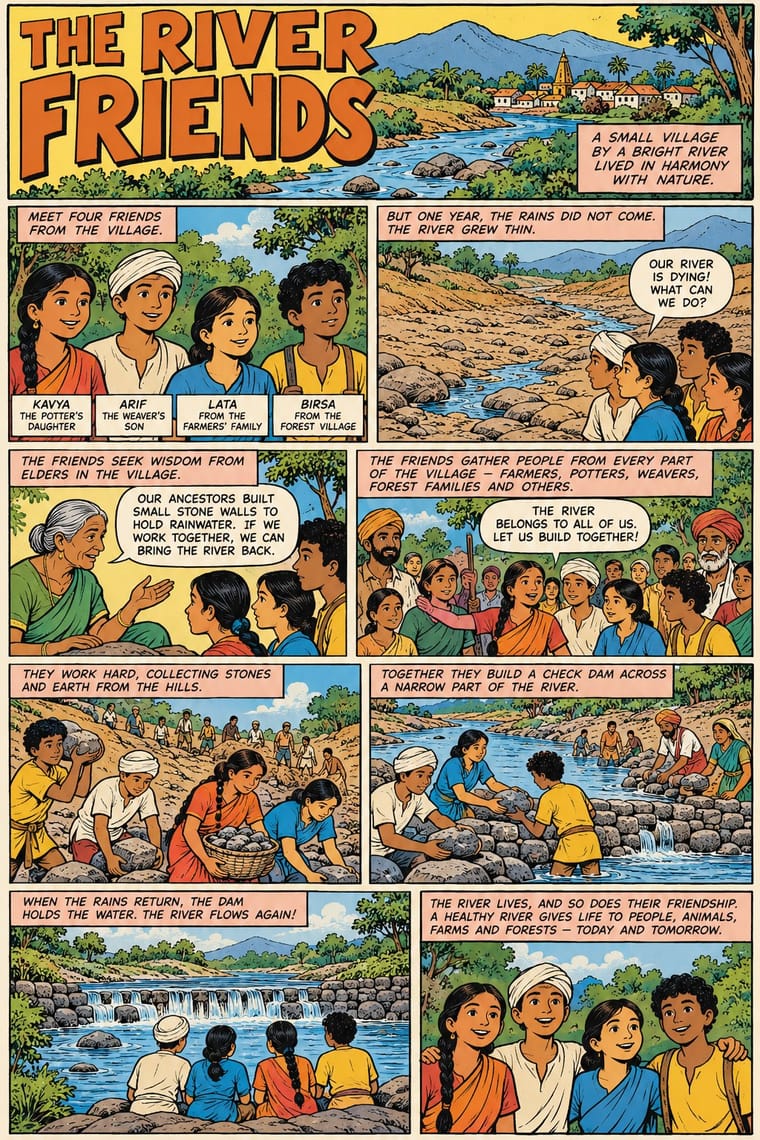
Both retell the Mahabharata and Ramayana with a fixed iconography, but Amar Chitra Katha draws idealised, near-naturalistic bodies in panels, while wayang codes character into impossible proportions.
Mix them and make something Amar Chitra Katha Comics Javanese Wayang Kulit
01
What each style brings
Each part of the design comes from the style with the stronger say in it, and each style gives at least two.
Amar Chitra Katha Comics Javanese Wayang Kulit (Tatah Sungging)
- Type from Amar Chitra Katha Comics
- Colour from Javanese Wayang Kulit
- Form from Javanese Wayang Kulit
- Composition from Amar Chitra Katha Comics
- Surface from Amar Chitra Katha Comics
02
The type
Open fonts standing in for each style’s own type, which is often hand-drawn or commercial.
Display · Amar Chitra Katha Comics
Public
Londrina Solid, standing in for Upright hand-lettered capitals (dialogue in round speech balloons, evenly spaced and drawn by hand)
Text · Javanese Wayang Kulit
The visual language of Javanese shadow puppets: flat figures cut from buffalo parchment, with head and legs in profile, shoulders turned to the front and long jointed arms worked by horn rods. Their insides are punched into filigree that draws costume and jewellery in light on the screen; both faces are painted in stepped colour gradations and gilded, for viewers on the puppeteer's side. Eyes, nose, head tilt, stance, size and face colour code each character as refined, strong, coarse or comic (the much-loved panakawan clowns); the leaf-shaped gunungan opens and closes the play.
Bodoni Moda; Javanese Wayang Kulit used Aksara Jawa (hanacaraka), the Javanese script of court manuscripts, whose illustrated narrative poems draw their figures in wayang style and Noto Sans Javanese (the Noto Javanese project, SIL Open Font License) for setting character names and captions in aksara Jawa
03
The colours
The ground and leading colours come from Javanese Wayang Kulit, with a counter-accent from Amar Chitra Katha Comics. The ink reads on the ground at 4.5:1 or more.
Amar Chitra Katha Comics Javanese Wayang Kulit (Tatah Sungging)
-
#efe2bfground · 36% -
#1d1a16ink · 14% -
#b3361faccent · 18% -
#e8772eaccent · 14% -
#c9a33baccent · 10% -
#6fa3d8accent · 8%
As CSS
:root {
  --ground: #efe2bf;
  --ink: #1d1a16;
  --accent-1: #b3361f;
  --accent-2: #e8772e;
  --accent-3: #c9a33b;
  --accent-4: #6fa3d8;
  --font-display: "Londrina Solid", cursive;
  --font-text: "Bodoni Moda", serif;
}
Use it with care
Amar Chitra Katha Comics: The series, its covers, characters and sunburst logo belong to its publisher (Amar Chitra Katha Pvt Ltd) and its artists: draw your own figures, covers and badge, never ask an image model for an ACK title or a named artist's hand, and never present a generated page as an ACK comic. Many of its subjects are deities whom readers worship, so do not mock, crop or deface them. Scholars have criticised the series for giving heroes extremely fair skin while coding dark skin with violence, brutality and low caste, for casting Muslims as either secular heroes or zealous villains, for drawing the British as ugly caricatures, and for leaving women, Muslims and lower castes out of its history: give gods, demons, villains, Muslims, Dalit and Adivasi characters the same drawing care, never use skin colour, features or dress as markers of evil, caste or religion, draw people across the real range of South Asian skin tones rather than one pale, uniform type, and do not present one Hindu reading as the whole of India's past.
Javanese Wayang Kulit (Tatah Sungging): Wayang kulit is a living Javanese theatre and craft, on UNESCO's intangible heritage list (proclaimed 2003, inscribed 2008): its puppets are made by carvers and painters for working dalang, and some performances are rites, such as the ruwatan exorcism held for children born under unlucky circumstances. Every figure is a particular character whose eyes, nose, head tilt, stance, size and face colour carry meaning, so do not assemble invented characters from mixed features or use a puppet as generic 'exotic' decoration. Semar, father of the other panakawan, is said to be the god Sang Hyang Ismaya in human form and is held by some to be the most sacred figure of the set, so do not reduce him to a clown or mascot. Never use kasar features such as fangs, red faces and bulging eyes to caricature real people, ethnic or religious groups. Commission or credit Javanese carvers and dalang rather than tracing museum puppets, many of which left Java under colonial rule. Do not sell printed or machine-cut copies as hand-carved tatah sungging, and never present a generated figure as a real wayang character.
04
The two styles
05
More combinations
With Amar Chitra Katha Comics
- Lianhuanhua Picture-Story Books Contrasts · Both are didactic picture-story series of classical and historical tales; lianhuanhua gives each page one black-ink picture over a printed caption, Amar Chitra Katha puts several coloured panels with balloons on every page.
- Indian Calendar & Bazaar Art Pairs well · Borrow the calendar print's frontal, haloed deity and saturated jewel colour for a cover or a single full-page epiphany panel, and keep the pages around it to flat colour and ruled panels.
- American Four-Colour Comic Book (Golden to Bronze Age) Contrasts · The same ruled panels, balloons and hand-lettered capitals; the newsstand comic shouts with slanted panels, dot tints and sound effects, while Amar Chitra Katha keeps a calm regular grid, long narration captions and an edifying voice.
- Hand-Painted Bollywood Poster Pairs well · Painted Hindi-film publicity from the same Bombay decades; its floating star heads, melodramatic colour and hand-drawn title logos suit an Amar Chitra Katha cover pushed louder.
- Ligne Claire (Franco-Belgian Clear Line) Contrasts · Both fill clean contours with flat colour; ligne claire draws one even, unhatched line around caricatural figures, Amar Chitra Katha a swelling brush contour with heavy blacks around idealised, near-naturalistic bodies.
- Bonelli Fumetto (Italian Popular Adventure Comics) Contrasts · Both lay out regular tiers of ruled panels with white gutters and hand-lettered capitals. Amar Chitra Katha fills every page with flat colour and teaches myth and history in about 32 pages in an authoritative voice; a Bonelli issue keeps about a hundred interior pages in black ink and tells a serial hero's adventure for entertainment.
- Arab Children's Comic Magazines (Samir to Majid) Pairs well · Another postcolonial children's comic that teaches heritage in flat colour; combine its narrated caption boxes with the Arab weekly's gag strips and puzzle pages.
- Filipino Komiks Contrasts · Both retell local myth and history as comics in Asian languages. Amar Chitra Katha prints flat colour on every page in an educational, authoritative voice; komiks keep black-and-white interiors for melodrama, fantasy and folk heroes.
With Javanese Wayang Kulit
- Batik Pattern Tradition Pairs well · Both are court arts of Yogyakarta and Surakarta; set one coded figure against batik's all-over repeat to pair a single focus with a patterned field.
- Chinese Paper-Cut (Jianzhi) Contrasts · Both draw with holes cut through a flat sheet, but paper-cuts are usually folded, symmetrical and one-coloured, while a wayang figure is in profile, painted and gilded on both faces, and made to move.
- Nieuwe Kunst (Dutch Art Nouveau) Contrasts · Toorop's long-limbed figures, whose silhouettes evoke Javanese shadow puppets, borrowed the outline under Dutch colonial rule without its code; compare them with a puppet whose every feature names a character.
- Northwest Coast Formline Design Contrasts · Both identify beings by fixed diagnostic features, but formline splits and splays its creature symmetrically to fill the field, while wayang keeps the figure in profile and alone on an empty screen.