Digital native · 2014–present · Global / networked, Central Europe
Brutalist Web Design
Also known as Web brutalism, Brutalist websites, Antidesign
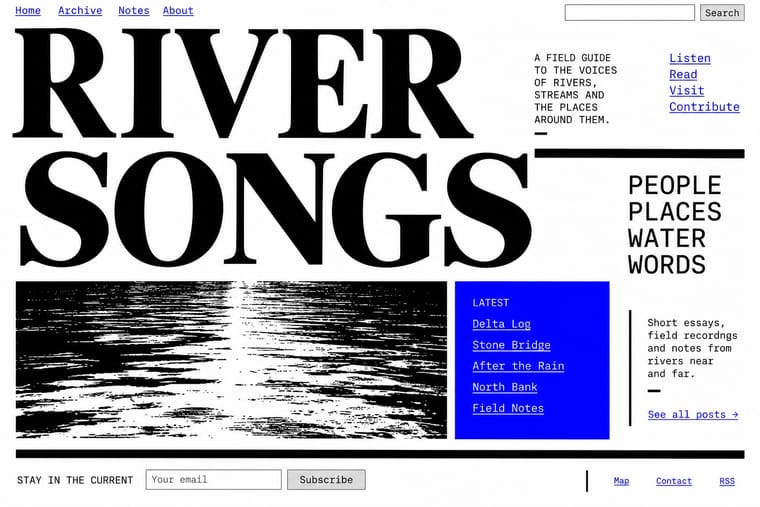
A reaction against templated, conversion-optimised web design that exposes the raw materials of the browser: default system fonts, blue underlined links, visible borders, unstyled forms and plain document flow. Named after architectural Brutalism by Pascal Deville's survey site brutalistwebsites.com (2014), it ranges from functional austerity to deliberately abrasive antidesign.
Make something in this styleGet advice in this styleMix it with another style
01
How it works
- Expose the browser's defaults: system or Times fonts, underlined blue links, grey buttons and unstyled form controls.
- Let content run in plain document order with minimal CSS; skip frameworks, animation and polish.
- Work in stark black on white, or one jarring flat colour, with no gradients, rounded corners or soft shadows.
- Make the structure visible: tables, rules and boxed borders are shown rather than hidden.
- Set type large and blunt, often in monospace, and accept collisions and abrupt scale jumps.
- Treat friction and plainness as a stance: fast, honest pages over seductive surfaces.
Named by Pascal Deville's survey site brutalistwebsites.com (Zurich); a global web-design tendency
02
Its design choices
From Stylogeny’s vocabulary of design choices: defining choices make the style, characteristic ones are usual, occasional ones turn up now and then.
- Layout & composition
- Typography
- Colour
- Form & shape
- Surface & texture
- Imagery
- Medium & production
- Tone & intent
- Avoids
- Gradients, Rounded & pill, Frosted glass, Soft extrusion, Gloss & highlights, Illusion of depth, Flat vector illustration, 3D render
Palette
#ffffff#000000#0000ee#551a8b#c0c0c0#ff0000
Typefaces
Times New Roman
browser default
Courier New and system monospace
Arial / Helvetica
System UI defaults
Known for
Pascal Deville, Brutalist Websites
brutalistwebsites.com, 2014–
Craigslist
Drudge Report
Yale School of Art website
editable, wiki-style
David Bryant Copeland, Brutalist Web Design guidelines
brutalist-web.design
03
Make something in this style
Say what you need, and Stylogeny’s image studio draws it from Brutalist Web Design’s design choices and checks it against them. It takes about a minute, and you get a link to share.
04
Where it comes from, and what it’s close to
Before it
The style it grew out of, and the styles it borrowed from.


Alike in its design choices
Styles that make many of the same choices, related or not, besides those above.


05
Real works
Artefacts in museums, libraries and archives that show the style, linked at their source.
- Brutalist Websites (brutalistwebsites.com), homepagePascal Deville · 2016 (archived 30 May 2016; site launched 2014) · Internet Archive Wayback Machine
- Drudge Report, homepageMatt Drudge · 2016 (archived 2 June 2016; layout in use since the late 1990s) · Internet Archive Wayback Machine
- craigslist New York City, homepagecraigslist, Inc. (Craig Newmark) · 2016 (archived 8 January 2016; layout in use since the early 2000s) · Internet Archive Wayback Machine
- Yale University School of Art, homepage (wiki-editable site)Linked by Air (site design); page content edited by School of Art users · 2016 (archived 16 January 2016; wiki site in use since 2006) · Internet Archive Wayback Machine
- Guidelines for Brutalist Web Design (brutalist-web.design)David Bryant Copeland · 2018 (archived 7 July 2018) · Internet Archive Wayback Machine
06
Sources
- Pascal Deville, Brutalist Websites (brutalistwebsites.com)
- Nielsen Norman Group, 'Brutalism and Antidesign' (nngroup.com/articles/brutalism-antidesign)
- David Bryant Copeland, Brutalist Web Design (brutalist-web.design)
How Stylogeny researches and checks a style: where the facts come from.