Postmodern · 1993–present · East Asia, Global / networked
Superflat
Also known as スーパーフラット, Super Flat, Murakami style
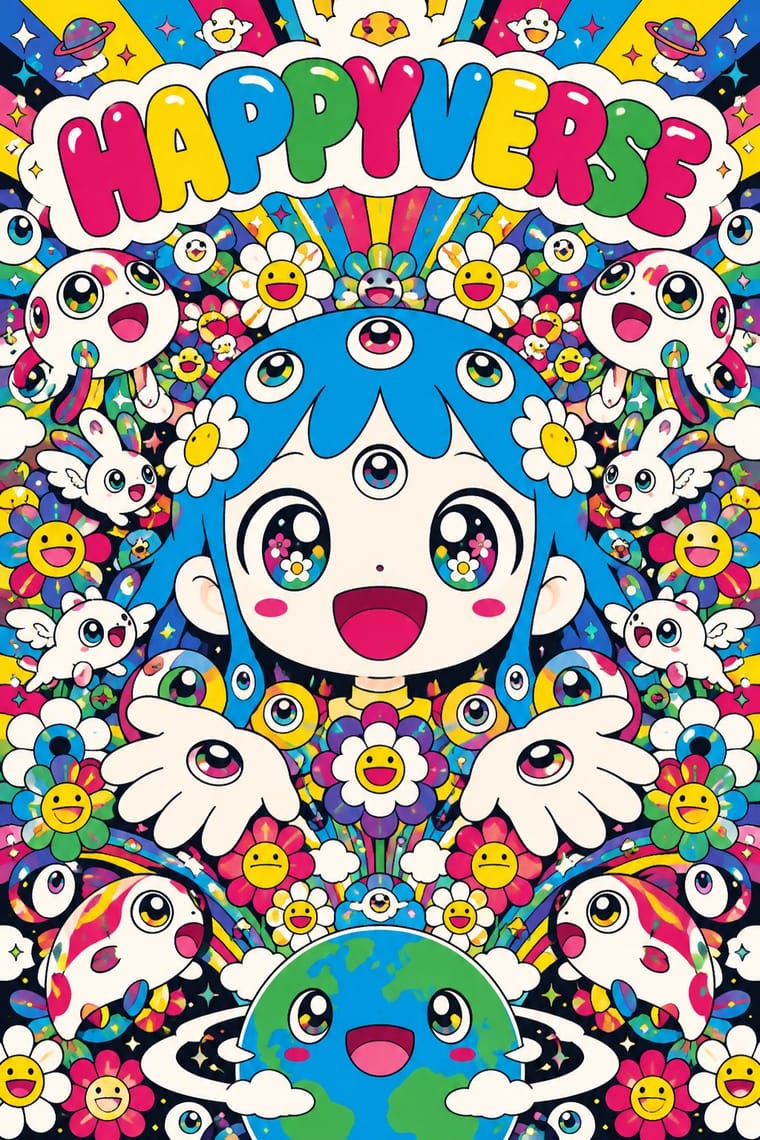
The flat, saturated, cartoon-crowded look that Takashi Murakami named in his exhibition and manifesto Superflat (Tokyo, 2000; US tour 2001). It draws a line from Edo painting and prints to postwar anime and manga, and flattens high and low, art and merchandise into one plane. Smiling flowers, many-eyed characters and anime figures come in unshaded polychrome, smooth and glossy, cute and grotesque at once, sold as handbags and album covers as well as paintings. This entry follows the drawn core of Murakami and his Kaikai Kiki circle; the shows also held photography, video and sculpture.
Make something in this styleGet advice in this styleMix it with another style
Use it with care
Some canonical works use explicit otaku sexual imagery, such as Murakami's My Lonesome Cowboy (1998), and associated artists engage with lolicon art: Mr. describes himself as a lolicon and Henmaru Machino parodies it; never sexualise childlike figures. The mushroom-cloud skulls of Murakami's Time Bokan works and the title Little Boy, the name of the Hiroshima bomb, refer to the atomic bombings, and critics such as Dong-Yeon Koh argue that this victim narrative obscures Japanese aggression in China and Korea; do not use mushroom clouds or skulls as cute decoration. Handle borrowed Buddhist iconography and phrases, such as Kannon, with respect, and draw original characters and flowers: Mr. DOB, the smiling flowers and the Louis Vuitton monogram are owned designs.
01
How it works
- Put everything on one picture plane: little or no perspective or modelling, only unshaded fields of colour inside crisp outlines, so even a landscape reads as stacked flat bands.
- Draw in the idiom of anime and character goods, with big eyes, round heads and smiling flowers, then let the cute turn grotesque: extra eyes, gaping mouths, monsters.
- Fill the surface edge to edge with repeated flowers, eyes, skulls or monograms as an even field, or set one frontal character in the centre against it.
- Draft every shape as clean vector curves before it is printed or painted, so outlines stay crisp at any size; colour it in full, saturated polychrome on white, now and then on gold or platinum leaf, and finish the surface smooth, with no visible brushstroke, giving gloss through drawn cartoon highlights in eyes and on surfaces.
- Treat painting, merchandise, fashion and animation as one output, so the same motifs move from canvas to handbag, toy, album cover and music video.
- Keep the stance ambivalent: present the cuteness of consumer culture deadpan, so pleasure and a critique of its emptiness read at the same time.
Tokyo, from 1993, when Takashi Murakami (born 1962, PhD in Nihonga, Tokyo University of the Arts, 1993) created his character Mr. DOB. He made the work in his Hiropon Factory studio (launched 1996, incorporated as Kaikai Kiki Co., Ltd. in 2001), and named and theorised it in the exhibition Superflat (Parco Gallery, Tokyo and Nagoya, 2000) and the 'Superflat Manifesto' in its catalogue (Madra Publishing, 2000). An extended version toured MOCA Pacific Design Center in Los Angeles, the Walker Art Center in Minneapolis and the Henry Art Gallery in Seattle from 2001
02
Its design choices
From Stylogeny’s vocabulary of design choices: defining choices make the style, characteristic ones are usual, occasional ones turn up now and then.
- Layout & composition
- Space & hierarchy
- Typography
- Colour
- Form & shape
- Surface & texture
- Ornament
- Imagery
- Medium & production
- Tone & intent
- Avoids
- Illusion of depth, Naturalistic depiction, Halftone & Ben-Day dots, Misregistration & overprint, Painterly brushwork, Photocopy & distress, Ornament-free, Typography only, Rational & objective
Palette
#fbfaf5#e4007f#ffd900#00a0e9#2fae4e#1a1a1a
Typefaces
Letters drawn into the character
the letters D, O and B across the round ears and head of Mr. DOB, from 1993
Many-coloured repeated monogram
initials repeated as an all-over field in 33 colours, as in the Monogram Multicolore that Murakami made for Louis Vuitton, on sale from March 2003; the LV monogram is a registered trademark, so draw an original monogram, never the LV one
Known for
Takashi Murakami (curator), Superflat, Parco Gallery, Shibuya, Tokyo
(28 April to 29 May 2000), also shown in Nagoya, with the 'Superflat Manifesto' in its catalogue (Madra Publishing, 2000); an extended version opened MOCA Pacific Design Center, Los Angeles (14 January to 27 May 2001), then travelled to the Walker Art Center, Minneapolis, and the Henry Art Gallery, Seattle
Artists in the 2001 Superflat show alongside Murakami, among them Chiho Aoshima, Aya Takano, Yoshitomo Nara, the animator Yoshinori Kanada, Henmaru Machino and the design studio groovisions
Chiho Aoshima, City Glow, Mountain Whisper, Platform for Art installation on a disused platform at Gloucester Road Underground station, London (2006)
Takashi Murakami, 727 (1996), with his character Mr. DOB
Museum of Modern Art, New York
Little Boy
The Arts of Japan's Exploding Subculture, curated by Murakami (Japan Society with Public Art Fund, New York, 8 April to 24 July 2005), the last part of the Superflat trilogy after Coloriage (Fondation Cartier, Paris, 2002)
Takashi Murakami's artwork for a Louis Vuitton handbag series that re-envisioned the company's monogram, a collaboration begun in 2002 at the invitation of Marc Jacobs
Takashi Murakami, cover artwork for Kanye West's album Graduation
2007
Takashi Murakami, Warp (2009), acrylic, platinum leaf and gold leaf on canvas
The Broad, Los Angeles
03
Make something in this style
Say what you need, and Stylogeny’s image studio draws it from Superflat’s design choices and checks it against them. It takes about a minute, and you get a link to share.
04
Where it comes from, and what it’s close to
Before it
The style it grew out of, and the styles it borrowed from.


After it
The styles that grew out of it.
No later style in the atlas grew out of it yet.
Alike in its design choices
Styles that make many of the same choices, related or not, besides those above.


05
Sources
- MOCA, 'Superflat' (exhibition page, MOCA Pacific Design Center, 14 January to 27 May 2001): https://www.moca.org/exhibitions/superflat (artists; Murakami's theory tracing flatness from 17th- to 19th-century Japanese painters and Hokusai to postwar manga and anime; kawaii consumer culture; Chiho Aoshima's 'digitally rendered girls'; groovisions' persona 'Chappie'; media from painting and photography to video, computer animation and sculpture)
- Mengfei Pan, 'Superflat', Japanese Media and Popular Culture keyword encyclopedia, University of Tokyo (20 April 2020): https://jmpc-utokyo.com/keyword/superflat/ (Parco Gallery Tokyo and Nagoya 2000; the Superflat book, Madra Publishing, 2000; the US tour with Michael Darling; the Superflat trilogy, with Coloriage at the Cartier Foundation in Paris in 2002 and Little Boy in 2005; Mr. DOB created in 1993; otaku; critiques of My Lonesome Cowboy; Dong-Yeon Koh's critique that the mushroom and atomic-bomb imagery places Japan in the position of victim and draws attention away from Japanese military aggression in China and Korea; commercialism)
- Art Institute of Chicago, Takashi Murakami, Mr. Pointy (2011), catalogue entry: https://www.artic.edu/artworks/229379 (Murakami coined 'superflat' in 2000; the 'Superflat Manifesto' on high and low culture that 'fuse into one'; Louis Vuitton collaborations; Pop Art precedents)
- Japan Society, 'Little Boy: The Arts of Japan's Exploding Subculture, Curated by Takashi Murakami': https://www.japansociety.org/event/little-boy-the-arts-of-japans-exploding-subculture-curated-by-takashi-murakami (dates, Public Art Fund, the end of the Superflat trilogy; the title refers to the atomic bomb dropped on Hiroshima in 1945)
- Andrew Yang, 'Murakami Exhibit is a Popular Culture "Explosion"', Metropolis (26 April 2005): https://metropolismag.com/projects/murakami-exhibit-is-a-popular-culture-explosion/ (the title Little Boy as the nickname for the bomb that flattened Hiroshima; Murakami's Time Bokan–Black in the show, a skeleton with an atomic cloud)
- MyArtBroker, 'Takashi Murakami: Time Bokan' and 'Flower Ball' series pages (dealer): https://myartbroker.com/artist-takashi-murakami/series-time-bokan and https://www.myartbroker.com/artist-takashi-murakami/series-flower-ball (Time Bokan prints of 2006 with skull-shaped mushroom clouds whose eyes are smiling daisies, referring to Hiroshima and Nagasaki; Flower Ball works as circular fields of flowers)
- Museum of Fine Arts, Boston, 'Takashi Murakami: Lineage of Eccentrics': https://www.mfa.org/exhibitions/takashi-murakami
- The Broad, 'Takashi Murakami' and 'Warp' (2009): https://www.thebroad.org/art/takashi-murakami and https://thebroad.org/art/takashi-murakami/warp (Warp's platinum and gold leaf; a lion painting that features the Buddhist phrase Sōmoku kokudo shikkai jōbutsu)
- Wikipedia: 'Superflat' (https://en.wikipedia.org/wiki/Superflat) and 'Takashi Murakami' (https://en.wikipedia.org/wiki/Takashi_Murakami) (Mr. a self-described lolicon and Henmaru Machino's parodies; Nihonga PhD 1993, Hiropon Factory 1996 and Kaikai Kiki 2001, the Superflat theory published in the catalogue for the 2000 exhibition, Louis Vuitton from 2002, Graduation cover 2007, Billie Eilish video 2019, flat and highly glossy surfaces)
- Japanese Wikipedia: '村上隆' (https://ja.wikipedia.org/wiki/村上隆) (Superflat at Shibuya Parco Gallery, 28 April to 29 May 2000; Louis Vuitton bag on sale from 1 March 2003)
- Arcana Books, listing of Superflat, Takashi Murakami and Hiroki Azuma (Tokyo: Madra Publishing, 2000, exhibition catalogue, 172 pp.): https://www.arcanabooks.com/catalog/book/026778/ (the 2000 catalogue and its 19 artists, groovisions among them)
- Wikipedia: 'Louis Vuitton' (https://en.wikipedia.org/wiki/Louis_Vuitton) (Murakami and Marc Jacobs's Monogram Multicolore range of 2003, the standard monograms in 33 colours on white or black; the LV monogram shown with its registered-trademark record; one of the most counterfeited brands)
- Anna Tantalin, 'Mr. DOB by Takashi Murakami: The Iconic Character', Artsper Magazine (9 September 2026): https://blog.artsper.com/en/a-closer-look/mr-dob-by-takashi-murakami-the-iconic-character/ (created in 1993; the letters D, O and B across his round ears and head)
- Garage Museum of Contemporary Art, 'Takashi Murakami's team on working with the artist' (Takashi Murakami: Under the Radiation Falls): https://www.garagemca.org/en/exhibition/takashi-murakami/materials/komanda-takasi-murakami-o-rabote-s-hudozhnikom-takashi-murakami-s-team-on-working-with-the-artist (a computer team prepares a digital image, which Kaikai Kiki's New York studio prints, puts on silkscreens and transfers onto canvas before paint and varnish)
- Wikipedia: 'Chiho Aoshima' (https://en.wikipedia.org/wiki/Chiho_Aoshima) (Illustrator Bezier curves; introduced Murakami to Illustrator and oversaw the design data for his works; City Glow on a disused platform of Gloucester Road tube station, London, 2006)
- Kaikai Kiki, 'Chiho Aoshima' (https://www.kaikaikiki.com/en/artists/chiho-aoshima/) (City Glow, Mountain Whisper, Platform for Art, Gloucester Road, 2006; debut chromogenic prints made through her mastery of Adobe Illustrator)
How Stylogeny researches and checks a style: where the facts come from.