Style combination · Contrasts
Kōwhaiwhai × Uli
Both build from curving line and balance positive against negative space, but kōwhaiwhai mirrors koru in continuous bands along a rafter, while uli scatters single motifs asymmetrically over open skin, wall or paper.
01
What each style brings
Each part of the design comes from the style with the stronger say in it, and each style gives at least two.
Kōwhaiwhai & Toi Māori Design Uli & Nsibidi Line and Sign Tradition
- Type from Uli
-
- Colour from Uli
- Form from Kōwhaiwhai
- Composition from Kōwhaiwhai
- Surface from Kōwhaiwhai
02
The type
Open fonts standing in for each style’s own type, which is often hand-drawn or commercial.
Display · Uli
Ours
Ojuju, standing in for Nsibidi signs as an ideographic set, drawn by hand (there is no standard font; check each sign's meaning and keep to public signs)
Text · Kōwhaiwhai
Toi Māori, the visual arts of the tangata whenua of Aotearoa, of which kōwhaiwhai, the painted scroll patterns of paddles and meeting-house rafters, is the most graphic strand. Patterns are built from the koru (unfurling frond) and crescent forms in red ochre (kōkōwai), black and white, balancing positive and negative shapes in long mirrored bands, alongside carving (whakairo), tukutuku lattice panels and woven tāniko.
Archivo; Kōwhaiwhai used Whakarare and Painted and carved lettering in 19th-century meeting houses
03
The colours
The ground and leading colours come from Uli, with a counter-accent from Kōwhaiwhai. The ink reads on the ground at 4.5:1 or more.
Kōwhaiwhai & Toi Māori Design Uli & Nsibidi Line and Sign Tradition
-
#f0ebdfground · 39% -
#1b1a1cink · 15% -
#c4952faccent · 20% -
#8c3a23accent · 15% -
#23305aaccent · 11%
As CSS
:root {
  --ground: #f0ebdf;
  --ink: #1b1a1c;
  --accent-1: #c4952f;
  --accent-2: #8c3a23;
  --accent-3: #23305a;
  --font-display: "Ojuju", sans-serif;
  --font-text: "Archivo", sans-serif;
}
Use it with care
Kōwhaiwhai & Toi Māori Design: Toi Māori is taonga: kōwhaiwhai patterns can belong to particular iwi and houses and carry whakapapa, and tā moko is personal and especially restricted. Work with Māori designers and iwi under tikanga, credit them, and do not graft koru onto letters or products as generic 'tribal' decoration.
Uli & Nsibidi Line and Sign Tradition: These are living traditions with restricted parts. Nsibidi has a sacred side kept by the Ekpe and Mgbe leopard societies, and ukara cloth is used exclusively by Ekpe members, so never copy society signs or ukara layouts for decoration, merchandise or invented 'secret' meanings; use only signs whose public meaning has been checked with knowledgeable members of the community. Uli is Igbo women's art, which declined after Christian missionaries discouraged it, and the mostly male Nsukka artists were criticised for drawing on it; credit and commission Igbo and Cross River artists, including women painters such as those of the Upa Women Artists Collective, and do not present invented pseudo-nsibidi or generated 'uli' as historical work. Keep the two traditions apart in credit: uli is Igbo women's painting, nsibidi a sign system of Ejagham origin kept by Ekpe and Mgbe men's societies; never label one as the other.
04
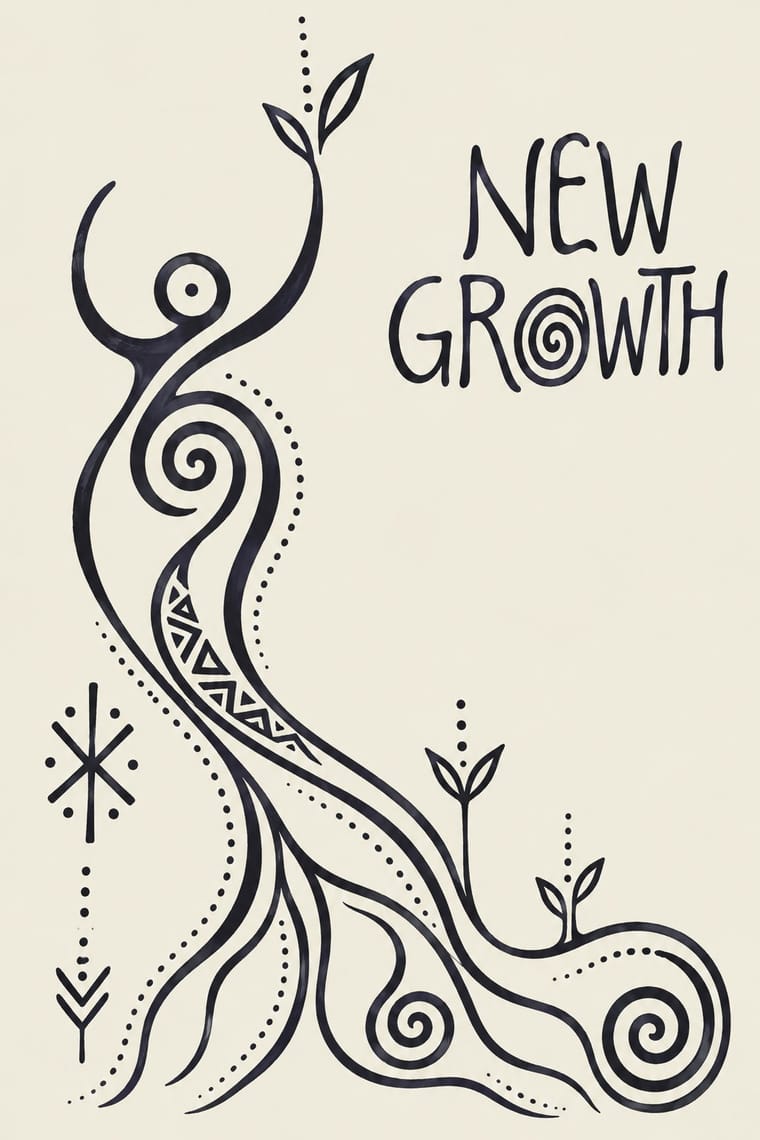
The two styles
05
More combinations
With Kōwhaiwhai
- Art Nouveau Pairs well · Both build on the living, curling stem; compare their curves to find a rhythm that is organic without being florid.
- International Typographic Style Contrasts · A rectilinear grid and neutral sans throw mirrored koru bands into relief, which suits bilingual institutional work in Aotearoa.
- Northwest Coast Formline Design Contrasts · Abstract koru bands and figurative formline crests are distinct Indigenous systems, not one 'tribal' look; study the difference and never blend them.
- Pacific Barkcloth (Tapa) Design Contrasts · Curvilinear kōwhaiwhai and ruled, gridded Polynesian barkcloth belong to different peoples and grammars; keep them separate and credit each source.
- Op Art Graphics Pairs well · Kōwhaiwhai figure-ground reversal reads as optical pattern, but Gordon Walters' koru paintings show the appropriation risk, so work with Māori artists.
- Torres Strait Islander Linocut Contrasts · Another Oceanian pattern tradition, but kōwhaiwhai paints symmetrical koru scrolls in red, black and white along rafters, while Torres Strait linocut carves hatching around narrative figures; never treat Māori and Torres Strait design as one 'Pacific' style.
- Tiki Pop (Polynesian Pop) Contrasts · Polynesian Pop folded Māori carving into one generic 'Tiki'; Toi Māori is taonga tied to particular iwi, so keep it out of tiki pastiche and work with Māori designers when the subject is Aotearoa.
With Uli
- Ma & Wabi-sabi Aesthetics Pairs well · Both make the empty interval carry meaning and place a few elements off-centre in earth colours; uli supplies a living line and named signs where wabi-sabi supplies texture and a single mark.
- Adinkra & Kente Symbol Systems Contrasts · Both put named signs on West African cloth, but adinkra stamps solid silhouettes into a filled grid in one dark dye, while uli draws open line on empty ground and ukara reserves nsibidi signs white in indigo; keep the two sign systems, their meanings and their makers apart.
- Afrofuturist Design Pairs well · Afrofuturism already borrows nsibidi, as in Black Panther's Ancient Wakandan script; keep uli's sparse dark line and real, public signs rather than glowing pseudo-glyphs on deep-space grounds.
- Bògòlanfini Mud Cloth Pairs well · Both leave pale signs in a dark-dyed ground, bògòlan by painting mud around them and ukara by stitching raffia to resist indigo; ukara itself is restricted to Ekpe, so borrow the light-on-dark idea with public signs placed freely, credit each source and keep each motif's meaning.
- Warli Painting Contrasts · Both are women's wall painting built on line; uli usually draws one dark tone on a light ground, skin or paper and leaves wide empty ground around single motifs, the reverse of Warli's white on earth with rows of figures filling the field, so borrow uli's restraint to calm a crowded Warli-derived layout.
- Mithila (Madhubani) Painting Contrasts · Both are women's wall-painting traditions led by line, but uli sets a few swelling lines and named motifs asymmetrically on open ground, so the gaps count, while Mithila closes a symmetrical, bordered field and fills every gap. Set them side by side to show restraint against abundance.