Style combination · Contrasts
Kiwiana × Kōwhaiwhai
Kōwhaiwhai is a living ancestral pattern system with its own meanings, whereas Kiwiana is settler-era brand imagery; keep them apart and work with Māori designers when the subject is Māori.
01
What each style brings
Each part of the design comes from the style with the stronger say in it, and each style gives at least two.
Kiwiana Kōwhaiwhai & Toi Māori Design
- Type from Kiwiana
- Colour from Kiwiana
- Form from Kōwhaiwhai
- Composition from Kōwhaiwhai
- Surface from Kōwhaiwhai
02
The type
Open fonts standing in for each style’s own type, which is often hand-drawn or commercial.
Text · Kōwhaiwhai
Toi Māori, the visual arts of the tangata whenua of Aotearoa, of which kōwhaiwhai, the painted scroll patterns of paddles and meeting-house rafters, is the most graphic strand. Patterns are built from the koru (unfurling frond) and crescent forms in red ochre (kōkōwai), black and white, balancing positive and negative shapes in long mirrored bands, alongside carving (whakairo), tukutuku lattice panels and woven tāniko.
Archivo; Kōwhaiwhai used Whakarare and Painted and carved lettering in 19th-century meeting houses
03
The colours
The ground and leading colours come from Kiwiana, with a counter-accent from Kōwhaiwhai. The ink reads on the ground at 4.5:1 or more.
Kiwiana Kōwhaiwhai & Toi Māori Design
-
#f3ead2ground · 36% -
#111111ink · 14% -
#f2b632accent · 18% -
#c46b2baccent · 14% -
#c8202faccent · 10% -
#1d4f91accent · 8%
As CSS
:root {
  --ground: #f3ead2;
  --ink: #111111;
  --accent-1: #f2b632;
  --accent-2: #c46b2b;
  --accent-3: #c8202f;
  --accent-4: #1d4f91;
  --font-display: "Agbalumo", cursive;
  --font-text: "Archivo", sans-serif;
}
Use it with care
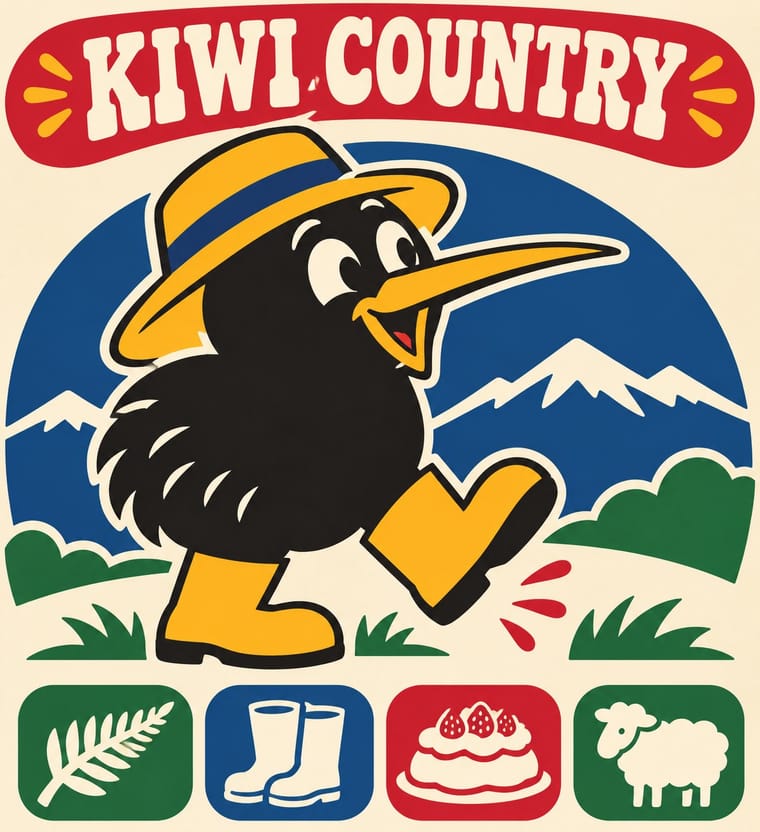
Kiwiana: Kiwiana is a shared national kitsch, and koru spirals, hei-tiki and other Māori forms appear in much of it as decoration; that is the contested part of the tradition. Those forms are taonga tied to particular iwi and a living tradition, not generic national emblems. Keep to the settler-era brand icons (kiwi, fern, gumboots, pavlova, mascots), do not use tā moko, koru or tiki as ornament, and commission Māori designers when the subject is Māori.
Kōwhaiwhai & Toi Māori Design: Toi Māori is taonga: kōwhaiwhai patterns can belong to particular iwi and houses and carry whakapapa, and tā moko is personal and especially restricted. Work with Māori designers and iwi under tikanga, credit them, and do not graft koru onto letters or products as generic 'tribal' decoration.
04
The two styles
05
More combinations
With Kiwiana
- Hand-Painted Signage & Vernacular Lettering Pairs well · Have a sign writer paint the shop name beneath a flat mascot so the lettering carries the same hand-made warmth as the emblem.
- Tiki Pop (Polynesian Pop) Contrasts · Both are souvenir kitsch with a grinning mascot, but tiki pop is an outsider's escapist pastiche, while Kiwiana is a domestic, rural and national kit of homely brand icons.
With Kōwhaiwhai
- Art Nouveau Pairs well · Both build on the living, curling stem; compare their curves to find a rhythm that is organic without being florid.
- International Typographic Style Contrasts · A rectilinear grid and neutral sans throw mirrored koru bands into relief, which suits bilingual institutional work in Aotearoa.
- Northwest Coast Formline Design Contrasts · Abstract koru bands and figurative formline crests are distinct Indigenous systems, not one 'tribal' look; study the difference and never blend them.
- Pacific Barkcloth (Tapa) Design Contrasts · Curvilinear kōwhaiwhai and ruled, gridded Polynesian barkcloth belong to different peoples and grammars; keep them separate and credit each source.
- Op Art Graphics Pairs well · Kōwhaiwhai figure-ground reversal reads as optical pattern, but Gordon Walters' koru paintings show the appropriation risk, so work with Māori artists.
- Uli & Nsibidi Line and Sign Tradition Contrasts · Both build from curving line and balance positive against negative space, but kōwhaiwhai mirrors koru in continuous bands along a rafter, while uli scatters single motifs asymmetrically over open skin, wall or paper.
- Torres Strait Islander Linocut Contrasts · Another Oceanian pattern tradition, but kōwhaiwhai paints symmetrical koru scrolls in red, black and white along rafters, while Torres Strait linocut carves hatching around narrative figures; never treat Māori and Torres Strait design as one 'Pacific' style.
- Tiki Pop (Polynesian Pop) Contrasts · Polynesian Pop folded Māori carving into one generic 'Tiki'; Toi Māori is taonga tied to particular iwi, so keep it out of tiki pastiche and work with Māori designers when the subject is Aotearoa.