Style combination · Contrasts
Guna Mola × Needlework Sampler Lettering
Both are textile image-making, but set the mola's colour density against the sampler's ordered rows.
Mix them and make something Guna Mola Needlework Sampler Lettering
01
What each style brings
Each part of the design comes from the style with the stronger say in it, and each style gives at least two.
Guna Mola Needlework Sampler Lettering
- Type from Needlework Sampler Lettering
- Colour from Guna Mola
- Form from Guna Mola
- Composition from Needlework Sampler Lettering
- Surface from Guna Mola
02
The type
Open fonts standing in for each style’s own type, which is often hand-drawn or commercial.
Display · Needlework Sampler Lettering
Kin
Cinzel, standing in for Stepped counted-thread capitals and lowercase for verses and inscriptions
Text · Guna Mola
The reverse-appliqué blouse panels of Guna women in Panama, made by cutting through two to seven stacked layers of cotton so that every shape is ringed by echoing bands of the colours beneath. Fields are packed with filler slits, sawtooth edges and mazes. The imagery runs from abstract ancestral designs and animals to Bible stories, cartoon characters, brand logos and party slogans, all redrawn in the same contour-echo idiom.
Archivo; Guna Mola used Letters cut through the cloth layers and outlined by echo bands, as in political and lettered mola panels and Brand wordmarks and cartoon lettering redrawn in reverse appliqué
03
The colours
The ground and leading colours come from Guna Mola, with a counter-accent from Needlework Sampler Lettering. The ink reads on the ground at 4.5:1 or more.
Guna Mola Needlework Sampler Lettering
-
#121212ground · 36% -
#f2c12eink · 14% -
#ee7a1faccent · 18% -
#c9a24caccent · 14% -
#c8262eaccent · 10% -
#9b3a32accent · 8%
As CSS
:root {
  --ground: #121212;
  --ink: #f2c12e;
  --accent-1: #ee7a1f;
  --accent-2: #c9a24c;
  --accent-3: #c8262e;
  --accent-4: #9b3a32;
  --font-display: "Cinzel", serif;
  --font-text: "Archivo", sans-serif;
}
Use it with care
Guna Mola: The mola is the everyday and ceremonial dress of Guna women and an emblem of Guna identity and autonomy, defended in the 1925 revolution against a Panamanian ban on Guna dress; many motifs draw on Guna cosmology and oral history, and early sergan designs have been studied and reclaimed by Guna representatives. Treat it as a community's living dress, not a decorative print: buy or commission molas from Guna makers and cooperatives, credit them, keep paired panels together, and do not print imitation 'mola' patterns on merchandise. In Panama, Law 20 of 2000 protects Guna dress as collective intellectual property and bars its industrial reproduction, in whole or in part, without official authorisation and the prior consent of the Guna general congresses.
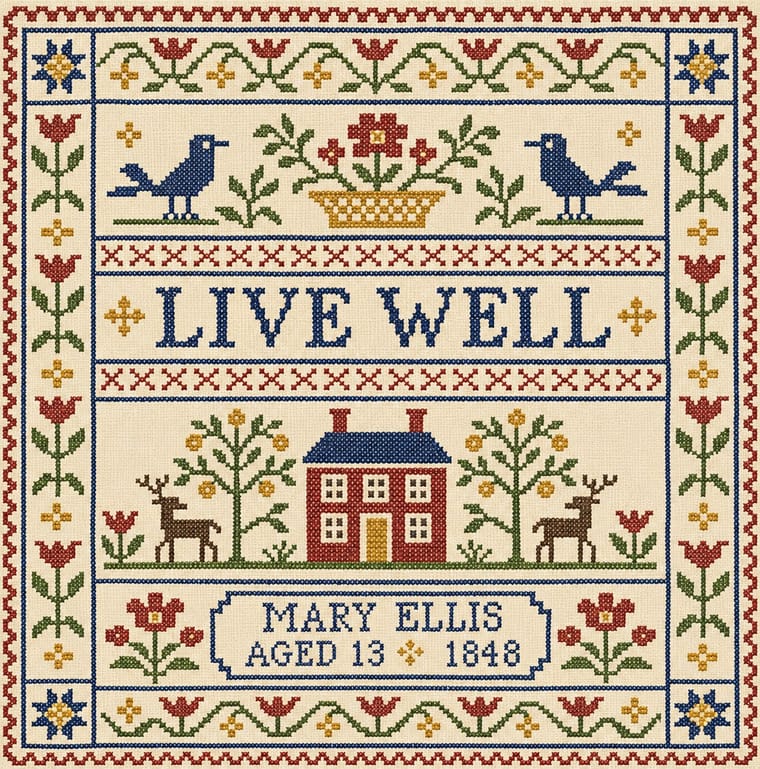
Needlework Sampler Lettering: This was largely girls' schoolwork and domestic training, so credit the individual makers by name where records survive and do not reduce it to anonymous cosy decoration; later packaging and contemporary embroidered typography are afterlives of the form, not proof of an uninterrupted tradition. One afterlife is Whitman's Sampler chocolate packaging (1912), whose stitched-look design echoes needlework samplers (Kent Delord House, kentdelordhouse.org/artifact-corner-whitmans-sampler-book/).
04
The two styles
05
More combinations
With Guna Mola
- Batik Pattern Tradition Contrasts · Batik builds pattern by resist-dyeing, molas by cutting and sewing; never render a mola as a printed texture, because the stepped, stitched edge is the whole point.
- Psychedelic Poster Pairs well · Wrap a headline in concentric echo bands of flat colour, the mola principle, to get psychedelic vibration from stacked layers instead of melting line.
- Pop Art Graphics Pairs well · Like Pop, molas absorb brand logos and cartoons; borrow that omnivorous attitude for a campaign, but commission Guna makers rather than faking the cut-cloth look.
- Chinese Paper-Cut (Jianzhi) Contrasts · Molas cut through stacked layers of cloth and stitch the edges, so colour builds in echo bands; paper-cut stays one flat layer of colour seen against light.
- Kanga (Swahili Message Cloth) Contrasts · Both are women's dress that takes in party slogans, logos and portraits, but a mola is hand-cut reverse appliqué packed edge to edge with echoing contour bands, while a kanga is a factory print with flat fields, an open, centred motif and its message in one plain box.
- Fante Asafo Flags (Frankaa) Contrasts · Both are hand-cut cotton appliqué in saturated colour that absorbs foreign images, but a mola packs every gap with slits and echoing contour bands, while an asafo flag leaves a plain ground around a few silhouettes so the scene reads from across a street.
With Needlework Sampler Lettering
- Andean Woven Graphic Systems Contrasts · Woven sign systems carry meaning in repeated motifs; the sampler carries it in alphabets and verse.
- Cottagecore Contrasts · Cottagecore takes the stitched look as soft pastoral mood; the sampler's core is the alphabet exercise and maker inscription.
- Arts & Crafts Movement Contrasts · Borrow its floral borders and handwork honesty, but keep the stepped thread-count letters instead of heavy book type.