Style combination · Contrasts
European Heraldry × Ultras Graphics
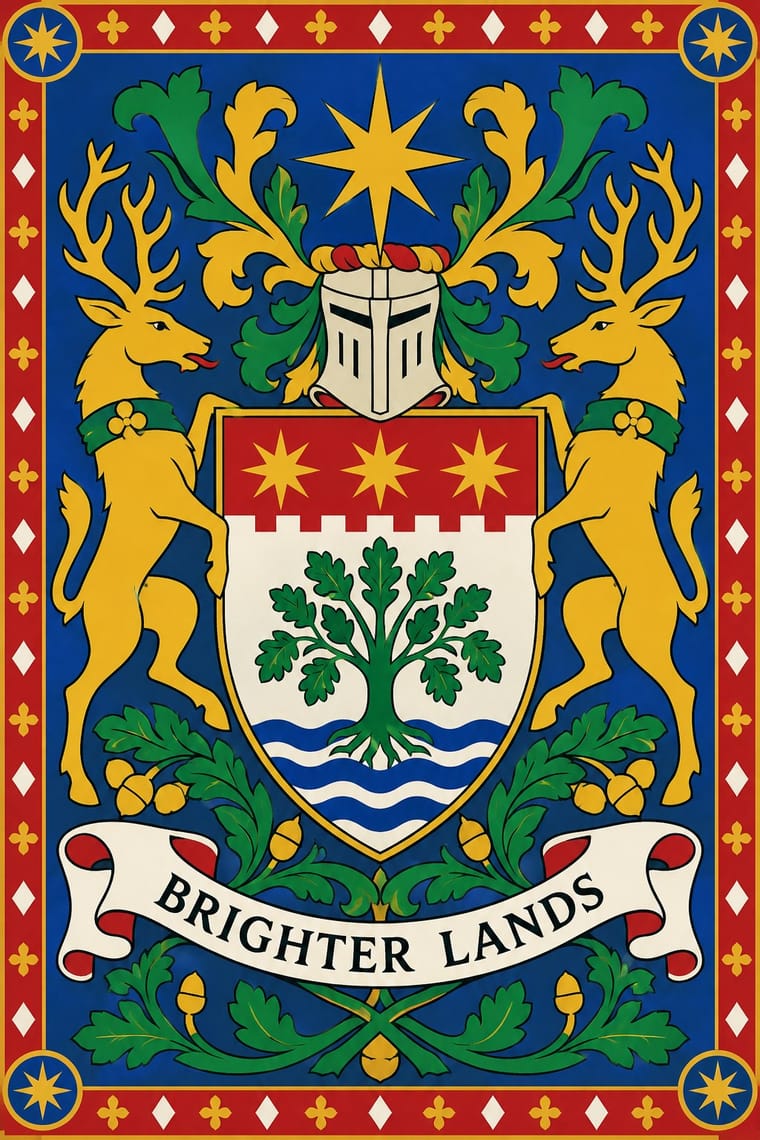
Both raise colours and emblems over a fighting company, but heraldry codifies one bearer's arms by rule, while a curva borrows the city's arms, a skull or a film villain for one afternoon and paints it the size of a stand; choose between a fixed blazon and a crowd-made, temporary emblem.
Mix them and make something European Heraldry Ultras Graphics
01
What each style brings
Each part of the design comes from the style with the stronger say in it, and each style gives at least two.
European Heraldry Ultras Graphics (Curva Banners and Tifo)
- Type from Ultras Graphics
- Colour from Ultras Graphics
- Form from European Heraldry
- Composition from European Heraldry
- Surface from Ultras Graphics
02
The type
Open fonts standing in for each style’s own type, which is often hand-drawn or commercial.
Display · Ultras Graphics
Ours
Big Shoulders; Ultras Graphics used The 'Ultras Liberi' genre and Set display faces enlarged and painted by hand
Text · European Heraldry
The hereditary identifying devices of medieval Europe's knights and seals, codified into a rule-bound grammar still used by states, cities, churches, universities and families. A coat of arms is defined by its written blazon, not by a drawing: a few flat tinctures (two metals, five colours and the furs) that keep metal off metal and colour off colour, a shield divided by bold ordinaries, and stylised charges in fixed poses, redrawn by every age in its own idiom and combined by impalement and quartering.
Libre Caslon Text; European Heraldry used Gothic book and cursive hands naming the bearer above or beside each shield in medieval rolls of arms and armorials, as 'die coninc van denmarke' beside the Danish flag in the Gelre Armorial and Mottoes lettered on a scroll beneath the shield
03
The colours
The ground and leading colours come from Ultras Graphics, with a counter-accent from European Heraldry. The ink reads on the ground at 4.5:1 or more.
European Heraldry Ultras Graphics (Curva Banners and Tifo)
-
#f4f1eaground · 36% -
#141414ink · 14% -
#f2b705accent · 18% -
#c8102eaccent · 14% -
#1d3c8faccent · 10% -
#1f7a3eaccent · 8%
As CSS
:root {
  --ground: #f4f1ea;
  --ink: #141414;
  --accent-1: #f2b705;
  --accent-2: #c8102e;
  --accent-3: #1d3c8f;
  --accent-4: #1f7a3e;
  --font-display: "Big Shoulders", sans-serif;
  --font-text: "Libre Caslon Text", serif;
}
Use it with care
European Heraldry: A coat of arms belongs to a particular bearer, lineage or (in Polish heraldry) clan, not to everyone with a surname: in Scotland it can belong to only one person at a time and the Court of the Lord Lyon can fine those who usurp arms and have the offending items removed or destroyed, state arms are protected against unauthorised registration and use as trademarks under Article 6ter of the Paris Convention, and many European cities and universities protect their arms as trademarks. Design new arms by the rules of the tradition rather than copying a real family's, city's or state's arms for decoration or branding, and do not present invented arms as a family's historic coat of arms. Crusader and Templar shields and knights with crosses on their chests or shields have also become far-right insignia (Charlottesville 2017, the US Capitol 2021), and neo-Nazis use an eagle loosely based on German coats of arms, though not every eagle derives from it; check how a cross, an eagle or a crusading knight will read before using it, and avoid pairing them with militant or ethnic-nationalist themes.
Ultras Graphics (Curva Banners and Tifo): Ultras graphics belong to living, often closed supporters' groups whose banner, name and emblem stand for the group itself, so do not lift a real group's name, logo or lettering for a brand, campaign or fashion line as if it were anonymous street style. The language carries the political baggage of both extremes of 1970s street politics: Vice and Scalcione trace the 'Ultras Liberi' lettering to French and Italian far-right lettering, and some curve, such as S.S. Lazio's Ultras (1974), are known for fascist slogans, but group names such as Commando, Brigate and Fedayn were borrowed from political marches, and many 1970s ultras came from the extra-parliamentary left, Lotta Continua above all, so the same sign can mean opposite things in two curve; check what a borrowed symbol or slogan has meant in that curva before using it. Fare's guide to discriminatory practices in European football lists the SS Totenkopf skull, Sig and Odal runes, the Wolfsangel, the Celtic cross (often in place of an 'O') and the code '88' among the far-right symbols seen in stadiums on banners, stickers and shirts: never use them, and keep a borrowed skull clearly apart from the Totenkopf, as the guide does. Nazi symbols are banned by law in Germany, Austria, Poland and other countries, and UEFA fined Germany's football association after its fans showed a neo-Nazi flag at Euro 2012. Memorial displays and murals, for the 74 dead of Port Said in 2012, 72 of them Al Ahly supporters, or the Superga air crash of 1949, are acts of mourning, not decoration. In Egypt a Cairo court banned all ultras groups in May 2015 and members have been arrested since; do not attribute new work to Egyptian ultras groups or their members. Flares and smoke are dangerous and banned in many stadiums; do not present pyrotechnics as a device to imitate.
04
The two styles
05
More combinations
With European Heraldry
- Hipster Artisanal Revival Contrasts · The craft badge borrows heraldry's air of lineage with an 'Est.' date and crossed arrows on kraft paper, while a real coat of arms is a granted or inherited, blazoned identity in strong tinctures; set the two side by side to show the difference between quoting heritage and holding it.
- Corporate Identity Modernism Pairs well · A coat of arms already is an identity defined by a specification rather than one drawing, applied to seals, banners, buildings and documents; Finnish municipal arms of the 1950s show how its flat two-tincture discipline reads as a modern mark, so use blazon-like rules to write a logo that can be redrawn without losing itself.
- Gothic Blackletter & Fraktur Tradition Pairs well · Medieval armorials name their shields in Gothic hands and German heraldic artists such as Otto Hupp also drew Fraktur; pair a flat Gothic shield with a blackletter name or motto for a certificate, diploma or civic document, checking how the broken script will read politically.
- Kamon (Japanese Family Crests) Contrasts · Both are hereditary emblem systems that began in the twelfth century and mark kinship by small codified variations, but a mon is a single-colour silhouette drawn round a centre while a coat of arms is a shield of contrasting tinctures read by the rule of tincture; compare them to choose between a one-ink crest and a coloured, partitioned one.
- Tarot de Marseille Woodcut Cards Pairs well · The Emperor's and Empress's eagle shields and the maker's escutcheon on the 2 of Coupes come from armory; pair heraldic tinctures and charges with a tarot figure for a crest-like card or label.
- Natural Wine Label Art Contrasts · The crest is the device of the classic château label that natural wine replaced with a face or an animal; put one heraldic charge beside a doodle to show which side of the wine world a bottle stands on.
- Emblem Book (Motto, Picture & Epigram) Contrasts · Alciato's book opens with the arms of the Duchy of Milan, but a coat of arms identifies a bearer by the rules of blazon, while an emblem is a freely invented moral riddle that needs its motto and verse; use arms to identify and an emblem to argue.
- Ottoman Tughra & Dîvânî Chancery Calligraphy Contrasts · Both mark a sovereign's identity and authority, but heraldry does it with charges and tinctures on a shield and the tughra with the ruler's name alone; compare them to decide whether an identity should be pictured or written.
With Ultras Graphics
- Egyptian Revolutionary Street Art (Mohamed Mahmoud Murals) Pairs well · The Mohamed Mahmoud murals painted the faces of Port Said's dead, most of them Ultras Ahlawy fans; pair the curva's collective name and colours with memorial portraits when a group mourns its own.
- Atelier Populaire (May '68 Screenprint Poster) Pairs well · The type designer Alessio D'Ellena, quoted by Vice, places ultras' vernacular letters 'more in the tradition of' the Atelier Populaire's anonymous May '68 posters; borrow their single brushed slogan and anonymous signature for a banner with something to say.
- Fante Asafo Flags (Frankaa) Contrasts · Another fighting group's cloth: the Fante company flag tells a proverb in appliquéd figures for one company, while the ultras banner states one name in painted capitals to a whole stadium.
- Graffiti & Hip-Hop Graphics Pairs well · Ginhoux compares ultras' tag and sticker wars to graffiti crews; add a writer's tags, throw-ups and wall murals to carry a group's name from the banner into the street.