Style combination · Pairs well
Egyptian Revolutionary Street Art × Lebanese October Uprising Graphics
Both turn a street uprising into quickly copied images; add its mural scale for walls. (Drafter's inference; not sourced.)
Mix them and make something Egyptian Revolutionary Street Art Lebanese October Uprising Graphics
01
What each style brings
Each part of the design comes from the style with the stronger say in it, and each style gives at least two.
Egyptian Revolutionary Street Art (Mohamed Mahmoud Murals) Lebanese October Uprising Graphics (Thawra 2019)
- Type from Lebanese October Uprising Graphics
- Colour from Lebanese October Uprising Graphics
- Form from Egyptian Revolutionary Street Art
- Composition from Lebanese October Uprising Graphics
- Surface from Egyptian Revolutionary Street Art
02
The type
Open fonts standing in for each style’s own type, which is often hand-drawn or commercial.
Display · Lebanese October Uprising Graphics
Rise
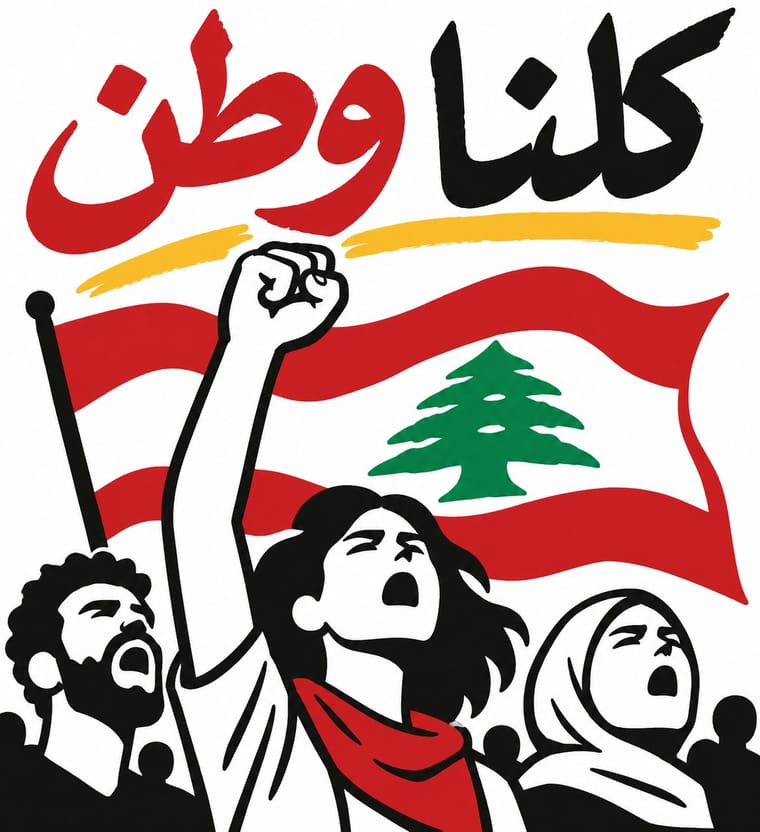
Rakkas, standing in for Hand-drawn Arabic protest lettering
Text · Egyptian Revolutionary Street Art
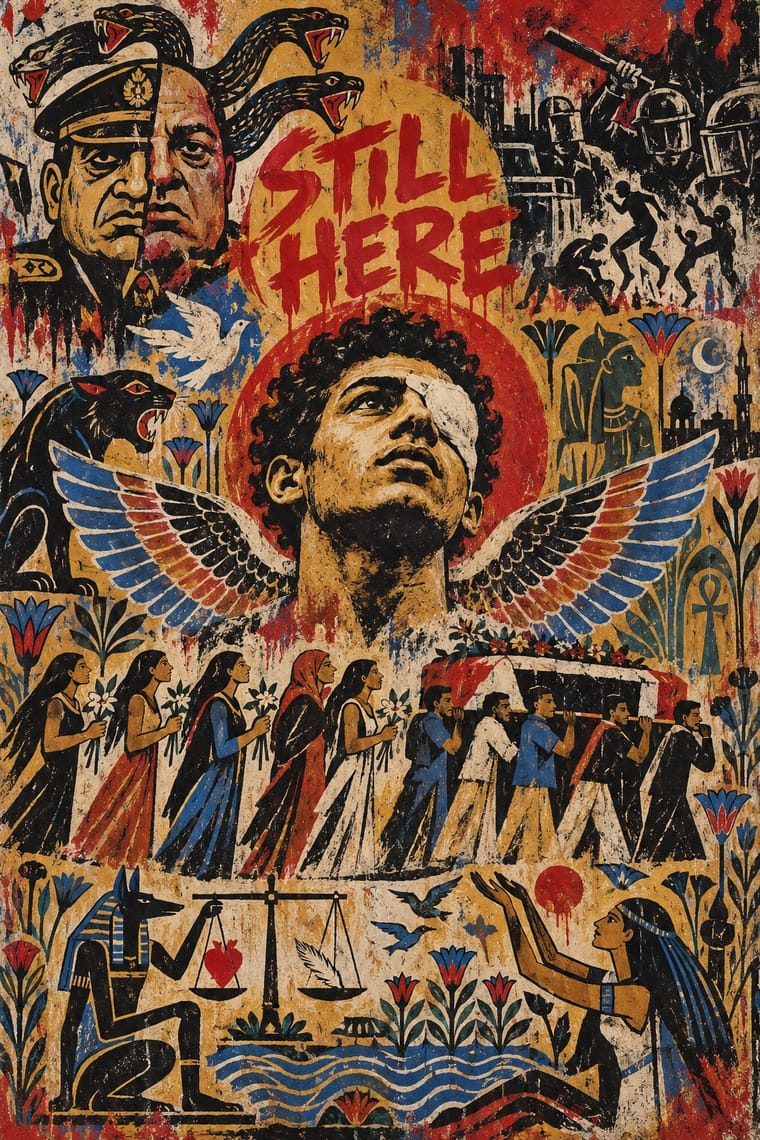
The street art of Egypt's 2011 revolution and the years after it, when Cairo's walls, above all around Tahrir and Mohamed Mahmoud Street, became what Ammar Abo Bakr called a newspaper. Three idioms share them: portraits of martyrs with wings and eye patches; neo-Pharaonic friezes of mourning and marching women by Luxor-trained muralists; and sardonic caricatures, stencils and Arabic slogans against the army, Mubarak and later Morsi. Whitewashed again and again, the walls were repainted in reply.
Newsreader; Egyptian Revolutionary Street Art used Freehand Arabic slogans in spray paint and marker, sometimes with English lines, scrawled beside and over the pictures and Historical lām-alif ('no') forms collected from buildings, mosques, ceramics, textiles and books across the Islamic world, sprayed by Bahia Shehab
03
The colours
The ground and leading colours come from Lebanese October Uprising Graphics, with a counter-accent from Egyptian Revolutionary Street Art. The ink reads on the ground at 4.5:1 or more.
Egyptian Revolutionary Street Art (Mohamed Mahmoud Murals) Lebanese October Uprising Graphics (Thawra 2019)
-
#ffffffground · 36% -
#111111ink · 14% -
#f2c230accent · 18% -
#c8102eaccent · 14% -
#c8963eaccent · 10% -
#00a651accent · 8%
As CSS
:root {
  --ground: #ffffff;
  --ink: #111111;
  --accent-1: #f2c230;
  --accent-2: #c8102e;
  --accent-3: #c8963e;
  --accent-4: #00a651;
  --font-display: "Rakkas", cursive;
  --font-text: "Newsreader", serif;
}
Use it with care
Egyptian Revolutionary Street Art (Mohamed Mahmoud Murals): These walls commemorate real people killed or maimed in 2011–13, whose families are alive, alongside images of women assaulted by security forces, Qur'anic verses and Coptic and Islamic sacred imagery; do not reuse martyr portraits, eye patches or the 'blue bra' as edgy protest styling for a brand, have every Arabic line read by a fluent reader, and credit the artists and photographers by name. The walls were also religiously contested: Awad painted some of his Pharaonic women nude as a stand against the Wahhabi style of Islam, and Salafists erased some martyr portraits and put Qur'anic verses in their place, so do not pair those figures with Qur'anic verses for effect. After July 2013 the interim government built its own martyrs' memorial in Tahrir, which protesters wrecked, and the Muslim Brotherhood staked its own claim to the revolution's dead, so check whose dead a reused martyr motif would seem to mourn. Political street art remains dangerous in Egypt: Ganzeer was detained in 2011, four graffiti artists were detained for 12 hours in May 2015 after painting a mural, and 400 copies of Walls of Freedom were confiscated in Alexandria for allegedly 'inciting violence', so never put Egyptian artists or collaborators at risk with work attributed to them.
04
The two styles
05
More combinations
With Egyptian Revolutionary Street Art
- Lebanese Civil War Party Poster Contrasts · Beirut's martyr posters were issued by parties marking walls as territory; Cairo's martyrs were painted by artists who said they had nothing to do with any party. Compare them to judge whose voice a commemoration speaks in.
- Graffiti & Hip-Hop Graphics Contrasts · Same spray can, opposite priority: New York writing makes the writer's name a letter-sculpture, while Cairo's walls are figurative and commemorative and the lettering is a caption. Decide whether the brief needs a name or a face.
- Stencil Street Art Pairs well · Cairo's stencillers worked in the same cut-and-spray idiom; set one stencilled face and a short slogan beside a brushed mural when a memorial has to be repeated across a city overnight.
- Tunisian Post-Revolution Street Graphics (Ahl El Kahf) Contrasts · Cairo's walls became epic commemorative murals; Tunis's core is small stencil-and-intervention work. Choose a witty one-liner or a memorial painting, not both.
- Ancient Egyptian Hieroglyphic & Register Composition Pairs well · In 2012 Luxor-trained muralists such as Alaa Awad recast tomb painting on Cairo's Mohamed Mahmoud Street: profile processions of mourning women, registers, a sarcophagus and the weighing of the heart, brushed in acrylic around the faces of the martyrs. Look there for a living Egyptian use of the register and the procession, credited to its painters, rather than Egyptomania décor.
- Ultras Graphics (Curva Banners and Tifo) Pairs well · The Mohamed Mahmoud murals painted the faces of Port Said's dead, most of them Ultras Ahlawy fans; pair the curva's collective name and colours with memorial portraits when a group mourns its own.
- Chilean Estallido Social Graphics (Revuelta Popular of 2019–20) Contrasts · Cairo and Santiago both put the eye patches of protesters shot in the eye on their walls and answered every whitewash with new work, but Cairo's martyr murals are brushed portraits beside Pharaonic friezes, while Santiago's are layered paper, stencil and punk iconoclasm.
- Syrian Revolution Graphics (Kafranbel Banners & Poster Collectives) Pairs well · Its 2011 neighbour: Cairo painted martyrs and friezes onto walls, Syria made portable sheets for the camera; put a Syrian-style printable slogan beside a mural photograph to join wall and feed.
With Lebanese October Uprising Graphics
- Lebanese Civil War Party Poster Contrasts · Swap its party header and photographic martyr portrait for an unaffiliated crowd figure to see the shift from factional to shared identity.
- Algerian Hirak Humorous Poster and Meme Graphics Pairs well · Both are protest graphics of the same decade that circulated online; take the caption-over-borrowed-image joke from Hirak and the wider uprising graphic repertoire from Lebanon.