Style combination · Pairs well
Algerian Post-Independence Sign Art and Poster × Amazigh Sign System
Its tattoo and weaving signs are the source vocabulary; use them with the community's own meanings in view.
Mix them and make something Algerian Post-Independence Sign Art and Poster Amazigh Sign System
01
What each style brings
Each part of the design comes from the style with the stronger say in it, and each style gives at least two.
Algerian Post-Independence Sign Art and Poster (École du Signe, Aouchem) Amazigh Sign System & Tifinagh
- Type from Algerian Post-Independence Sign Art and Poster
-
Amazigh Sign System avoids brush & pen calligraphy: this is where the two pull against each other.
- Colour from Amazigh Sign System
- Form from Amazigh Sign System
- Composition from Algerian Post-Independence Sign Art and Poster
- Surface from Algerian Post-Independence Sign Art and Poster
02
The type
Open fonts standing in for each style’s own type, which is often hand-drawn or commercial.
Display · Algerian Post-Independence Sign Art and Poster
Ours
Rakkas, standing in for Maghrebi and Kufic-derived Arabic hands, abstracted
Text · Amazigh Sign System
The visual language shared by Amazigh communities from the Rif, Atlas and Kabylie to the Aurès and the Tuareg Sahara. Women weave a common repertoire of geometric signs (lozenges, chevrons, triangles, crosses, zigzags, dots) into rugs and capes, paint it on pottery and tattoo it on the face, and smiths, many of them Jewish in Morocco and Kabylie until the 1950s, cast and engrave it in silver. Its script, Tifinagh, descends from Libyco-Berber writing. Since 2003 Neo-Tifinagh has marked Amazigh identity on Moroccan public signs; the red yaz ⵣ has stood on the Amazigh flag since 1970.
Jost; Amazigh Sign System used IRCAM standard Neo-Tifinagh and Noto Sans Tifinagh
03
The colours
The ground and leading colours come from Amazigh Sign System, with a counter-accent from Algerian Post-Independence Sign Art and Poster. The ink reads on the ground at 4.5:1 or more.
Algerian Post-Independence Sign Art and Poster (École du Signe, Aouchem) Amazigh Sign System & Tifinagh
-
#efe7d6ground · 36% -
#1b1916ink · 14% -
#c48a2caccent · 18% -
#a23a2aaccent · 14% -
#1f4f8faccent · 10% -
#3f7a4aaccent · 8%
As CSS
:root {
  --ground: #efe7d6;
  --ink: #1b1916;
  --accent-1: #c48a2c;
  --accent-2: #a23a2a;
  --accent-3: #1f4f8f;
  --accent-4: #3f7a4a;
  --font-display: "Rakkas", cursive;
  --font-text: "Jost", sans-serif;
}
Use it with care
Algerian Post-Independence Sign Art and Poster (École du Signe, Aouchem): Amazigh signs, tattoo marks and Tifinagh belong to a living community and carry meanings of their own; do not use them as decorative filler or invent 'authentic' glyphs. Aouchem and the École du Signe were mostly Arabic-speaking and Francophone urban artists drawing on Amazigh sources during state Arabisation, and Amazigh identity was politically contested in Algeria, so the sign repertoire should not be presented as simply national. M'hamed Issiakhem, who designed banknotes, stamps and a 1978 Kateb Yacine poster, is figurative and not a member of either group; IEMED cites his posters as examples of the official realist style, so he is not an exemplar here. The poster use of this tradition is thinly documented: claims of Khadda posters for SNED (1960–1980) and the 1969 Pan-African Festival poster could not be confirmed, and the palette is approximate. The founding year of the UNAP differs between sources (1963, 1964).
Amazigh Sign System & Tifinagh: These signs belong to living Amazigh communities, and much of the repertoire is women's work: weavers, potters, and older women whose facial tattoos belong to a fading practice that many Moroccans now regard as sacrilegious. Signs and jewellery are worn for protection against the evil eye and to mark region, tribe and life stage, so do not merge regional motifs into a generic 'Berber' pattern or put tattoo signs on throwaway goods. The best-known photographs of Kabyle women's facial tattoos, Marc Garanger's portraits of 1960, were made by a French army conscript for compulsory identity cards, with the women made to unveil; do not use them as neutral pattern sources, and prefer documentation made with the women's consent or by Amazigh researchers. The choice of script is itself political: IRCAM's 2003 adoption of Neo-Tifinagh was a palace compromise that many Amazigh activists criticised, most Moroccan speakers and Kabyle writers use Latin script, and Tuareg Tifinagh is its own living variant. Have any Tifinagh text spelled and checked by a speaker and set it in a proper Unicode font rather than inventing pseudo-letters. The yaz and the Amazigh flag are political emblems of the Amazigh identity movement, and the flag was banned in Algeria during the 2019 Hirak. Much historical Moroccan and Kabyle 'Berber' silver was made by Jewish silversmiths, and Tuareg pieces by Tuareg smiths: credit them accurately, commission and credit Amazigh weavers, potters and type designers, and do not sell printed 'Berber' rug pattern as hand-woven.
04
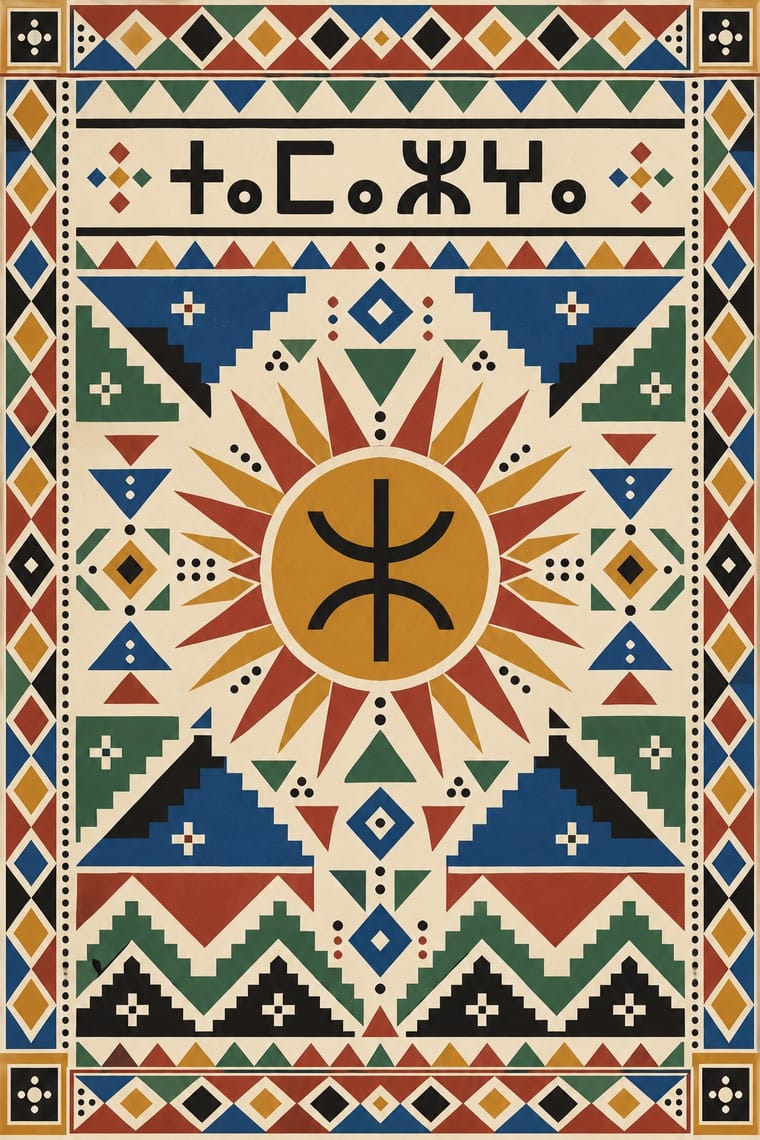
The two styles
05
More combinations
With Algerian Post-Independence Sign Art and Poster
No other combination with it yet.
With Amazigh Sign System
- Adinkra & Kente Symbol Systems Contrasts · Both are sign systems that carry meaning, but adinkra stamps named symbols into a ruled grid of squares. Amazigh weavers and tattooists vary the size and spacing of their signs by hand within bands and lattices, and share them with a script.
- Bògòlanfini Mud Cloth Contrasts · Bògòlan leaves pale signs in a dark mud-painted ground, while Beni Ouarain rugs and Kabyle pots draw dark signs on cream wool or white slip. Black-ground Amazigh weavings, such as Middle Atlas tent bands and the akhnif cape, are the exception; there, tell the two apart by the stepped, woven construction rather than by the ground.
- Islamic Geometric & Calligraphic Tradition Contrasts · Islamic pattern builds compass-drawn star tilings and calligraphic hierarchy; Amazigh signs are freehand, stroke-built and non-calligraphic. Choose one logic for a Maghrebi brief instead of blending them into generic 'Moroccan' pattern.
- Contemporary Arabic & Dual-Script Type Design Pairs well · Matched Arabic–Latin families such as Qandus and Awal add Tifinagh as a third script. Give Tifinagh the same weight and baseline as its partners on trilingual signs.
- Baybayin Revival Graphics Contrasts · Both turn a revived script into an identity sign, but Tifinagh is carried by a woven and painted geometric repertoire and appears on public signage, while baybayin is a looped brush or pen hand used almost only as emblem; do not swap one script's look for the other's.
- Diné (Navajo) Weaving Design Contrasts · Both are rug-weaving traditions of stepped geometry, made largely by women. Amazigh weavers share a repertoire of protective signs with pots, silver and tattoos, and let a lattice drift or break off by hand, while a Diné rug is one field planned and mirrored around a centre, in a grammar and palette set by period and region. Do not merge them into a generic 'tribal rug'.