Traditions & vernacular · c. 1200–1560 · Latin America & Caribbean
Mixteca-Puebla Codex Painting
Also known as Mixteca-Puebla style, Mixtec pictorial manuscripts, Borgia Group codices, Postclassic central and southern Mexican screenfold books, Ñee ñuhu ('sacred skins', a Mixtec name for the codices)
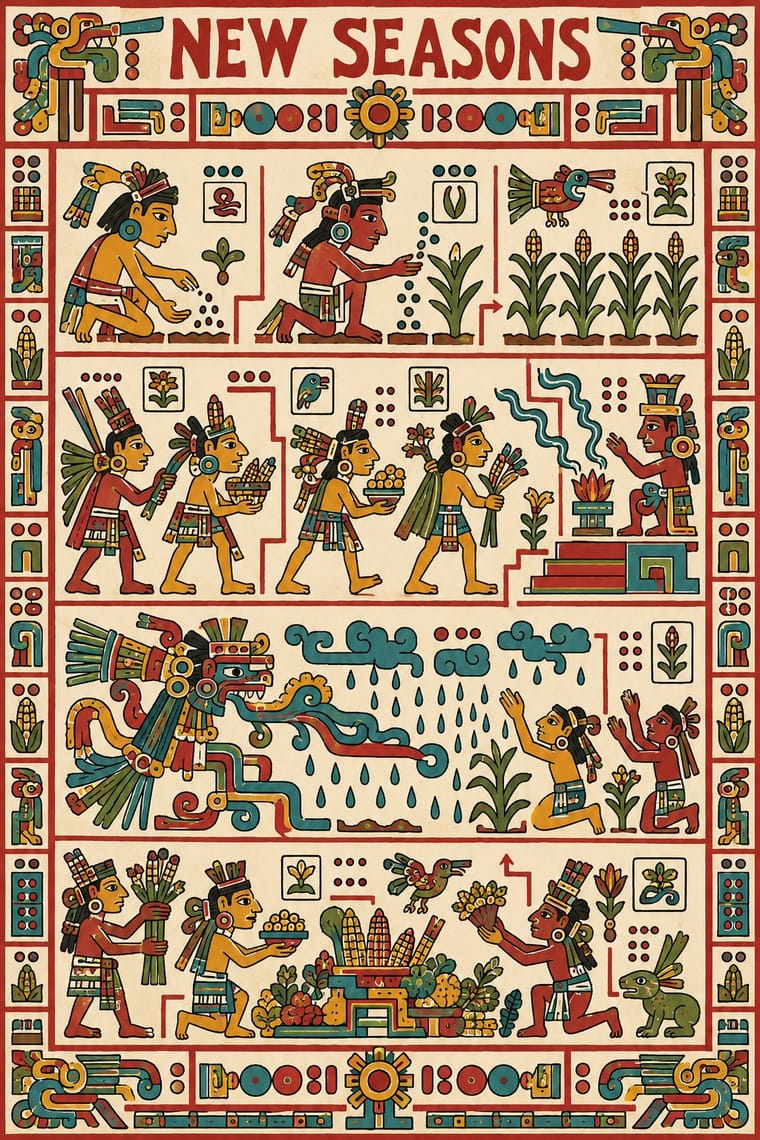
The painted screenfold books of Postclassic southern and central Mexico (not the Maya codices): long strips of gesso-coated deerskin, folded like a screen and painted on both sides. In the Mixtec histories red guidelines lead the reader in a zigzag through the deeds and marriages of rulers; in the divinatory Borgia Group, pages pair deities with periods of the 260-day count. Profile figures with large heads, glyphs for names, dates and places, and flat colour inside an even black contour make picture and writing one codified system.
Make something in this styleGet advice in this styleMix it with another style
Use it with care
These books are Indigenous sacred and dynastic records: Mixtec speakers called them ñee ñuhu, 'sacred skins'; the Borgia Group almanacs set out deities and the ritual 260-day count, and the Mixtec histories record the genealogies of ruling houses whose Ñuu Dzaui (Mixtec) descendants live in Oaxaca, Puebla, Guerrero and the diaspora today. Almost all surviving books left Mexico during the conquest, the colonial period or the nineteenth century and are now in European libraries and museums; the Codex Colombino in Mexico City is a rare exception. 'Mixteca-Puebla' itself is an archaeologists' label, not a name the painters used: George Vaillant described a Mixteca-Puebla 'culture' or 'civilization', H. B. Nicholson redefined it as a style shared by Nahua and Mixtec artists, and its questions remain open. Do not lift deities, calendar signs or named rulers as decoration, logos or generic 'Aztec pattern', never invent pseudo-glyphs or present generated pages as historical, and work with Mixtec and Nahua scholars, artists and communities, crediting the codex and its people.
01
How it works
- In the Mixtec histories, divide each page with red guidelines into bands or columns and lead the reader through them in a zigzag (boustrophedon), leaving the line open where the story passes into the next band; in the Borgia Group almanacs, divide it instead into rows of day signs, quarters or large scenes, some turned 90 degrees (Codex Borgia pp. 29–46).
- Draw figures in profile with large heads and standard poses, lay in the shapes in red, fill each with one flat colour and finish with an even black contour: no shading, modelling or perspective.
- Name each person by a birth date in the 260-day count, a day sign plus counting dots (Lord Eight Deer is a deer head with eight dots), painted beside the figure it names.
- Write most places as hill signs carrying the attributes that identify them, show travel with a trail of footprints and speech with a scroll from the mouth.
- In divinatory almanacs, set the day signs in counted rows and cells beside the deity who governs each period, so the page works as a table of time.
Mixtec (Ñuu Dzaui) kingdoms of highland Oaxaca such as Tilantongo and Tlaxiaco, and Puebla–Tlaxcala–western Oaxaca for the Borgia Group (Cholula, Tlaxcala and the Mixtec region of Puebla are proposed), with early colonial continuations
02
Its design choices
From Stylogeny’s vocabulary of design choices: defining choices make the style, characteristic ones are usual, occasional ones turn up now and then.
- Layout & composition
- Space & hierarchy
- Typography
- Colour
- Form & shape
- Surface & texture
- Ornament
- Imagery
- Medium & production
- Avoids
- Illusion of depth, Gradients, Naturalistic depiction, Painterly brushwork, Painterly illustration, Straight photography, Generous white space
Palette
#f1ead8#1a1714#b22a2a#d49a2a#3f8f97#6f7a34
Typefaces
Calendar-name glyphs
one of the 20 day signs with one to thirteen counting dots, painted beside the figure it names
Place signs, most built on a hill glyph that carries the attributes naming the town
Hill of the Bee-Wasp and Hill of the Mask in Codex Bodley
For accompanying text, a sturdy humanist sans with full diacritic support (e.g. Noto Sans) for Spanish and Mixtec (Tu'un Savi) orthographies, never a novelty 'Aztec' display font
Known for
Codex Zouche-Nuttall (Mixtec, 14th–15th century; 47 leaves, about 11.35 m; British Museum, Am1902,0308.1, also cited as Add MS 39671), whose pages 42–84 tell the story of Lord Eight Deer Jaguar Claw of Tilantongo
Codex Vindobonensis Mexicanus I
Mixtec; 52 pages, about 13.5 m; Austrian National Library, Cod. Vindob. mex. 1
Codex Bodley
Mixtec, early 16th century, before 1521; deerskin, 6.7 m, in red-banded registers; Bodleian Library, MS Mex. d. 1
Codex Selden
Mixtec genealogy of the Jaltepec dynasty, last date 1556, counted among the six surviving pre-Hispanic-style Mixtec codices; Bodleian Library, MS. Arch. Selden. A. 2
Codex Borgia
Borgia Group divinatory almanac on gesso-coated skin, 76 painted pages; Vatican Library, Borg.mess.1
Codex Fejérváry-Mayer
Borgia Group almanac on deerskin, 23 pages; World Museum Liverpool, 12014 M
03
Make something in this style
Say what you need, and Stylogeny’s image studio draws it from Mixteca-Puebla Codex Painting’s design choices and checks it against them. It takes about a minute, and you get a link to share.
04
Where it comes from, and what it’s close to
Before it
The style it grew out of, and the styles it borrowed from.
Nothing earlier is recorded: in the atlas it is a starting point.

After it
The styles that grew out of it.
No later style in the atlas grew out of it yet.
Alike in its design choices
Styles that make many of the same choices, related or not, besides those above.


05
Sources
- https://en.wikipedia.org/wiki/Codex_Zouche-Nuttall
- Facsimile Finder, Codex Zouche-Nuttall (London, British Museum, Am1902,0308.1; 15th century): https://www.facsimilefinder.com/facsimiles/codex-zouche-nuttall-facsimile
- https://en.wikipedia.org/wiki/Codex_Vindobonensis_Mexicanus_I
- https://en.wikipedia.org/wiki/Codex_Bodley (deerskin with white base coat, horizontal red bands, a variant of the Mixteca-Puebla style)
- https://en.wikipedia.org/wiki/Codex_Borgia
- https://en.wikipedia.org/wiki/Codex_Fej%C3%A9rv%C3%A1ry-Mayer
- https://en.wikipedia.org/wiki/Codex_Selden
- https://en.wikipedia.org/wiki/Codex_Colombino (held in the National Museum of Anthropology, Mexico City; its other half, Becker I, is in Vienna)
- Facsimile Finder, Codices Becker I/II (Becker I passed through Mexican owners to Philipp J. Becker before 1872; his collection went to Vienna in 1897): https://www.facsimilefinder.com/facsimiles/codices-becker-i-ii-facsimile
- https://en.wikipedia.org/wiki/Borgia_Group
- https://en.wikipedia.org/wiki/Aztec_codices (colour applied within linear boundaries without modelling or shading)
- https://en.wikipedia.org/wiki/Aztec_script (footprints for movement, speech scrolls)
- https://en.wikipedia.org/wiki/Eight_Deer_Jaguar_Claw (name glyph of a deer head and eight dots)
- John Pohl, Ancient Books: Mixtec Group Codices, FAMSI: https://www.famsi.org/research/pohl/jpcodices/pohlmixtec3.html and https://www.famsi.org/research/pohl/jpcodices/bodley/index.html
- Manuel A. Hermann Lejarazu, 'An Introduction to pre-Hispanic Mixtec Codices', Mexicolore: https://www.mexicolore.co.uk/aztecs/writing/introduction-to-mixtec-codices
- Miguel Covarrubias, Indian Art of Mexico and Central America (1957), excerpted at https://www.mexicolore.co.uk/aztecs/writing/mixtec-designs (even black or red outline; palette of ochre, sienna, carmine, turquoise, olive, grey and black)
- Mexicolore, 'Codex Corner' on colours (citing Joyce Marcus, Mesoamerican Writing Systems, 1992, on red layout, flat fill and black outline) and on reading order (citing Elizabeth Hill Boone and Gordon Brotherston): https://www.mexicolore.co.uk/aztecs/writing/codex-corner-colours and https://www.mexicolore.co.uk/aztecs/writing/codex-corner-reading-order
- H. B. Nicholson and Eloise Quiñones Keber (eds), Mixteca-Puebla: Discoveries and Research in Mesoamerican Art and Archaeology (1994)
- Geoffrey G. McCafferty, Ceramics of Postclassic Cholula, Mexico (UCLA Cotsen Institute of Archaeology, 2001)
- Eloise Quiñones Keber, 'Gifts of the Feathered Serpent: The Life and Career of H. B. Nicholson (1925–2007)', Ancient Mesoamerica 18 (2007), 3–10, doi:10.1017/S0956536107000132 (Nicholson redefined Mixteca-Puebla as a style, correcting Vaillant's 'culture' or 'civilization')
- People's Graphic Design Archive, Mexico City Metro wayfinding system (Lance Wyman, 1969): https://peoplesgdarchive.org/item/18240/mexico-city-metro-wayfinding-system; Wikipedia, 'Chapultepec metro station' (the grasshopper icon for Nahuatl 'grasshopper hill'): https://en.wikipedia.org/wiki/Chapultepec_metro_station
How Stylogeny researches and checks a style: where the facts come from.