Digital native · 2019–2023 · North America
Book Blob (Abstract Colour-Blob Literary Fiction Cover)
Also known as The book blob, The blobs, Blobs of suggestive colors, Unicorn frappuccino cover, Color blob cover, Blobwave
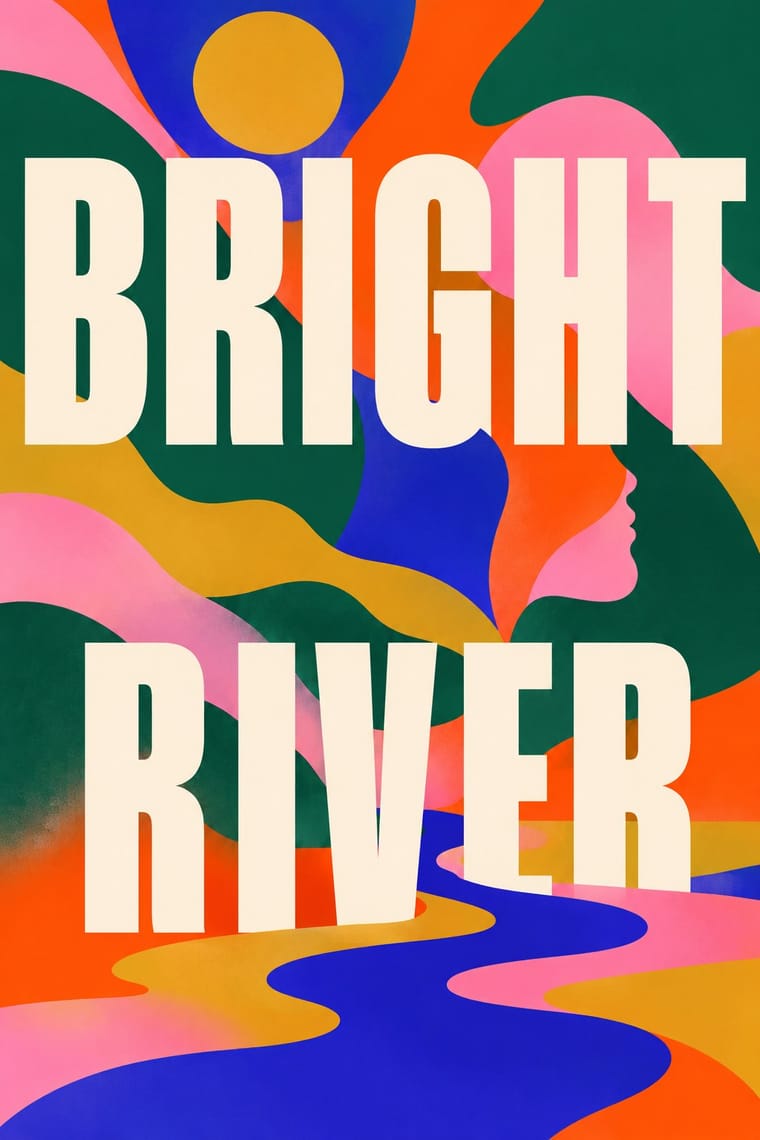
The default jacket of US literary fiction around 2019–2023: soft, overlapping blobs of saturated colour fill the cover edge to edge (cobalt, pink, orange-red, deep green, mustard). If you look twice, a profile, an eye or a braid may appear. Over them sit a big title in spaced white or cream sans capitals and a small handwritten 'a novel'. It was designed to stay legible as a phone thumbnail and to look good on Instagram. Jeva Lange was delighted by its clashing colours, but Print called it a safe, reliably marketable look, used disproportionately for books by women of colour and debut authors.
Make something in this styleGet advice in this styleMix it with another style
Use it with care
These jackets are the in-copyright work of named, living designers and illustrators: borrow the method, not a particular cover. Print (2021) read the look as a 'safe' route taken disproportionately for women of colour and debut authors, who deserve covers 'that wouldn't have been created for anyone else'. If you use the blob for such a book, draw the shapes from that book's own story so the cover does not become a mere demographic signal.
01
How it works
- Fill the jacket with soft organic shapes in three to six saturated colours (cobalt, hot pink, orange-red, deep green, mustard), most often overlapping edge to edge so that overlaps and blurred or brushed edges make new hues. Or let one cluster of shapes or a single figure rise over a flat coloured ground (grey on The Death of Vivek Oji, mustard on The Beauty of Your Face), or scatter flat cut-out shapes in one colour (birds, fish, leaves, fruit) all over a black ground, as on Such a Fun Age. Never a white page: no paper-white margin, panel or frame.
- Suggest people instead of showing them: let a few shapes converge into a profile, an eye, lips or a braid that rewards a second look, like the two sisters' faces in The Vanishing Half or the eyes and mouths of Detransition, Baby. Never put a photograph or a specific face on the cover, so that as many readers as possible can see themselves in it.
- Set the title and the author's name very large in sturdy capitals, a plain sans in white or cream, one or two words to a line. Stack them or spread them across the width so they can still be read when the cover shrinks to a thumbnail on a retail app or a phone screen.
- Add one small handwritten line, such as 'a novel', 'a memoir' or 'author of Freshwater', in a loose script. It is the only intimate touch against the big capitals.
- Give the colour a made-by-hand surface where flat fills would look generic: brushed paint (The Death of Vivek Oji), watercolour bloom (The Beauty of Your Face), grain (Detransition, Baby) or streaks of gold (You Exist Too Much).
- Expect the cover to be read as one of a set: the shared look tells a browser 'if you liked The Vanishing Half, you might also like this'. To stop it being generic, draw the shapes from the book's own story.
US literary-fiction publishing, above all the Big Five houses (Print, 2021). In 2019 Margot Boyer-Dry's Vulture piece 'Welcome to the Bold and Blocky Instagram Era of Book Covers' tracked the bright, Instagram-friendly covers she had begun to notice with the diagonal rainbow stripes and bold white title of Meg Wolitzer's The Female Persuasion (Riverhead Books, 2018). She traced them to Riverhead Books (Penguin Random House), whose art director, Helen Yentus (transcribed 'Helen Giantess' by On the Media), explained, as Boyer-Dry relays it, that a book 'needs to render well in every environment'. On the Media (2022) presents the blobs as the later form of that look. In January 2020 Jeva Lange called 'blobs of suggestive colors' the hottest trend in book covers (The Week). Brit Bennett's The Vanishing Half (Riverhead, June 2020), with a cover by Lauren Peters-Collaer, became one of its most cited examples. In September 2021 Print called the trend 'well into its third or fourth year in the major publishing houses', a count that points to a start around 2018. Defector (2024) dates its moment to 2019–2023; toward its end, On the Media (December 2022) heard newer literary covers turning to cooler, moodier palettes, and Defector saw old-timey animal drawings replacing the blobs. The sources and exemplars here are all US editions, so the record is US-centred: it does not show whether, or how far, publishers elsewhere took up the look.
02
Its design choices
From Stylogeny’s vocabulary of design choices: defining choices make the style, characteristic ones are usual, occasional ones turn up now and then.
- Layout & composition
- Space & hierarchy
- Typography
- Colour
- Form & shape
- Surface & texture
- Ornament
- Imagery
- Medium & production
- Tone & intent
- Avoids
- Straight photography, Photomontage, Naturalistic depiction, Framed panels, Modular grid, Generous white space, Light ground, Monochrome, Lowercase only
Palette
#2a26c3#f495b7#ff4a03#074e34#dba729#f4e8d6
Typefaces
Large spaced capitals in a sturdy sans, white or cream, one or two words to a line across the width
the 'blocky but refined sans serif' of Print's description, as on The Vanishing Half
Spaced sans capitals with round, slightly hand-drawn shapes, staggered left and right down the cover
The Death of Vivek Oji
Tall condensed sans capitals, the title face of four of the eight exemplars
Detransition, Baby, Untamed, The Beauty of Your Face (stacked flush left) and The Female Persuasion (the precursor)
A small handwritten script for 'a novel', 'a memoir' or 'a New York Times bestseller' (Print), as on The Vanishing Half and The Death of Vivek Oji
A hand-lettered brush-script title that carries the whole cover, the exception rather than the rule
Such a Fun Age
A black high-contrast Didone title, stacked and centred, a one-off among the exemplars
You Exist Too Much
Known for
Lauren Peters-Collaer, cover of Brit Bennett, The Vanishing Half (Riverhead Books, 2 June 2020)
overlapping cobalt, pink, orange-red, deep green and mustard shapes with soft, glowing edges. Inside them two profiles face each other, the two sisters according to InsideHook. The title and author are in cream capitals spread across the width, with 'a Novel' in a handwritten script. Print, InsideHook and Defector all cite it
Rachel Ake Kuech, cover of Torrey Peters, Detransition, Baby (One World, 12 January 2021)
a grainy, all-over field of green, orange, violet and pink shapes that holds staring eyes, lips and faces, under a centred title in tall, spaced white capitals and 'A NOVEL' in small capitals. Print called it 'genuinely masterful work' within the trend; Defector notes that it and Such a Fun Age 'are often held up as two prime examples of the blob'
Kiley Reid, Such a Fun Age (G. P. Putnam's Sons, 31 December 2019; cover artist Vi-An Nguyen, per Wikipedia)
blue cut-out shapes of birds, fish, leaves and fruit scattered over black, with the title hand-lettered in a pink brush script, 'a novel' in a small script and the author in spaced pink capitals
Akwaeke Emezi, The Death of Vivek Oji (Riverhead Books, 4 August 2020)
brushed red, magenta and pink forms rise like a braid or a flame over a grey ground. The title is set in spaced cream sans capitals staggered down the cover, with 'author of Freshwater' and 'A Novel' handwritten. Print lists it with The Vanishing Half and You Exist Too Much as books whose covers group them for the browser
Zaina Arafat, You Exist Too Much (Catapult, 2020)
painterly blue and lilac fields cut by green bands and streaks of gold, under a black high-contrast Didone title stacked and centred. Print and Defector cite it
Sahar Mustafah, The Beauty of Your Face (W. W. Norton, 2020)
a woman's profile in watercolour-textured pink, violet and orange on a mustard ground, with the title in white condensed capitals set flush left. Jeva Lange (The Week, January 2020) chose it as a case where the abstract cover 'totally makes sense'
Lynn Buckley (design), with art by Leslie David, cover of Glennon Doyle, Untamed (The Dial Press, 2020)
marbled pink, blue, red and violet swirls flecked with gold glitter, under a title in white condensed capitals and a handwritten line naming Doyle's previous bestseller. The art credit comes from Doyle's post quoted by InsideHook, where Buckley also says: 'The modern, abstract rainbow thing catches people, but doing it in a little bit of a different way is generally what I aim for'
Precursor
Meg Wolitzer, The Female Persuasion (Riverhead Books, 2018): nested chevrons of diagonal rainbow stripes under a bold white title in condensed capitals. On the Media names it as the cover that set Margot Boyer-Dry tracking the bright, blocky covers of 2019 from which the blobs grew
03
Make something in this style
Say what you need, and Stylogeny’s image studio draws it from Book Blob (Abstract Colour-Blob Literary Fiction Cover)’s design choices and checks it against them. It takes about a minute, and you get a link to share.
04
Where it comes from, and what it’s close to
Before it
The style it grew out of, and the styles it borrowed from.
Nothing earlier is recorded: in the atlas it is a starting point.

After it
The styles that grew out of it.
No later style in the atlas grew out of it yet.
Alike in its design choices
Styles that make many of the same choices, related or not, besides those above.


05
Sources
- R. E. Hawley, 'Behold, the Book Blob', PRINT (23 September 2021): https://www.printmag.com/book-covers/the-book-cover-behold-the-book-blob (the description of 'amorphous daubs of warm, bright color' overlapping into new hues, implied braids, eyes or a woman's face, 'a blocky but refined sans serif' title and small handwritten 'a novel', 'a memoir' or 'a New York Times bestseller'; 'well into its third or fourth year in the major publishing houses'; the nicknames by Jeva Lange, Alana Pockros ('unicorn frappuccino cover') and Kyle Chayka ('the Zombie Formalism of book covers'); books 'nearly always written by women, often women of color' from the Big Five; Boyer-Dry on 'safer choices'; The Vanishing Half, You Exist Too Much and The Death of Vivek Oji as grouped comparative titles; Rachel Ake Kuech's Detransition, Baby as 'genuinely masterful work'; the 'safe' route 'disproportionately taken in service of women of color and debut authors')
- Jeva Lange, 'The hottest trend in book covers is colorful blobs', The Week (15 January 2020): https://theweek.com/articles/889334/hottest-trend-book-covers-colorful-blobs (names the trend 'blobs of suggestive colors' as successor to the headless-woman, women's-backs and flat-woman covers; blobs 'often come in womanish shapes'; Sahar Mustafah's The Beauty of Your Face as a case where it 'totally makes sense'; Lange on herself: 'the overload of clashing colors makes me, a chromophile, delighted')
- On the Media (WNYC Studios), 'The Story Behind the Book Cover Blobs', with Margot Boyer-Dry (16 September 2022), reaired as 'Why So Many Book Covers Look the Same' (30 December 2022): https://wnycstudios.org/podcasts/otm/segments/story-behind-book-cover-blobs-on-the-media and https://www.wnycstudios.org/podcasts/otm/segments/why-so-many-book-covers-look-same-on-the-media (Boyer-Dry's 2019 Vulture piece 'Welcome to the Bold and Blocky Instagram Era of Book Covers'; The Female Persuasion's 'diagonal rainbow stripes' as her starting point; the bright, Instagram-worthy covers of 2019 traced to Riverhead Books and evolving into the blobs; Boyer-Dry relaying the art director (named 'Helen Giantess' only in Brooke Gladstone's narration): 'the way that she explains it is that a book needs to render well in every environment' and covers as 'teeny, tiny thumbnails'; newer covers in 'a cooler, moodier palette')
- Trish Rooney, 'Why Do All Books Suddenly Look the Same?', InsideHook (24 May 2022): https://www.insidehook.com/article/books/why-all-books-suddenly-look-same ('electric blues, earthy greens, maybe pops of pinks and splashes of red' under a 'plain white font'; cover credits for The Vanishing Half (Lauren Peters-Collaer) and Detransition, Baby (Rachel Ake Kuech) and their hidden faces; Lynn Buckley's Untamed, with Glennon Doyle's post crediting Leslie David's art; Buckley: 'It has to look good in the thumbnail and Amazon'; Boyer-Dry in Vulture quoted on covers that must 'look great in miniature')
- Patrick Redford, Defector (27 August 2024), on the shift from blobs to old-timey animals: https://defector.com/the-new-trend-in-book-covers-is-old-timey-animals (the blob in new-fiction sections 'between 2019 and 2023'; preceded by 'the two-dimensional color block meta and the headless woman fad'; Detransition, Baby and Such a Fun Age as 'two prime examples'; Lauren Peters-Collaer as designer of The Vanishing Half; designer Elisha Zepeda on blob covers as 'very boring to design' and on publishers not wanting 'to show a particular face')
- Publishers Weekly, Star Watch update on Helen Yentus (8 May 2019): https://www.publishersweekly.com/pw/by-topic/industry-news/people/article/79979-star-watch-keeping-up-with-helen-yentus.html ('Today, Yentus continues as the art director at Riverhead'); and John Maher, 'Don't Call Riverhead Design Labs Just Another Art Department', Publishers Weekly (26 August 2016)
- Wikipedia: 'The Vanishing Half' (cover artist Lauren Peters-Collaer; Riverhead Books, 2 June 2020), 'Detransition, Baby' (One World, 12 January 2021; cover file credited to Rachel Ake Kuech), 'Such a Fun Age' (cover artist Vi-An Nguyen; G. P. Putnam's Sons, 31 December 2019), 'The Death of Vivek Oji' (Riverhead Books, 4 August 2020), 'Zaina Arafat' (You Exist Too Much, Catapult, 2020); Open Library records for The Beauty of Your Face (W. W. Norton, 2020), The Female Persuasion (Riverhead, 2018) and Untamed (The Dial Press, 2020). Cover images of all eight books viewed for the descriptions (Wikipedia's first-edition covers of The Vanishing Half and Detransition, Baby; Open Library covers for the others); the palette is sampled from The Vanishing Half
How Stylogeny researches and checks a style: where the facts come from.