Counterculture · 1968–present · North America
AfriCOBRA
Also known as African Commune of Bad Relevant Artists, COBRA (Coalition of Black Revolutionary Artists), the 1968 name, AfriCOBRA/Farafindugu
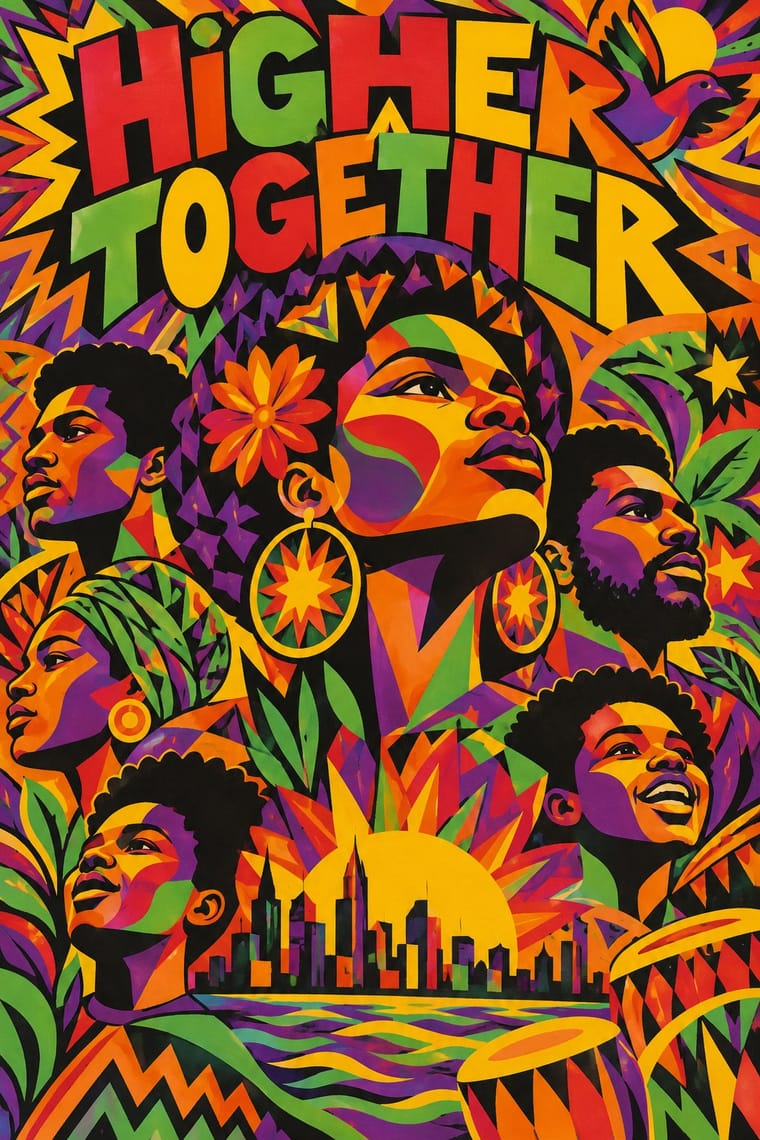
The Black Arts Movement collective founded in Chicago in 1968 by Jeff Donaldson, Wadsworth and Jae Jarrell, Barbara Jones-Hogu and Gerald Williams, after OBAC's Wall of Respect mural. Its principles call for free symmetry, 'mimesis at mid-point', visibility, 'shine' and 'Cool-ade' colour. Paintings and screenprints pack the surface with bright, high-keyed hues set edge to edge and stylised Black figures, with slogans such as UNITE or Black is Beautiful drawn into faces, hair and ground. Editions (100 of Unite, 300 of Jarrell's Revolutionary) carried it to Black viewers without art training.
Make something in this styleGet advice in this styleMix it with another style
Use it with care
AfriCOBRA is a self-defined Black aesthetic made by Black artists for Black communities; the collective still exists, its members and estates hold the copyrights, and the raised fist, the ankh, Yoruba orisha imagery and slogans like Nation Time carry political and spiritual meaning. Do not strip the Kool-Aid palette and letter-filled portraits into generic 'retro Black Power' branding: credit the artists, and commission Black artists for work addressed to Black audiences.
01
How it works
- Paint in 'Cool-ade' colour: 'bright, vivid, singing' hues of orange, strawberry, cherry, lemon, lime and grape at full strength, as vivid as the lime-green, purple, strawberry and red outfits worn in Chicago's streets in the late 1960s, yet set 'with sensibility and harmony', never muted or tonal.
- Draw figures at 'mimesis at mid-point', halfway between likeness and abstraction: recognisable Black people built from flat, broken planes, never photographic and never wholly abstract.
- Write the message into the picture and keep it 'visible': hand-draw slogans and letters (UNITE, Resist, the letter B for Black, Bad and Beautiful) through faces, hair, clothes and ground with the clear, irregular line of a freely drawn circle, so text and figure share the same marks and the words stay legible however packed the field.
- Apply 'free symmetry': syncopated repetition that keeps changing colour, texture and shape, so rows of profiles, raised fists and letters fill the whole field in rhythm.
- Give skin, hair and dress 'shine' with bright highlights, the literal and figurative lustre of a well-groomed, well-dressed people.
- Make positive, direct images for Black viewers without art training, and screenprint them in editions so that everyone can own one.
South Side, Chicago: Wadsworth and Jae Jarrell's home and studio, where artists from the Organization of Black American Culture (OBAC) who had painted the Wall of Respect (1967, 43rd Street and Langley Avenue) began meeting in 1968; from 1970 Jeff Donaldson taught at Howard University in Washington DC, where Wadsworth Jarrell joined him in 1971 and Jae Jarrell studied
02
Its design choices
From Stylogeny’s vocabulary of design choices: defining choices make the style, characteristic ones are usual, occasional ones turn up now and then.
- Layout & composition
- Space & hierarchy
- Typography
- Colour
- Form & shape
- Tone & intent
- Avoids
- Naturalistic depiction, Straight photography, Pastel, Monochrome, Generous white space, Ornament-free, Ironic & self-aware
Palette
#e8202a#f7861c#ffd400#5fbf3a#6a2a8c#151311
Typefaces
Hand-drawn block capitals fractured into coloured shards behind the figures
Barbara Jones-Hogu, Unite
Letter-built portraits
hair, face and clothes made of words and the repeated capital B for Black, Bad and Beautiful (Wadsworth Jarrell, Revolutionary)
Hand-painted street slogans worked into the picture, such as 'Don't be jivin' and 'Unite'
Gerald Williams, Nation Time
Known for
Wall of Respect, OBAC mural at 43rd Street and Langley Avenue, Chicago (1967; destroyed 1971), the precursor, with contributions by Jeff Donaldson, Wadsworth Jarrell and Barbara Jones-Hogu
Jeff Donaldson, 'Ten in Search of a Nation' manifesto
1970; reprinted in Nka: Journal of Contemporary African Art 30, 2012
AFRICOBRA I
Ten in Search of a Nation, Studio Museum in Harlem (1970)
Barbara Jones-Hogu, Unite
1969, screenprinted 1971 by the artist in an edition of 100 published by AfriCOBRA; Whitney Museum, Cleveland Museum of Art, Brooklyn Museum, NMAAHC
Wadsworth Jarrell, Revolutionary (Angela Davis) (1971, acrylic and mixed media, Brooklyn Museum) and its 1972 screenprint in an edition of 300 (Princeton University Art Museum)
Gerald Williams, Nation Time
1969, acrylic on canvas
Jeff Donaldson, Wives of Shango
1969
Jae Jarrell, Revolutionary Suit
c. 1968–70; sources date it 1968, early 1969 or 1970
03
Make something in this style
Say what you need, and Stylogeny’s image studio draws it from AfriCOBRA’s design choices and checks it against them. It takes about a minute, and you get a link to share.
04
Where it comes from, and what it’s close to
Before it
The style it grew out of, and the styles it borrowed from.
Nothing earlier is recorded: in the atlas it is a starting point.

After it
The styles that grew out of it.
No later style in the atlas grew out of it yet.
Alike in its design choices
Styles that make many of the same choices, related or not, besides those above.


05
Sources
- Wikipedia: AfriCOBRA (https://en.wikipedia.org/wiki/AfriCOBRA)
- Tate, 'AfriCOBRA' art term (https://www.tate.org.uk/art/art-terms/a/africobra)
- Crystal Bridges Museum of American Art, 'Soul of a Nation: AfriCOBRA' (2018), quoting Barbara Jones-Hogu's statement of the principles (https://old.crystalbridges.org/blog/soul-of-a-nation-africobra/)
- Smithsonian American Art Museum, Barbara Jones-Hogu, Unite (1971), Oh Freedom! (https://americanart.si.edu/node/57676)
- Cleveland Museum of Art, Barbara Jones-Hogu, Unite, 2021.14 (https://www.clevelandart.org/art/2021.14)
- Whitney Museum of American Art, Barbara Jones-Hogu, Unite, 2026.12 (https://whitney.org/collection/works/70153)
- Princeton University Art Museum, Wadsworth Jarrell, Revolutionary (1972), 2017-200 (https://artmuseum.princeton.edu/collections/objects/131635)
- Encyclopedia of Arkansas, 'Jeffrey Richardson (Jeff) Donaldson (1932–2004)' (https://encyclopediaofarkansas.net/entries/jeffrey-richardson-7484/)
- Jeff Donaldson, 'AfriCOBRA Manifesto? "Ten in Search of a Nation"', Nka: Journal of Contemporary African Art 30 (2012): 76–83
- Wadsworth A. Jarrell, AFRICOBRA: Experimental Art toward a School of Thought (Duke University Press, 2020)
- Hyperallergic, 'For Gerald Williams, a Co-Founder of AfriCOBRA, Transnational Black Aesthetics Are as Relevant as Ever' (2017)
- Antwaun Sargent, '"We Are More Than This"', Tate Etc. issue 40 (Summer 2017), on COBRA (Coalition of Black Revolutionary Artists) and Jones-Hogu's 1973 colour statement (https://www.tate.org.uk/tate-etc/issue-40-summer-2017/soul-nation-art-black-power-we-are-more-antwaun-sargent)
- Rebecca Zorach, 'Wadsworth and Jae Jarrell' (interview), Never The Same (https://never-the-same.org/interviews/wadsworth-and-jae-jarrell/)
- Wikipedia: Jae Jarrell (https://en.wikipedia.org/wiki/Jae_Jarrell) and Wadsworth Jarrell (https://en.wikipedia.org/wiki/Wadsworth_Jarrell), on COBRA, Howard University and the Revolutionary Suit
- Brooklyn Museum, Wadsworth Jarrell, Revolutionary (Angela Davis), 1971, 2012.80.18, with the note dating Jae Jarrell's suit to early 1969 (https://www.brooklynmuseum.org/objects/210696)
- PBS NewsHour/GBH CANVAS, 'Napoleon Jones-Henderson's new exhibit shows his unflagging spirit and artistic prowess' (15 July 2022), on the Kool-Aid colour outfits (https://www.pbs.org/newshour/show/napoleon-jones-hendersons-new-exhibit-shows-his-unflagging-spirit-and-artistic-prowess)
- Jasmine Weber, 'Fifty Years of AfriCOBRA's Radical, "Cool-Ade Colored" Art', Hyperallergic (15 August 2018), quoting Jones-Hogu's 'singing cool-ade colors' (https://hyperallergic.com/455841/africobra-now-kravets-wehby-gallery/)
How Stylogeny researches and checks a style: where the facts come from.