Style combination · Pairs well
Iranian Modernist Graphic Design × Persian Popular Narrative
Farshid Mesghali collaged coloured clippings of Qajar lithograph illustrations for a poster for the Tehran International Festival of Films for Children and Young Adults (dated November 1967 by Marzolph); crop and enlarge a hatched lithograph figure inside a modernist, white-ground layout.
Mix them and make something Iranian Modernist Graphic Design Persian Popular Narrative
01
What each style brings
Each part of the design comes from the style with the stronger say in it, and each style gives at least two.
Iranian Modernist Graphic Design Persian Popular Narrative (Lithographs & Coffeehouse Painting)
- Type from Iranian Modernist Graphic Design
- Colour from Iranian Modernist Graphic Design
- Form from Persian Popular Narrative
- Composition from Persian Popular Narrative
- Surface from Persian Popular Narrative
02
The type
Open fonts standing in for each style’s own type, which is often hand-drawn or commercial.
Text · Persian Popular Narrative
Iran's popular picture-stories in two media. From 1843, lithographed books printed handwritten Nastaʿlīq verse and pen drawings in one process: framed scenes in ruled text columns, hatched and dotted. Mirza Ali-Qoli Khoi, the most prolific illustrator, drew over 2,000 scenes for epics, romances and Karbala martyrologies in 1846–55. From the 20th century Hossein Qollar-Aqasi, Mohammad Modabber and pupils, heirs to storytellers' screens (pardeh) and taʿziyeh, painted epic and Karbala cycles on canvases for coffeehouses where storytellers performed, each figure named, into the 2010s.
Archivo; Persian Popular Narrative used Nastaʿlīq written by the lithographic scribes (kātebs), for verse and prose and Naskh, used for the Qur'an and some lithographed texts
03
The colours
The ground and leading colours come from Iranian Modernist Graphic Design, with a counter-accent from Persian Popular Narrative. The ink reads on the ground at 4.5:1 or more.
Iranian Modernist Graphic Design Persian Popular Narrative (Lithographs & Coffeehouse Painting)
-
#efe6d2ground · 36% -
#1a1a1aink · 14% -
#c49a3aaccent · 18% -
#b0322aaccent · 14% -
#1d6f8aaccent · 10% -
#2f7a4aaccent · 8%
As CSS
:root {
  --ground: #efe6d2;
  --ink: #1a1a1a;
  --accent-1: #c49a3a;
  --accent-2: #b0322a;
  --accent-3: #1d6f8a;
  --accent-4: #2f7a4a;
  --font-display: "Rakkas", cursive;
  --font-text: "Archivo", sans-serif;
}
Use it with care
Persian Popular Narrative (Lithographs & Coffeehouse Painting): Many of these images depict Imam Husayn, his family and the martyrs of Karbala, whose mourning is at the heart of Shiʿa devotion, and coffeehouse paintings of Karbala still hang in tekyehs and are shown during Muharram; some lithographs also depict the Prophet Muhammad, which many Muslims consider forbidden. The lithographers often veiled the faces of the Prophet, ʿAli and Husayn or ringed a holy face with a halo, so keep that convention and never supply a face for the Prophet, ʿAli or Husayn. Do not use these figures as decoration, parody or throwaway packaging, and have any Persian or Arabic text, including names of God, the Prophet and the Imams, read by a fluent reader. Coffeehouse paintings are the work of named painters and their pupils, so credit them, and commission Iranian painters and calligraphers rather than tracing their work.
04
The two styles
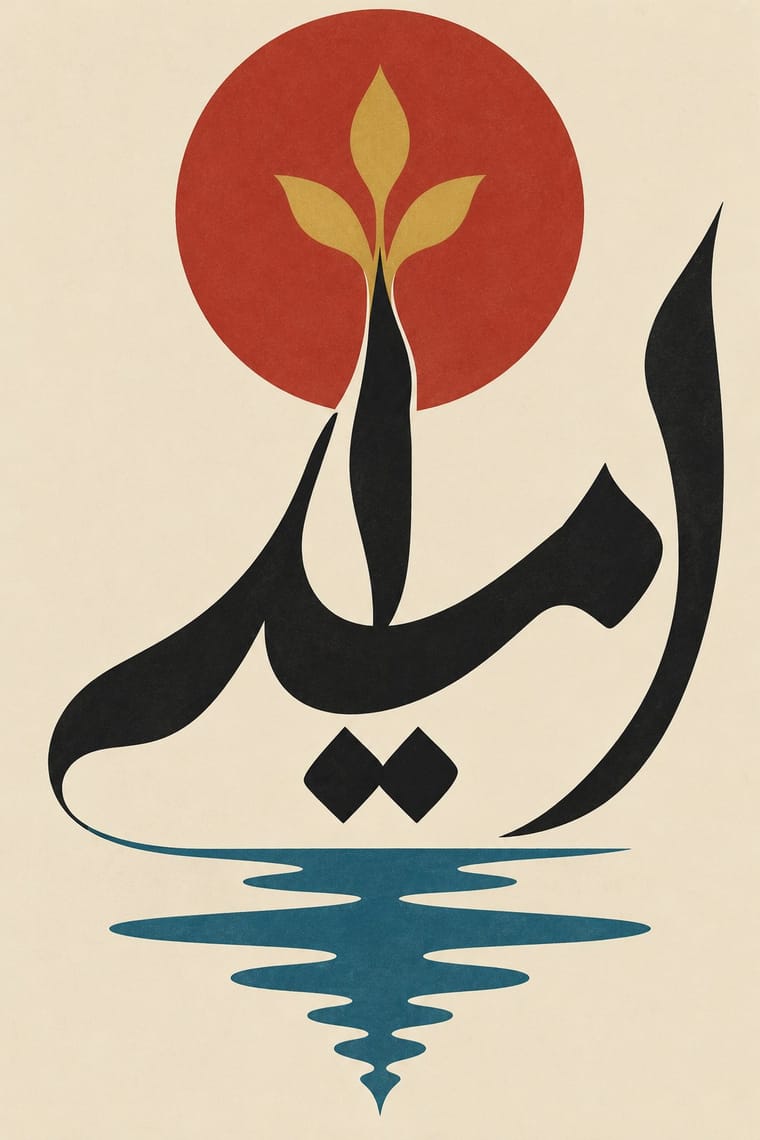
05
More combinations
With Iranian Modernist Graphic Design
- Polish Poster School Pairs well · Combine the Polish school's painted metaphor with Persian lettering for a conceptual cultural poster.
- International Typographic Style Contrasts · Iranian designers deliberately sidestepped the Swiss grid; set neutral Latin type against expressive Persian letters to dramatise system versus script.
- Cairo–Beirut Arab Modernist Book & Periodical Design Pairs well · Tehran's Kanoon and Beirut's Dar al-Fata al-Arabi were parallel 1970s children's-publishing cultures; combine Persian calligraphic covers with Arab picture-book drawing for a regional series.
- Islamic Geometric & Calligraphic Tradition Pairs well · Use girih geometry as the hidden construction grid for stretched and interlocked calligraphic letters.
- Square Kufic (Bannāʾī) Pairs well · Persian Wikipedia records bannāʾī in modern posters, logos and letterheads, and the atlas's Iranian modernist entry counts it among its Persian scripts; pair a square-Kufic title block with a Nastaʿlīq line and one flat figure for a Persian cultural poster.
- Greek Tourism Modernism (EOT) Contrasts · Both are 1960s national modernisms that turned heritage into modern posters: Tehran built it from calligraphic letterforms, EOT from photographed antiquities under a single word of sans; compare them to choose between letter-led and object-led heritage modernism.
- Turkish Modernist Poster & Graphic Design Contrasts · Its Iranian contemporary also learned from the Polish poster, but built its posters on Persian calligraphy and miniature; after the 1928 alphabet reform Turkish designers worked in Latin letters and quoted Kufic only as a reduced sign. Choose Tehran when the letterform should be the protagonist, Istanbul when a drawn figure should be.
- Persian Miniature (Ilkhanid, Timurid and Safavid Book Painting) Pairs well · Iranian modernists drew on miniature imagery; take one stylised figure, a cloud band or a gold rule from the miniature and set it in the open, single-focus space of a modern poster rather than copying a whole crowded page.
With Persian Popular Narrative
- Mexican Popular Graphics (Posada) Contrasts · Both are cheap popular print of heroes, saints and devils, but Posada's broadsheets set metal type beside relief cuts, while the Persian page is one handwritten lithograph in which calligraphy and drawing share the same pen.
- Urdu Katib Lithography Pairs well · The same lithographed Nastaʿlīq page culture across Iran and India: Khoi's Tehran Shahnameh followed the pictures of the Persian-language Bombay edition of 1846, written by Reza al-Hoseini al-Shirazi. Add hatched, framed scenes to a katib's dense columns for an illustrated Persian or Urdu text page.
- Kalighat Pat & Battala Bazaar Prints Contrasts · Kalighat pats isolate one bold brushed figure on bare paper; the Persian lithograph crowds a whole hatched scene into a frame inside verse columns. Choose between the open single figure and the packed narrative page.
- Persian Miniature (Ilkhanid, Timurid and Safavid Book Painting) Pairs well · Its popular heir: the same epics in ruled columns of Nastaʿlīq, but drawn in hatched black ink for lithography; pair a court-style coloured frame with a lithographic line drawing to move between luxury and street register.