Style combination · Pairs well
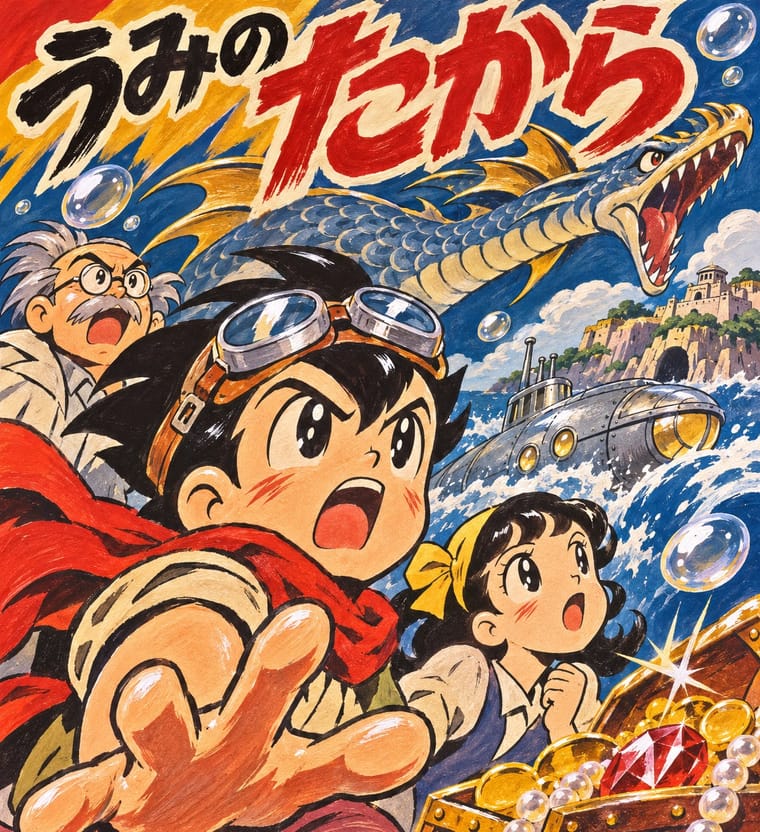
Gaito Kamishibai × Story Manga
Its print descendant: swap one painted card for many inked panels per page to move from performance to reading.
01
What each style brings
Each part of the design comes from the style with the stronger say in it, and each style gives at least two.
Gaito Kamishibai (Japanese Paper-Theatre Cards) Story Manga (Postwar Japanese Comics)
- Type from Story Manga
- Colour from Gaito Kamishibai
- Form from Story Manga
- Composition from Gaito Kamishibai
- Surface from Gaito Kamishibai
02
The type
Open fonts standing in for each style’s own type, which is often hand-drawn or commercial.
Display · Story Manga
Hello
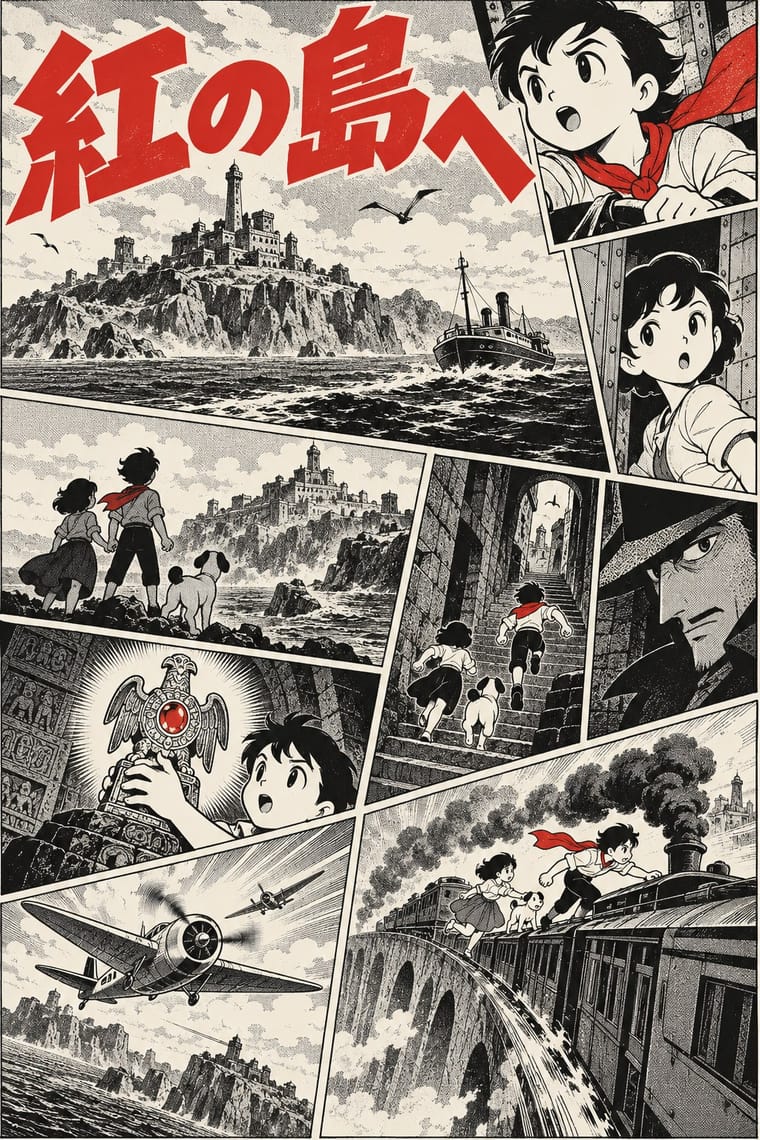
Mochiy Pop One, standing in for Anchi-goshi balloon setting (gothic kanji with bold antique kana, アンチゴチ: the antique kana is a bold face of the 1890s from the kagomoji of Edo temple plaques, not a Mincho; the default for children’s manga by about 1960 and across commercial manga with desktop publishing)
Text · Gaito Kamishibai
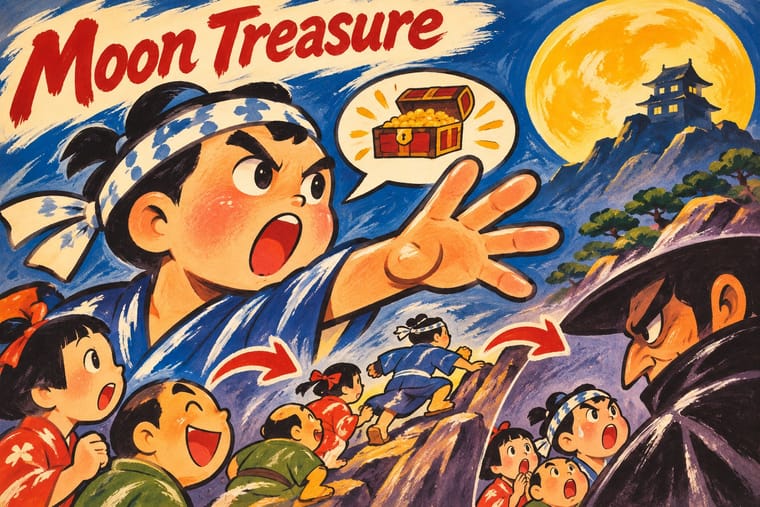
Street storytelling from a stack of large hand-painted cards, shown in a small wooden stage frame while the narrator reads the script and pulls each card away. Each card is one unique brush-and-colour scene with dramatic framing and a cliffhanger, made for children in 1930s-50s Japan before television. Its wartime use by the state for propaganda is documented history, noted here as context and not as an endorsement.
Zen Maru Gothic; Gaito Kamishibai used Hand-brushed title lettering on set covers and Handwritten narrator scripts on card backs
03
The colours
The ground and leading colours come from Gaito Kamishibai, with a counter-accent from Story Manga. The ink reads on the ground at 4.5:1 or more.
Gaito Kamishibai (Japanese Paper-Theatre Cards) Story Manga (Postwar Japanese Comics)
-
#f1e3c0ground · 36% -
#1c1a1aink · 14% -
#e0a82eaccent · 18% -
#d32f2faccent · 14% -
#8c8c8caccent · 10% -
#2f5d8aaccent · 8%
As CSS
:root {
  --ground: #f1e3c0;
  --ink: #1c1a1a;
  --accent-1: #e0a82e;
  --accent-2: #d32f2f;
  --accent-3: #8c8c8c;
  --accent-4: #2f5d8a;
  --font-display: "Mochiy Pop One", sans-serif;
  --font-text: "Zen Maru Gothic", sans-serif;
}
Use it with care
Story Manga (Postwar Japanese Comics): Manga characters and series, from Astro Boy to Dragon Ball and One Piece, are in copyright and belong to their creators and publishers, and manga is the living work of professional artists and assistants: draw original characters in the shared idiom, never ask an image model for a named series, character or artist's hand, and label generated pages as AI-made rather than presenting them as a manga artist's work. Some of Tezuka's own books drew foreigners, including Black Africans and Asians, in exaggerated caricature; after protests from September 1990 by the Osaka-based Association to Stop Racism Against Blacks, Tezuka Productions put a disclaimer slip into his books. Give every character the same drawing care, and never use skin, lips or dress as ethnic shorthand.
04
The two styles
05
More combinations
With Gaito Kamishibai
With Story Manga
- Korean Webtoon Graphics Contrasts · The Korean webtoon turned manhwa, Korean comics shaped in part by Japanese manga, into a single full-colour scroll column with long empty gutters, first on PC portals and then on phones; return to story manga for a printed spread of black-and-white panels read right to left, with screentone and panels that bleed and break.
- American Four-Colour Comic Book (Golden to Bronze Age) Contrasts · Both are mass-market pen-and-ink comics with balloons and sound effects; the American comic book reads left to right in four-colour dot tints with hand-lettered capitals in a steadier grid, while story manga stays black and white, reads right to left, greys with screentone and sets its dialogue vertically.
- Lianhuanhua Picture-Story Books Contrasts · Both are cheap, widely rented East Asian picture-story books; lianhuanhua gives each palm-sized page one framed drawing with a caption beneath and no balloons, while story manga packs a page with panels of changing size, balloons, speed lines and drawn sound effects.
- Superflat Contrasts · Murakami's Superflat lifts anime and manga figures out of the story onto one flat, glossy, polychrome plane for the gallery; story manga keeps the sequence, the depth of its backgrounds and its single black ink.
- Taishō Roman & Lyrical Illustration Pairs well · Jojōga's large, highlighted, long-lashed eyes passed from Nakahara Jun'ichi to Takahashi Macoto, who added stars and dots to the iris, and so into shōjo manga; add Taishō lyrical faces, kimono patterns and soft lines to a manga page for a period romance.
- Ligne Claire (Franco-Belgian Clear Line) Contrasts · Ligne claire closes every form with one even contour and flat colour, with no hatching or tone; story manga varies its line weight and builds grey and mood from screentone, solid blacks, speed lines and focus lines.
- Kawaii Design Pairs well · Kawaii takes manga's round faces and symbols but not its page; borrow its pastel mascots and rounded type for a comedy chapter, a character goods tie-in or a super-deformed aside, and keep the panels and screentone.
- Shōjo Manga (Japanese Girls' Comics) Pairs well · Girls' manga grew out of story manga from Tezuka's Princess Knight on and took its flowers, screentone moods and floating monologues furthest; borrow those when a story-manga page needs interior feeling rather than action.