Style combination · Contrasts
Argentine Adventure Historieta × Mexican Historieta
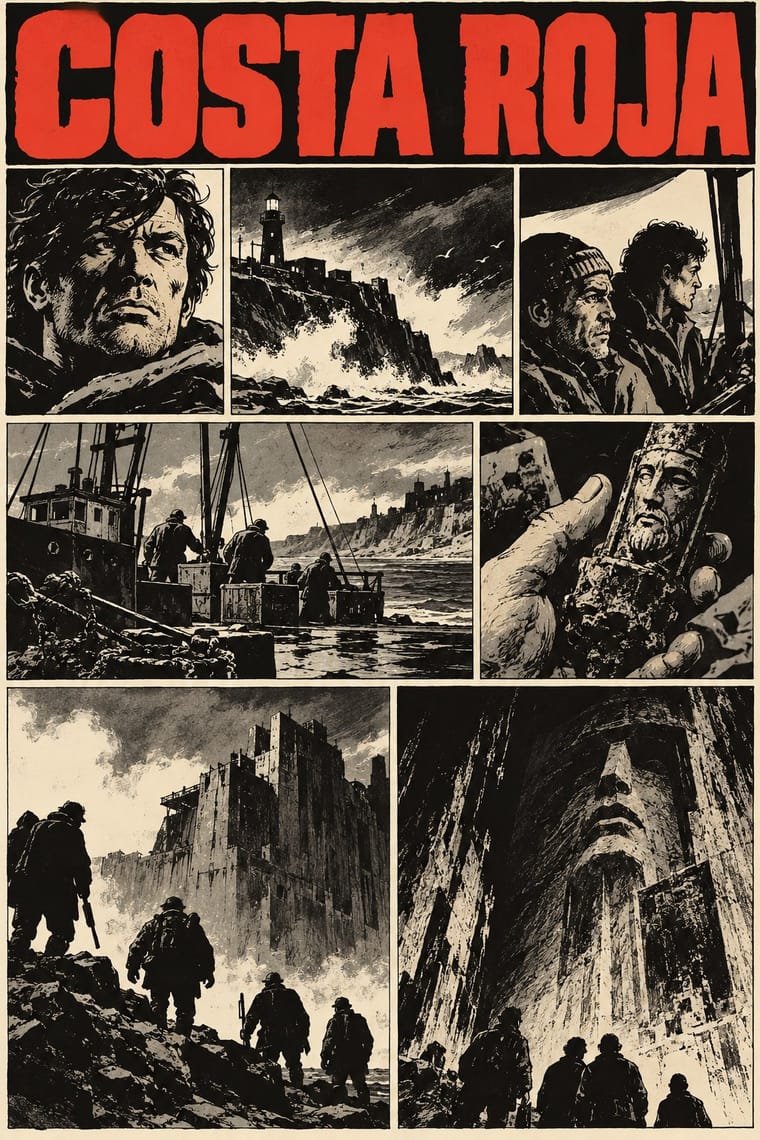
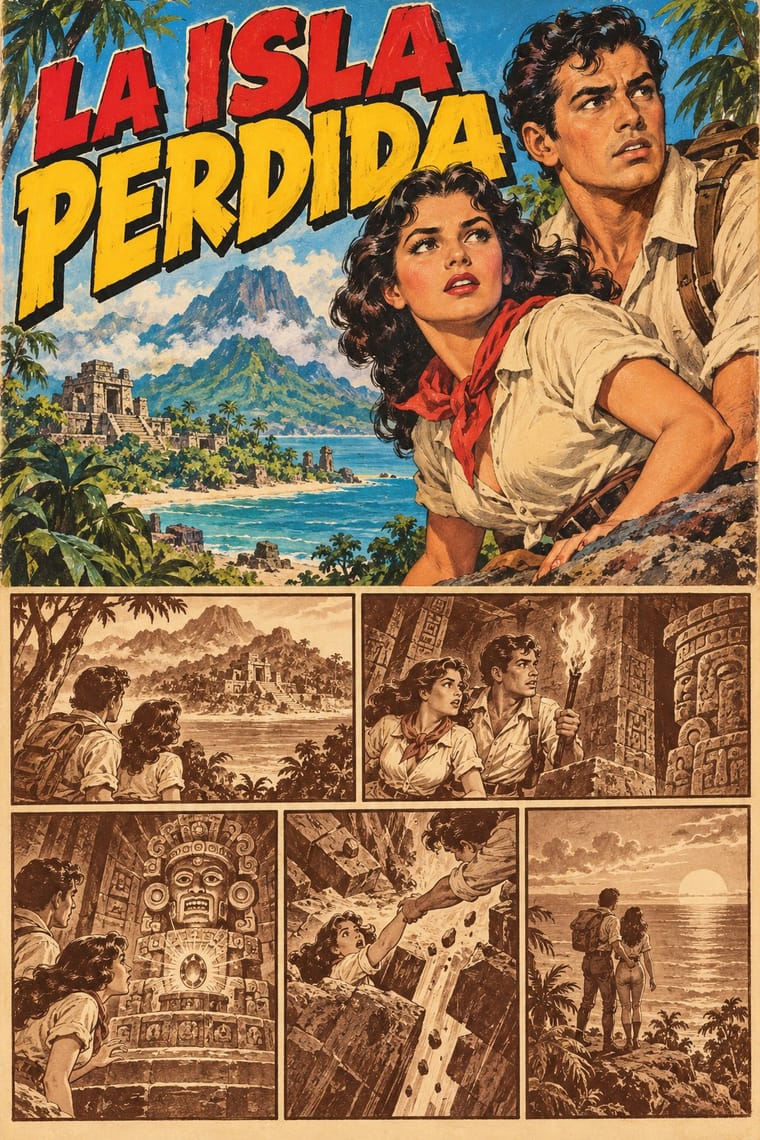
Both are Latin American newsstand comics of the mid-century with colour kept for the cover; the Argentine adventure historieta builds its pages from solid black brush ink and side light around an auteur's hand, while the Mexican historieta models its figures in tonal wash, prints them in one brown or green ink and tells anonymous, industrial melodrama.
Mix them and make something Argentine Adventure Historieta Mexican Historieta
01
What each style brings
Each part of the design comes from the style with the stronger say in it, and each style gives at least two.
Argentine Adventure Historieta (Oesterheld–Breccia) Mexican Historieta (Pepines to Sensacionales)
- Type from Argentine Adventure Historieta
- Colour from Mexican Historieta
- Form from Argentine Adventure Historieta
- Composition from Argentine Adventure Historieta
- Surface from Mexican Historieta
-
Argentine Adventure Historieta avoids halftone & ben-day dots: this is where the two pull against each other, which is the point of the contrast.
02
The type
Open fonts standing in for each style’s own type, which is often hand-drawn or commercial.
Display · Argentine Adventure Historieta
Fiesta
Londrina Solid, standing in for Tall, condensed hand-drawn title capitals in white on black (ETERNAUTA on the first page of the serial in Hora Cero Semanal no. 1, 4 September 1957, with a small lowercase 'el' and slightly irregular strokes)
Text · Mexican Historieta
The mass newsstand comics of Mexico, read by adults as much as children, whose format shrank from the large pepines of the 1930s to pocket digests. It has two phases: from the 1930s to the 1970s, melodrama, romance and adventure serials such as Memín Pinguín, Lágrimas, Risas y Amor and Kalimán, drawn in tonal wash and printed in one sepia, brown or green ink on cheap paper; from the late 1970s, small full-colour pocket westerns and erotic 'Sensacionales' of caricatured barrio types. Both sold every issue with hand-lettered balloons and a lurid painted colour cover.
Comic Neue; Mexican Historieta used Hand-lettered balloon and caption text written by a letterer on each page and Bulging, outlined masthead capitals with exclamation marks, drawn as part of the cover
03
The colours
The ground and leading colours come from Mexican Historieta, with a counter-accent from Argentine Adventure Historieta. The ink reads on the ground at 4.5:1 or more.
Argentine Adventure Historieta (Oesterheld–Breccia) Mexican Historieta (Pepines to Sensacionales)
-
#ebdfc3ground · 36% -
#5b3a24ink · 14% -
#f2c12eaccent · 18% -
#e8312caccent · 14% -
#e2622caccent · 10% -
#2a9fd2accent · 8%
As CSS
:root {
  --ground: #ebdfc3;
  --ink: #5b3a24;
  --accent-1: #f2c12e;
  --accent-2: #e8312c;
  --accent-3: #e2622c;
  --accent-4: #2a9fd2;
  --font-display: "Londrina Solid", cursive;
  --font-text: "Comic Neue", cursive;
}
Use it with care
Argentine Adventure Historieta (Oesterheld–Breccia): El Eternauta, Mort Cinder, Perramus and the other serials remain in copyright with their authors' heirs and publishers: draw your own characters, titles and mastheads in the shared idiom, never ask an image model for these characters or for a named artist's hand (Breccia, Solano López, Pratt), and never present a generated page as a vintage historieta. Oesterheld was abducted by the dictatorship's forces on 27 April 1977 and remains disappeared; his four daughters were abducted or killed in 1976–1977, and three of their bodies were never found. El Eternauta is bound up with that memory, and its hero's figure has been redrawn for party campaigns (the 'Nestornauta' of 2010): do not use the figure as a mascot, an advertising gimmick or a casual political prop.
Mexican Historieta (Pepines to Sensacionales): Memín Pinguín is drawn in the 'darky' iconography of blackface, and his mother as a 'mammy' caricature; his 2005 Mexican stamps were criticised by the White House press secretary ('racial stereotypes are offensive no matter what their origin'), Jesse Jackson and the Hispanic civil-rights groups LULAC and NCLR, so do not copy his features or use racial caricature of any kind, and give every character the same anatomy and drawing care. Kalimán is an Orientalist figure, a turbaned 'prince of India' and mystic: do not take him as a model for exoticised 'Oriental' types. The Sensacionales and the Libro Vaquero covers sell women's bodies to male readers and are often called machista: draw adults with dignity and consent and leave out the stock 'easy woman'. Memín, Kalimán, La Familia Burrón, Lágrimas, Risas y Amor and El Libro Vaquero are still owned by their publishers and heirs: draw your own characters and mastheads, never ask an image model for these characters or a named artist's hand, and never present a generated page or cover as a vintage historieta.
04
The two styles
05
More combinations
With Argentine Adventure Historieta
- Story Manga (Postwar Japanese Comics) Contrasts · Both are black-and-white serials of the late 1940s and 1950s; manga gets its greys from dot screentone and its motion from speed lines, while the historieta gets its tone from solid brush black, at most a flat grey tint, scraped white and monotype texture, and slows down for long captions.
- Expressionist Woodcut Graphics Pairs well · Breccia's white scraped out of a black ground looks like the gouge of a Brücke woodcut; borrow the woodcut's jagged hand-cut capitals for a historieta title page or cover, and keep the comic's panels and captions inside.
- Filipino Komiks Contrasts · Both are black-and-white anthology magazines of long serials with colour kept for the cover; komiks model romantic, naturalistic figures in hatched and feathered brush on a light page, while the historieta builds its pages from black masses, hard light and, in its darkest work, distorted faces.
- Bonelli Fumetto (Italian Popular Adventure Comics) Contrasts · Both are black-and-white newsstand adventure serials born in 1948 and drawn in pen and brush ink; Bonelli keeps a fixed cage of three strips of one or two panels on a small upright page and an even naturalistic line, while the historieta's 1950s weeklies run three tiers of two to six panels each across an oblong page, sink them in solid black, light faces from one side and, with Breccia, let the drawing break into expressionist texture.
- Fileteado Porteño Contrasts · Two Buenos Aires vernaculars that both work on dark grounds: fileteado frames a lettered name with polychrome, highlighted acanthus and ribbons, while the historieta rejects ornament and lets bare black ink and side light carry a story.
- American Four-Colour Comic Book (Golden to Bronze Age) Contrasts · Pratt's early work leaned on Milton Caniff, and Spanish Wikipedia notes that expressionism was already present in Krazy Kat, The Spirit and Dick Tracy; the American comic book is the atlas's nearest entry for those newspaper-strip models. Choose the American comic book for four-colour dot tints and superheroes, the historieta for uncoloured black-ink pages, ordinary people and a collective hero.
With Mexican Historieta
- Escuela Bruguera (Spanish Humour Comics) Contrasts · Two Spanish-language humour lines of the same decades: Bruguera's tebeos are flat-coloured slapstick for children, while the Sensacionales caricature adult barrio and market types in crowded, fully painted scenes with sex and double meanings.
- American Four-Colour Comic Book (Golden to Bronze Age) Contrasts · Paquín and Pepín began with American syndicated strips and Novaro brought in the American comic-book format in 1949, but the Mexican historieta keeps one sepia or green ink and tonal wash where the American book has four flat colours over Ben-Day dots, and melodrama where it has superheroes.
- Mexican Calendar Chromo (Cromos calendáricos) Pairs well · Both are mid-century Mexican mass pictures painted for the street and the home; borrow the chromo's glowing painted pin-up and romantic scene for a historieta cover, and keep the outlined masthead and the boxed cover line.
- Fotoromanzo (Italian Photo-Romance) Contrasts · Both sold sentimental melodrama in sequential panels to a mass, largely female and working-class readership; the fotoromanzo photographs actors, while the historieta draws its lovers in wash, and José G. Cruz's photomontage melodramas and the first, photonovel issues of Lágrimas, Risas y Amor sit between the two.
- Filipino Komiks Contrasts · The nearest cousin: another mass anthology of romantic serials with painted covers. Komiks model their figures in hatched and feathered black brush line; choose the Mexican historieta for tonal wash in sepia ink and for the pocket digest with its crowded painted cover.