Pictorial & machine age · 1948–1996 · Latin America & Caribbean
Argentine Adventure Historieta (Oesterheld–Breccia)
Also known as Historieta de aventuras argentina, Argentine adventure comics, Hora Cero and Misterix comics
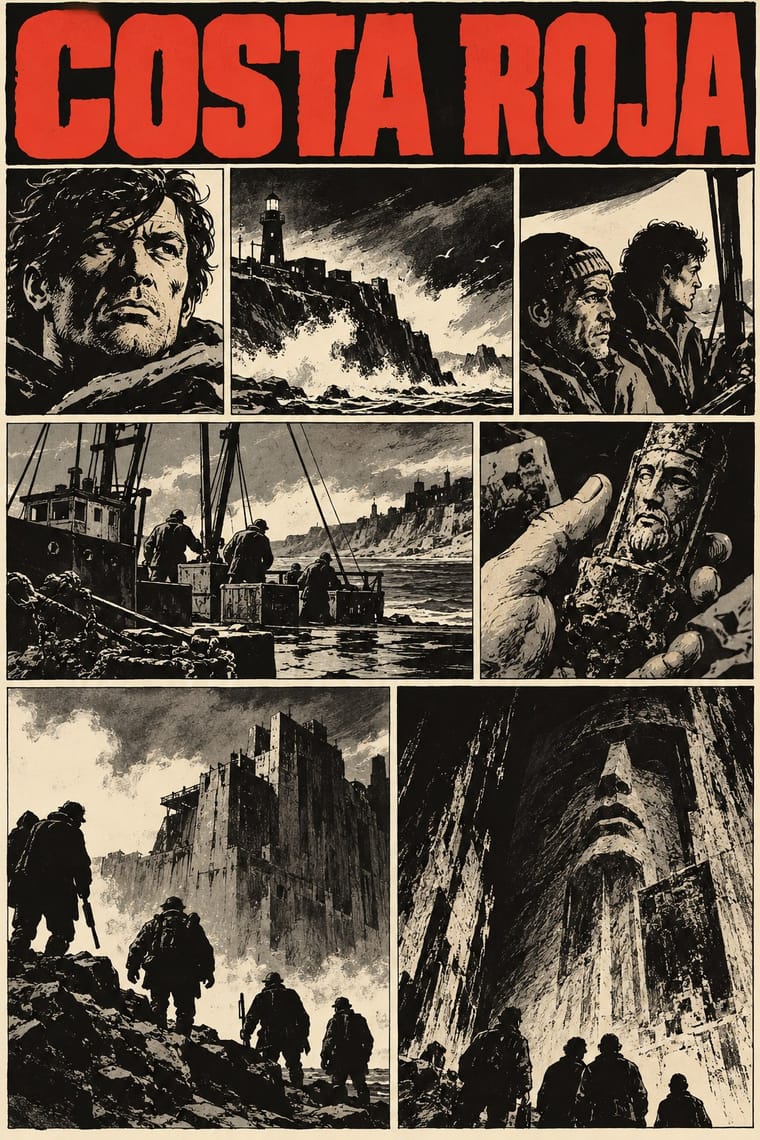
The adult adventure comics of Buenos Aires newsstand magazines, from Misterix (1948) and Oesterheld's Hora Cero (1957) to Skorpio and Fierro; the humour line of Patoruzú, Rico Tipo and Mafalda is another tradition. Novel-like serials with complex characters and a collective hero, such as El Eternauta, were drawn in black brush ink, in the 1950s in tiers of panels on oblong pages: solid blacks, hard side light and, in Alberto Breccia's hands, distorted faces and textures scraped, printed and pasted into the black. Colour was kept for covers.
Make something in this styleGet advice in this styleMix it with another style
Use it with care
El Eternauta, Mort Cinder, Perramus and the other serials remain in copyright with their authors' heirs and publishers: draw your own characters, titles and mastheads in the shared idiom, never ask an image model for these characters or for a named artist's hand (Breccia, Solano López, Pratt), and never present a generated page as a vintage historieta. Oesterheld was abducted by the dictatorship's forces on 27 April 1977 and remains disappeared; his four daughters were abducted or killed in 1976–1977, and three of their bodies were never found. El Eternauta is bound up with that memory, and its hero's figure has been redrawn for party campaigns (the 'Nestornauta' of 2010): do not use the figure as a mascot, an advertising gimmick or a casual political prop.
01
How it works
- Draw the story pages in black ink, with at most one flat grey tint that shows no dots, and let solid black do the work of colour: set faces and rooms against black grounds, cut them with hard light from one side, and make night, snow and shadow the weather of the page, as Breccia's claroscuro does in Mort Cinder. El Eternauta's first instalment in Hora Cero is pure black and white; Pratt's Ernie Pike in the same issue adds a flat grey.
- Ink with a brush and an economy of line, putting down only the lines and patches of black that build the panel, as Ignacio Fontes said of Pratt; hatch a face with the pen where the light falls and leave the rest to the black mass.
- Let the drawing turn expressionist as the story darkens: weathered, distorted faces, fragmentary backgrounds and, in Breccia's manner, white scraped out of a prepared black ground with razor blades, monotype prints, finger and hand prints and, later, collage.
- Write the serial like a novel and run it for months in weekly or monthly instalments, three pages a week in El Eternauta's case: give each character complex motives, make the villain a human being as well, and put a group of ordinary people at the centre in places the readers know, as El Eternauta does with Juan Salvo, the physics teacher Favalli and the lathe worker Franco in Vicente López, or Ernie Pike with unknown soldiers rather than battles.
- Hand-letter captions and balloons in capitals, set a caption straight into the white of the panel or in a ruled box, open its first sentence with an enlarged initial and pick out names in bold capitals. Open a serial's first page with a title panel in the top left: a hand-drawn logo (El Eternauta's tall condensed capitals on a black starfield, the slanted brush lettering of Ernie Pike and Randall), a boxed episode title or lettered straplines, and the credits for script (Guión) and drawings (Dibujos).
- In the weeklies of the 1950s, print on an oblong page, three tiers to the landscape page, each of two to six ruled panels of varying width, as Hora Cero Suplemento Semanal (27 × 20 cm) does, and keep colour for the outside: heavy masthead capitals and flat inks on the cover, such as Hora Cero's white title reversed out of a black block on orange, or Misterix's yellow, black-outlined capitals on a red block with the episode starting in panels beside and under the masthead, as on Misterix no. 345.
Buenos Aires. Editorial Abril launched Misterix as a magazine of its own in 1948, at first with Italian material and then with Argentine authors, and with Surameris brought Hugo Pratt (in Buenos Aires from 1949) and other Italian artists over. Héctor Germán Oesterheld wrote Bull Rockett (1952) and Sargento Kirk, with Pratt, for it, then with his brother Jorge founded Editorial Frontera, whose Frontera and Hora Cero appeared in 1957; the weekly Hora Cero Suplemento Semanal ran from 4 September 1957 to 18 November 1959 (116 issues). Alberto Breccia's Mort Cinder ran in Misterix (1962–1964); Ediciones Récord's Skorpio (1974–January 1996) and Ediciones de la Urraca's Fierro (September 1984–December 1992, 100 issues) carried the line on.
02
Its design choices
From Stylogeny’s vocabulary of design choices: defining choices make the style, characteristic ones are usual, occasional ones turn up now and then.
- Layout & composition
- Space & hierarchy
- Colour
- Surface & texture
- Ornament
- Medium & production
- Tone & intent
- Avoids
- Flat, Gloss & highlights, Halftone & Ben-Day dots, Pastel, Fluorescent & neon, Generous white space, Abundant decoration, Playful & witty, Calm & contemplative
Palette
#efe8d6#131211#8f8b84#e8312c#e2622c#e6d63a
Typefaces
Tall, condensed hand-drawn title capitals in white on black
ETERNAUTA on the first page of the serial in Hora Cero Semanal no. 1, 4 September 1957, with a small lowercase 'el' and slightly irregular strokes
Slanted brush-lettered serial logos with a boxed episode title in bold capitals
Ernie Pike over 'DESENCUENTRO' and the script 'Randall' over '"THE KILLER"' and 'MUERTE Y VENGANZA' in Hora Cero Semanal no. 1
Bold condensed sans capitals for straplines on white bands (UNA CITA CON EL FUTURO, MEMORIAS DE UN NAVEGANTE DEL PORVENIR) and credit lines with bold italic labels ('Guión: OESTERHELD', 'Dibujos: SOLANO LOPEZ') on the same page
Lettered capitals in captions and balloons, a caption's first sentence opening with an enlarged initial and names in bold capitals
EL ALAMEIN, TOBRUK in Ernie Pike, Hora Cero Semanal no. 1; the opening of Sargento Kirk's 'Tierra enemiga' on the cover of Misterix no. 345
Heavy magazine masthead capitals
Misterix's yellow, black-outlined MISTERIX on a red block over the line 'Gran semanario de aventuras'; Hora Cero's heavy sans title reversed in white out of a black block on an orange cover
Known for
El Eternauta (Héctor Germán Oesterheld, script; Francisco Solano López, drawings)
Hora Cero Suplemento Semanal from no. 1, 4 September 1957, to no. 106, 1959, three pages a week: its first page, in pure black and white on an oblong page of three tiers, sets a hand-drawn ETERNAUTA in tall, slightly irregular white condensed capitals, with a small lowercase 'el', on a black starfield between white bands lettered UNA CITA CON EL FUTURO and MEMORIAS DE UN NAVEGANTE DEL PORVENIR, over the credits 'Guión: OESTERHELD' and 'Dibujos: SOLANO LOPEZ' (es.wikipedia File:El Eternauta - logo.jpg; AHIRA scan of Hora Cero Semanal no. 1, pp. 7–9)
Mort Cinder (Oesterheld and Alberto Breccia), Misterix, 1962–1964
a panel of the London antiquarian Ezra Winston, his face hatched in pen and lit from one side against a solid black ground (en.wikipedia File:Mort Cinder.jpg); Spanish Wikipedia describes Breccia's 'consistente y minucioso dibujo en claroscuro', and Ron Tiner his razor-blade white carved out of a prepared black surface, with monotype in some frames
Sargento Kirk (Oesterheld and Hugo Pratt), Misterix, from 1952–1953
the oblong cover of Misterix no. 345, 'Gran semanario de aventuras', sets the yellow, black-outlined MISTERIX capitals on a red block above a boxed title, 'El Sargento Kirk en Tierra enemiga', credited to H. Pratt and Oesterheld, and starts the episode in flat-colour panels beside and below it, with lettered capitals in pale yellow and pink caption boxes (en.wikipedia File:Pratt-Misterix345-kirk.jpg)
Ernie Pike (Oesterheld and Pratt), Hora Cero, 1957–1959
a war correspondent modelled on Ernie Pyle who tells the stories of mostly unknown soldiers; the episode 'Desencuentro' in Hora Cero Semanal no. 1 (Guión: OESTERHELD, Dibujos: H. PRATT) opens under a slanted brush-lettered logo, with a dead tank in the North African desert, heavy brush blacks and a flat grey tint, and Pratt's panel of Pike at his typewriter in a tent is built from a few heavy brush lines and patches of black (AHIRA scan, pp. 2–6; en.wikipedia File:Ernie Pike.jpg)
Sherlock Time (Oesterheld and Breccia), Hora Cero Extra, 1958–1959, Breccia's first major work, in increasingly moody and expressionist drawings
Vida del Che (Oesterheld with Alberto and Enrique Breccia, 1968), seized and destroyed by the military government's censors
El Eternauta 1969 (Oesterheld and Breccia), in the weekly Gente from 29 May 1969
a more openly political remake in an experimental style, cancelled and ended in a rush
El Eternauta II (Oesterheld and Solano López), Skorpio, from December 1975 (1976 in Spanish Wikipedia)
set in a distant post-apocalyptic future, its plot in line with the Montoneros' political agenda; Oesterheld wrote it from hiding ('desde la clandestinidad') under the dictatorship that took power in 1976, until his abduction
03
Make something in this style
Say what you need, and Stylogeny’s image studio draws it from Argentine Adventure Historieta (Oesterheld–Breccia)’s design choices and checks it against them. It takes about a minute, and you get a link to share.
04
Where it comes from, and what it’s close to
Before it
The style it grew out of, and the styles it borrowed from.


After it
The styles that grew out of it.
No later style in the atlas grew out of it yet.
Alike in its design choices
Styles that make many of the same choices, related or not, besides those above.


05
Sources
- Wikipedia (es): 'Historieta en Argentina' (https://es.wikipedia.org/wiki/Historieta_en_Argentina: Editorial Abril launched Misterix as its own magazine in 1948, first with Italian and then Argentine material; Editorial Frontera's Frontera and Hora Cero, monthly, 1957, and Hora Cero Suplemento Semanal from 4 September 1957; Sargento Kirk with Pratt (1953), Mort Cinder (1962–1964), Che (1968), the 1969 El Eternauta in Gente; the 'expresionismo' brought in by Breccia, Solano López, Pratt, Haupt and Trigo, which the article says was already present in Krazy Kat, The Spirit and Dick Tracy, adding that these traits alone were not a novelty ('Pero estos rasgos no componen un estilo, una novedad'); what was new was joining them to 'narraciones novelísticas' with 'motivaciones psicológicas complejas'; the separate humour line of Patoruzú (from 1928), Divito's Rico Tipo (1944), Hortensia (Córdoba, 1972) and Quino's Mafalda (1964–1973); Skorpio, Ediciones Récord, 1974 to January 1996, directed by Alfredo Scutti; Fierro, Ediciones de la Urraca, September 1984 to December 1992, 100 issues; Oesterheld abducted 27 April 1977. Its golden-age dates cite Oscar Masotta, La historieta en el mundo moderno, 1970)
- Wikipedia (en): 'El Eternauta' (https://en.wikipedia.org/wiki/El_Eternauta: Oesterheld and Solano López, Hora Cero from 4 September 1957 to 1959; the deadly snowfall on Buenos Aires and Vicente López; the 1969 reboot with Breccia in Gente from 29 May 1969, experimental, cancelled and rushed to an end; El Eternauta II in Skorpio from December 1975, its plot 'in line with the political agenda of Montoneros'; the 2010 'Nestornauta' advertisement) and Wikipedia (es): 'El Eternauta' (https://es.wikipedia.org/wiki/El_Eternauta: Favalli 'profesor de Física de gran erudición e ingenio', Franco 'un obrero tornero de gran valentía', Juan Salvo who becomes the Eternauta; no. 1, 4 September 1957, to no. 106, 'Tres páginas semanales'; El Eternauta II published in Skorpio in 1976 and set 'en un futuro lejano y posapocalíptico', written 'desde la clandestinidad' under 'la dictadura que tomó el poder en 1976'; Solano López's 'estética verista')
- Wikipedia (es): 'Héctor Germán Oesterheld' (https://es.wikipedia.org/wiki/H%C3%A9ctor_Germ%C3%A1n_Oesterheld: Bull Rockett in Misterix no. 176, 1952, drawn by Paul Campani; Sargento Kirk with Pratt; Editorial Frontera founded with his brother Jorge in 1955; Ernie Pike, 1957, about 'soldados generalmente desconocidos'; Ticonderoga; Sherlock Time; Vida del Che, 1968, seized and destroyed by the censors; abducted 27 April 1977 in La Plata) and Wikipedia (en): 'Héctor Germán Oesterheld' (https://en.wikipedia.org/wiki/H%C3%A9ctor_Germ%C3%A1n_Oesterheld: El Eternauta ran over 106 weekly episodes; Editorial Frontera's Hora Cero Semanal, Hora Cero Mensual and Frontera Mensual; Beatriz abducted 19 June 1976 and her body handed to her mother, Diana abducted 7 August 1976 and Marina 27 November 1976, their bodies never recovered, Estela killed in a shoot-out in Longchamps on 13 December 1977 and her body never found). The spelling 'Bull Rockett' is also the one printed in Hora Cero Semanal no. 1
- Wikipedia (es): 'Mort Cinder' (https://es.wikipedia.org/wiki/Mort_Cinder: Misterix no. 718, 17 August 1962, to no. 798, 28 February 1964; 'el consistente y minucioso dibujo en claroscuro que usa Breccia'; an evolution towards expressionism). Wikipedia (en): 'Alberto Breccia' (https://en.wikipedia.org/wiki/Alberto_Breccia) gives the start as 26 July 1962, no. 714, and Lambiek 17 August 1962; the draft gives only the years
- Wikipedia (es): 'Alberto Breccia' (https://es.wikipedia.org/wiki/Alberto_Breccia: Sherlock Time, 1958–1959, in Hora Cero Extra and Hora Cero Semanal; Mort Cinder in Misterix; Los mitos de Cthulhu, 1973, more expressionist; Perramus, 1983, in Fierro, Amnesty prize 1989; Enrique Lipszyc on his brush line, 'juega con el colorido y la textura de la línea'; José Muñoz as his pupil) and Wikipedia (en): 'Alberto Breccia' (collage, acrylic and watercolour in Chi ha paura delle fiabe?, 1979–1981; Perramus a pamphlet against the dictatorship)
- Lambiek Comiclopedia, 'Alberto Breccia' (https://www.lambiek.net/artists/b/breccia.htm: 15 April 1919 – 10 November 1993; Mort Cinder launched 17 August 1962; the 1969 El Eternauta in Gente; Perramus with Juan Sasturain, 1984; his black-and-white artwork; sample images of Mort Cinder, Sherlock Time, the 1969 Eternauta, Che and Perramus)
- Ron Tiner, 'Comic Creator Spotlight: The Life and Work of Alberto Breccia – Part Two', downthetubes.net, 19 July 2016 (https://downthetubes.net/comic-creator-spotlight-the-life-and-work-of-alberto-breccia-part-two-by-ron-tiner/: Sherlock Time's 'increasingly moody and expressionist illustrations'; Mort Cinder 'done using razor blades to carve out areas of white from a prepared black surface', with brush drawing, finger- and hand-prints and monotype in some frames; the 1969 El Eternauta in 'an even more diverse range of experimental graphic techniques')
- Wikipedia (es): 'Hugo Pratt' (https://es.wikipedia.org/wiki/Hugo_Pratt: in Buenos Aires from 1949 for Editorial Abril; Sargento Kirk 1952, Ticonderoga 1957–1958, Ernie Pike 1957–1959; taught with Breccia at the Escuela Panamericana de Arte; Ignacio Fontes on the Caniff influence and on panels with 'las líneas y manchas fundamentales'; Lipszyc on his 'espontáneo, pesado y vigoroso' brush line)
- Wikipedia (es): 'Francisco Solano López (historietista)' (https://es.wikipedia.org/wiki/Francisco_Solano_L%C3%B3pez_(historietista): 1928–2011; El Eternauta from 4 September 1957 to issue 106, with 'un tono más realista'; El Eternauta II in Skorpio, 1976; emigrated to Spain in 1977; Evaristo with Carlos Sampayo in Fierro, 1984–1986)
- Archivo Histórico de Revistas Argentinas (AHIRA), 'Hora Cero' (https://ahira.com.ar/revistas/hora-cero-suplemento-semanal/: Editorial Frontera, directed by Oesterheld; 4 September 1957 – 18 November 1959, 116 issues, 27 × 20 cm; 'historietas para mayores de 14 años'; Ernie Pike by Pratt, Sherlock Time by Breccia, Randall the Killer by Arturo Pérez del Castillo, El Eternauta by Solano López) and Alex Leibovich, 'La historia de Hora Cero, la revista que dio origen a El Eternauta', Clarín Zonales, 10 April 2024, archived by AHIRA (https://ahira.com.ar/wp-content/uploads/2024/04/Leibovich-La-historia-de-Hora-Cero-la-revista-que-dio-origen-a-El-Eternauta.pdf: the Día de la Historieta on 4 September, by law since 2009; Andrés Accorsi on Oesterheld's villain as 'un ser humano igual que el héroe'; Soledad Quereilhac on a cross-class alliance (her examples miscast Favalli, a physics teacher per Spanish Wikipedia, and name a worker Sosa who is Franco in the strip); a heroism 'no individual, sino colectivo')
- Wikipedia (es): 'Fierro (revista)' (https://es.wikipedia.org/wiki/Fierro_(revista): 'Historietas para sobrevivientes', September 1984 – December 1992, 100 issues, Ediciones de la Urraca; Perramus; Solano López's Evaristo with Sampayo; a balance of 'experimentación gráfica y narrativa') and 'Skorpio (revista)' (https://es.wikipedia.org/wiki/Skorpio_(revista): Ediciones Récord, first issue 1974, last January 1996, 235 issues, directed by Alfredo Scutti; El Eternauta II)
- AHIRA's full scan of Hora Cero Suplemento Semanal no. 1, 4 September 1957 (https://ahira.com.ar/wp-content/uploads/2019/07/Hora-Cero-001.pdf), examined page by page: 16 oblong pages (744 × 535 pt, landscape); an orange cover with HORA CERO in white heavy sans capitals reversed out of a black block, a soldier drawn in black brush and a credit block 'ARGUMENTOS: H. G. OESTERHELD / DIBUJOS: H. PRATT • SOLANO LOPEZ • C. ROUME • A. DEL CASTILLO'; Ernie Pike 'Desencuentro' (pp. 2–6), El Eternauta (pp. 7–9) and Randall 'The Killer' 'Muerte y venganza' (pp. 10–15), each interior page in three tiers of two to six ruled panels of varying width, only Randall's title panel spanning two tiers; each serial's first page opens with a title panel at top left and 'Guión' and 'Dibujos' credits; captions in capitals, a sentence's first letter enlarged and names in bold. Measured on six interior pages: 56–72% of the page white and 15–34% solid black; the El Eternauta pages have almost no mid-grey (2%), while Pratt's Ernie Pike and del Castillo's Randall carry flat grey tints (10–13% of the page, about 140 on a 0–255 scale, no dots visible in the 150 ppi scan). The back page lists 'Bull Rockett' among Oesterheld's serials
- Images examined: es.wikipedia File:El Eternauta - logo.jpg (the first page of El Eternauta in Hora Cero Suplemento Semanal no. 1, 4 September 1957), File:Oesterheld hora cero.jpg (Oesterheld holding an orange Hora Cero cover); en.wikipedia File:Mort Cinder.jpg (Breccia's Ezra Winston against black), File:Pratt-Misterix345-kirk.jpg (the oblong cover of Misterix no. 345, 394 × 253 px: yellow, black-outlined MISTERIX on a red block, about #ef332b and #f6ef49 in the file, a boxed title, and the Kirk episode in flat-colour panels with pale yellow and pink caption boxes), File:Ernie Pike.jpg (Pratt's brush panel); Lambiek's Mort Cinder sample (two tiers of ruled panels, two over three, captions in capitals). No full Mort Cinder page was available, so the page format of Misterix in 1962–1964 and of Skorpio and Fierro is not claimed; the oblong format and the three tiers are stated only for Hora Cero Suplemento Semanal and Misterix no. 345
How Stylogeny researches and checks a style: where the facts come from.