Style combination · Pairs well
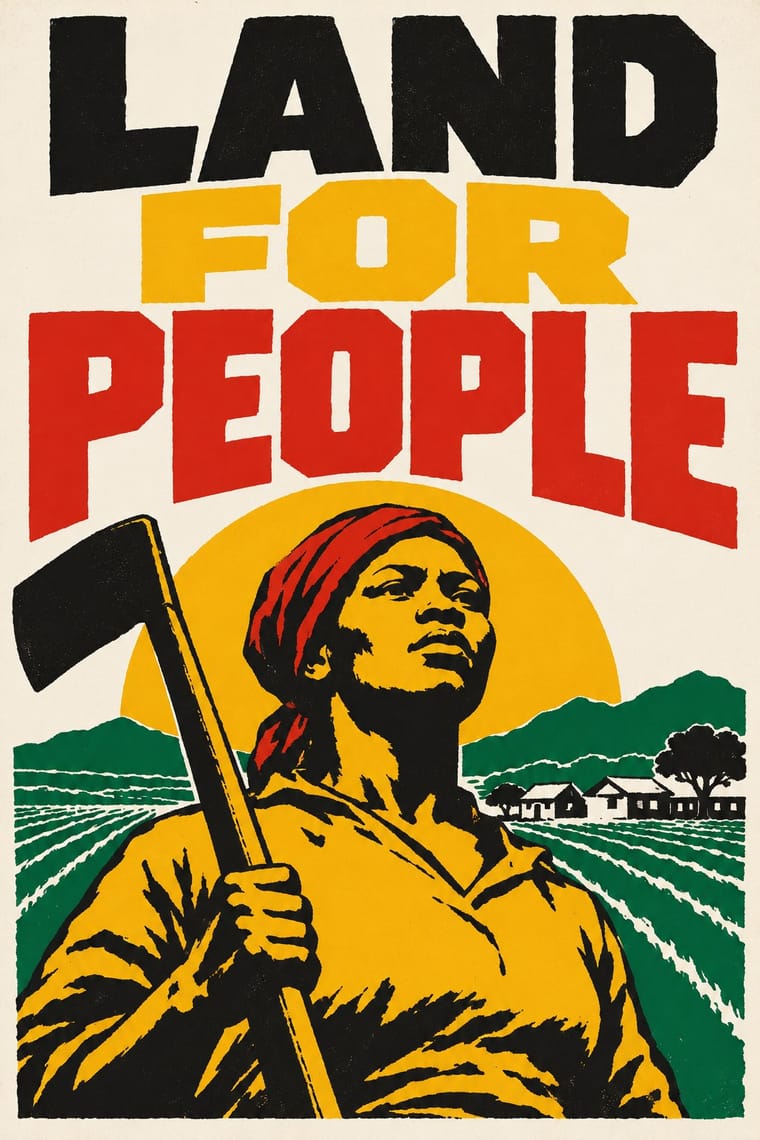
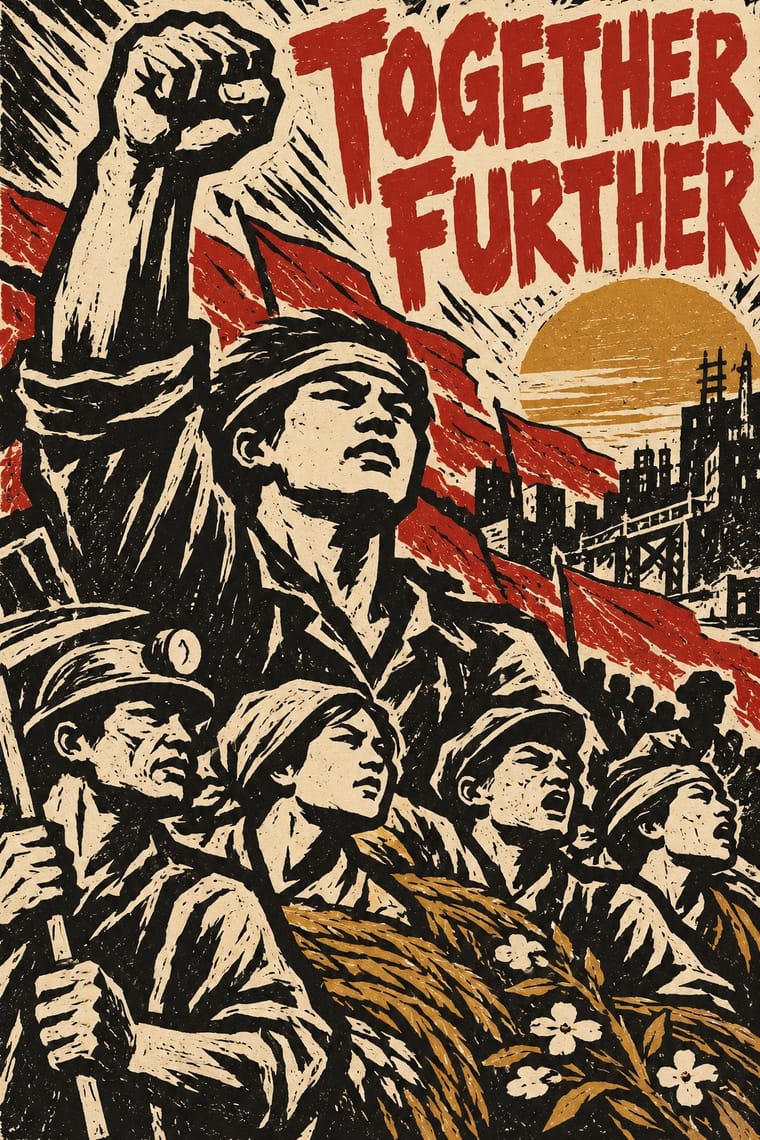
South African Resistance Poster × Minjung Woodcut Graphics
Exact contemporaries in another democracy struggle; set a carved figure beside community screenprint colour for solidarity graphics.
Mix them and make something South African Resistance Poster Minjung Woodcut Graphics
01
What each style brings
Each part of the design comes from the style with the stronger say in it, and each style gives at least two.
South African Resistance Poster Minjung Woodcut Graphics (Korean People's Art)
- Type from South African Resistance Poster
- Colour from South African Resistance Poster
- Form from Minjung Woodcut Graphics
- Composition from South African Resistance Poster
- Surface from Minjung Woodcut Graphics
02
The type
Open fonts standing in for each style’s own type, which is often hand-drawn or commercial.
Display · South African Resistance Poster
Rise
Allerta Stencil, standing in for Hand-cut stencil capitals
Text · Minjung Woodcut Graphics
The reproducible graphic branch of Minjung misul (people's art), South Korea's art of the 1980s democracy and labour movements. After the Gwangju Uprising of May 1980, artists such as Oh Yoon and Hong Sung-dam took up the woodcut for the movement: bold, succinct black-line figures of workers, farmers, miners and dancers, cut in wood and reused on poetry-book covers, pamphlets, posters, chest badges and enlarged painted geolgae banners for rallies.
Archivo; Minjung Woodcut Graphics used Hangul titles and slogans carved into the woodblock and Brush-written Hangul slogans on painted geolgae banners and posters
03
The colours
The ground and leading colours come from South African Resistance Poster, with a counter-accent from Minjung Woodcut Graphics. The ink reads on the ground at 4.5:1 or more.
South African Resistance Poster Minjung Woodcut Graphics (Korean People's Art)
-
#f4f1e8ground · 36% -
#141414ink · 14% -
#f2b51daccent · 18% -
#c89a3caccent · 14% -
#d7261eaccent · 10% -
#007a4daccent · 8%
As CSS
:root {
  --ground: #f4f1e8;
  --ink: #141414;
  --accent-1: #f2b51d;
  --accent-2: #c89a3c;
  --accent-3: #d7261e;
  --accent-4: #007a4d;
  --font-display: "Allerta Stencil", sans-serif;
  --font-text: "Archivo", sans-serif;
}
Use it with care
South African Resistance Poster: The photograph of the dying Hector Pieterson (Sam Nzima, 16 June 1976) and the portraits of detainees and the dead show real people whose families and communities still remember them, and ANC, UDF and COSATU colours and the spear and shield are the marks of living organisations. Use them with context and permission rather than as generic protest styling.
Minjung Woodcut Graphics (Korean People's Art): Minjung prints were made for a living movement and many record the dead of the Gwangju Uprising; their makers or estates hold the rights, and the movement's exhibitions met police suppression (The Power of People in Their 20s, 1985). Their borrowings from shamanic gut, mask dance and Buddhist painting carry ritual meaning in Korea: do not lift those motifs as decorative 'Korean folk' texture, do not turn Gwangju imagery into generic protest branding, and credit the artists by name. The genome describes the reproducible woodcut branch of a wider movement that also painted, made banners, comics and photomontage.
04
The two styles
05
More combinations
With South African Resistance Poster
- Cuban Revolutionary Poster (OSPAAAL & ICAIC) Contrasts · State-funded Cuban posters are polychrome and conceptual where these are literal, text-heavy and cheap; pick by whether the audience needs an idea or an instruction.
- WPA Silkscreen Posters Pairs well · Another public-service silkscreen culture of flat inks and plain capitals; borrow its calmer layout when a meeting poster needs to inform rather than shout.
- Rorke's Drift Linocut Contrasts · Same country, overlapping and then following it (1978–1994): screenprinted slogans and emblems for mass protest against small, hand-printed editions that tell a story; use the poster to mobilise and the linocut to bear witness.
- Atelier Populaire (May '68 Screenprint Poster) Pairs well · Both chose hand-made silkscreen because it was cheap, quick and teachable to non-artists; borrow the struggle posters' organisation emblems and second ink when a campaign must stay recognisable beyond one day's slogan.
- Extinction Rebellion Graphics Pairs well · Both are cheap workshop prints with heavy capitals and an organisation's emblem; XR adds a centrally specified twelve-colour kit where the struggle posters kept to one to three hand-cut inks.
- Drum Magazine & Sophiatown Photojournalism Contrasts · The later South African struggle poster argues with screenprinted slogans, emblems and drawn figures; Drum argued through candid photography and urban glamour inside a commercial magazine.
- See Red Women's Workshop Feminist Screenprints Pairs well · Community silkscreen for movements; add its heavy slogans and organisation emblems to See Red's drawn everyday scenes.
- South African Vernacular Design (Ijusi) Contrasts · The struggle posters spoke with one voice in two or three inks; Ijusi, after 1994, mixes many voices, languages and colours. Quote the stencilled slogans as history, not as decoration.
With Minjung Woodcut Graphics
- Socialist Realist Propaganda Poster Contrasts · State posters paint polished heroes from above; Minjung prints cut rough, grieving and dancing people from below.
- Taller de Gráfica Popular Contrasts · Nearest in the atlas, and the closest Mexican print lineage to the Mexican Muralism that MMCA names as a source: both cut black-line people's prints for movements, but TGP sets condensed Latin capitals and lithographs, while Minjung prints carry short Hangul slogans and dancing, ritual-derived figures, and are scaled up to geolgae banners.
- Chinese Modern Woodcut Movement Pairs well · MMCA names it as a source; keep its self-cut black line but trade the gouged diagonal shock for Minjung's frontal, dancing figures.
- Chaekgeori & Minhwa Screen Painting Pairs well · Minjung artists studied folk painting; borrow minhwa's flat colour and folk motifs to warm a black-and-white print.