Style combination · Pairs well
Kalighat Pat × Lubok Popular Print
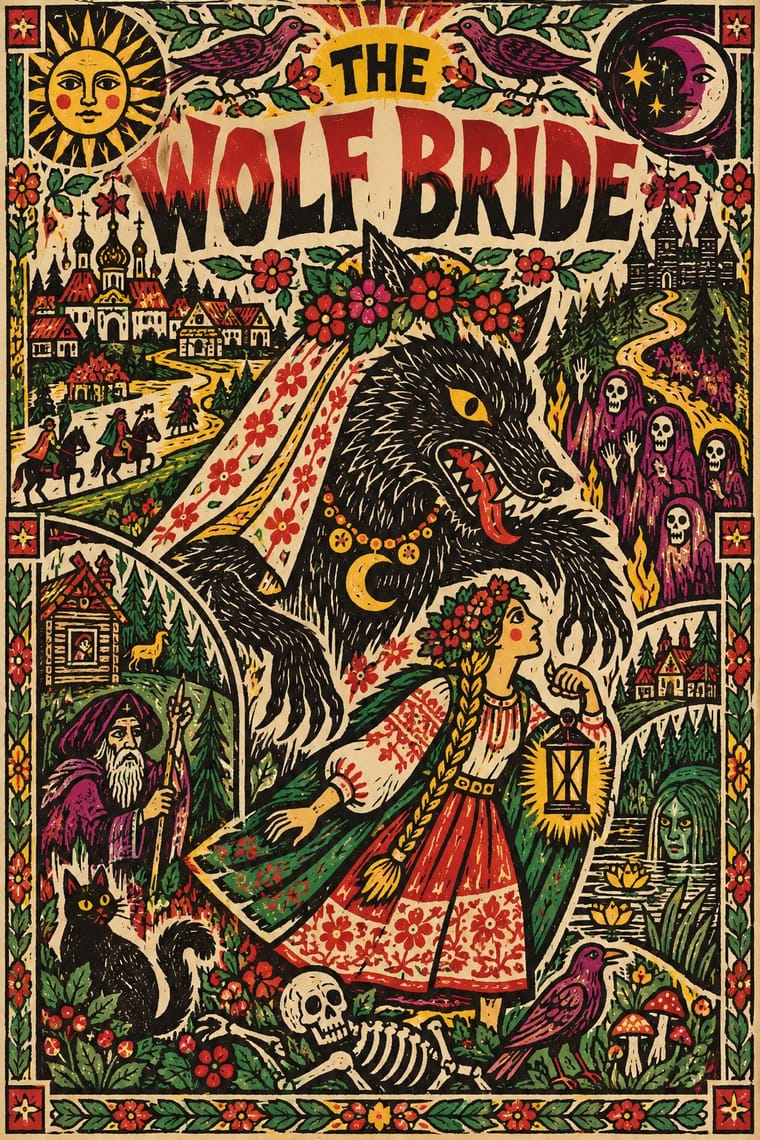
Both are cheap popular prints that mix piety with satire and splash colour on by hand; combine them for a folk-print exhibition or publishing identity.
Mix them and make something Kalighat Pat Lubok Popular Print
01
What each style brings
Each part of the design comes from the style with the stronger say in it, and each style gives at least two.
Kalighat Pat & Battala Bazaar Prints Lubok Popular Print
- Type from Lubok Popular Print
- Colour from Lubok Popular Print
- Form from Kalighat Pat
- Composition from Kalighat Pat
- Surface from Kalighat Pat
02
The type
Open fonts standing in for each style’s own type, which is often hand-drawn or commercial.
Display · Lubok Popular Print
Ours
Londrina Solid; Lubok Popular Print used Hand-cut Cyrillic lettering in the block, from Church Slavonic-style semi-uncial (poluustav) to civil script and Rubber-stamped and stencilled lettering imitating lubok woodcut letters in Russian Futurist books
Text · Kalighat Pat
The bazaar art of nineteenth-century Calcutta: watercolours sold to pilgrims by patua painters at the Kalighat temple, and the cheap woodcuts and metal engravings that Battala presses printed for chapbooks and almanacs. A single plaque-like figure stands on unpainted paper, drawn with one loaded, sweeping brushstroke that both outlines and shades it. Deities share the repertoire with satire of the Westernised babu, domestic scandal and street life.
Archivo; Kalighat Pat used Bengali captions cut into Battala woodblocks and Bengali letterpress text of Battala chapbooks and almanacs
03
The colours
The ground and leading colours come from Lubok Popular Print, with a counter-accent from Kalighat Pat. The ink reads on the ground at 4.5:1 or more.
Kalighat Pat & Battala Bazaar Prints Lubok Popular Print
-
#efe3c8ground · 36% -
#1a1612ink · 14% -
#e8b923accent · 18% -
#c62d2aaccent · 14% -
#a3245aaccent · 10% -
#3f7f3aaccent · 8%
As CSS
:root {
  --ground: #efe3c8;
  --ink: #1a1612;
  --accent-1: #e8b923;
  --accent-2: #c62d2a;
  --accent-3: #a3245a;
  --accent-4: #3f7f3a;
  --font-display: "Londrina Solid", cursive;
  --font-text: "Archivo", sans-serif;
}
Use it with care
Kalighat Pat & Battala Bazaar Prints: Many sheets depict Hindu deities that are still worshipped (Kali, Durga, Lakshmi, Krishna), and some were painted for Muslim patrons (Duldul, Imam Husain's horse), so do not distort, crop or place these figures in mocking or disposable contexts. The patua (chitrakar) families of Bengal still practise the art; commission or credit living painters rather than tracing museum images, and name the artist where known.
04
The two styles
05
More combinations
With Kalighat Pat
- Mexican Popular Graphics (Posada) Pairs well · Posada's broadsheets are its closest cousin in function; pair a Kalighat-style brush figure with shouting display type for a satirical street-print series.
- Indian Calendar & Bazaar Art Contrasts · The glossy, crowded naturalism of calendar art displaced the pat; set an empty-ground Kalighat line beside it to contrast quick satire with devotional finish.
- Bengali Modernist Book Cover (Prachchhad) Pairs well · Reduce the Kalighat contour to a bold, flat brush line, as Bengali cover designers later did, to give modern literary covers a local voice.
- Santiniketan & Bengal School Graphics Pairs well · Santiniketan took its quick, loaded brush contour from Bengal's pata painters; combine the two for single figures on bare paper, with Kalighat's satire or Haripura's dignity.
- Warli Painting Contrasts · Both are Indian painting traditions taken up by a market; Kalighat isolates one brushed, coloured figure on a pale ground, Warli spreads many white pictogram figures over a dark one, so choose between a single satirical figure and a communal crowd.
- Mithila (Madhubani) Painting Contrasts · Both are eastern Indian popular pictures of deities, but Kalighat sweeps a few brushed figures across an empty sheet while Mithila outlines everything and fills every gap; set them side by side to show sparse brush against dense line.
- Kinngait (Cape Dorset) Inuit Printmaking Contrasts · Both isolate a stylised figure on pale paper with little else; Kalighat paints it with a loaded brush and a sweeping outline for a bazaar market, Kinngait cuts it in stone or daubs it through a stencil, so take Kalighat for a painted, satirical line and Kinngait for a still, printed silhouette.
- Dhaka Rickshaw Painting Pairs well · Another Bengali popular-picture tradition made by working artists for ordinary buyers.
With Lubok Popular Print
- Mexican Popular Graphics (Posada) Pairs well · Posada's broadsheets and lubki share cheap paper, crude relief cuts and street humour; brush lubok-style washes over a black relief broadsheet.
- ROSTA Windows Pairs well · ROSTA windows inherited the lubok's numbered, captioned panels and rhymed text; combine the two for sequential agitational posters with a folk voice.
- Literatura de Cordel Woodcut Pairs well · Brazilian cordel is another chapbook woodcut tradition; set rhymed verse and a single crude block together, as both do, for narrative print with a vernacular voice.
- Nianhua & Chinese Folk Print Pairs well · Both are hand-coloured market woodcuts; take nianhua's symmetrical auspicious emblems and lubok's crowded captions and satire for festive print that also tells a story.
- Minimalist Graphic Design Contrasts · Lubok's crowding is its voice; isolate one figure on white to test how much of the meaning lives in the jostling text.
- Imagerie d'Épinal & European Bilderbogen Contrasts · Both are pedlars' broadsheets coloured by hand, but the lubok crams verse into the gaps around its figures and brushes washes on freely, while the Épinal sheet keeps its text beneath a ruled frame and stencils colour across rows of repeated figures; choose the lubok for jostling satire and Épinal for an orderly catalogue or story.
- Narbut School (Ukrainian Baroque Revival Graphics) Contrasts · Popular, coloured woodcut exuberance against Narbut's academic, restrained black line.
- Đông Hồ & Hàng Trống Folk Prints Pairs well · Lubok's Mice Burying the Cat and Đông Hồ's Rats' Wedding tell the same joke about power; pair them for a folk-satire series or exhibition identity.