Style combination · Contrasts
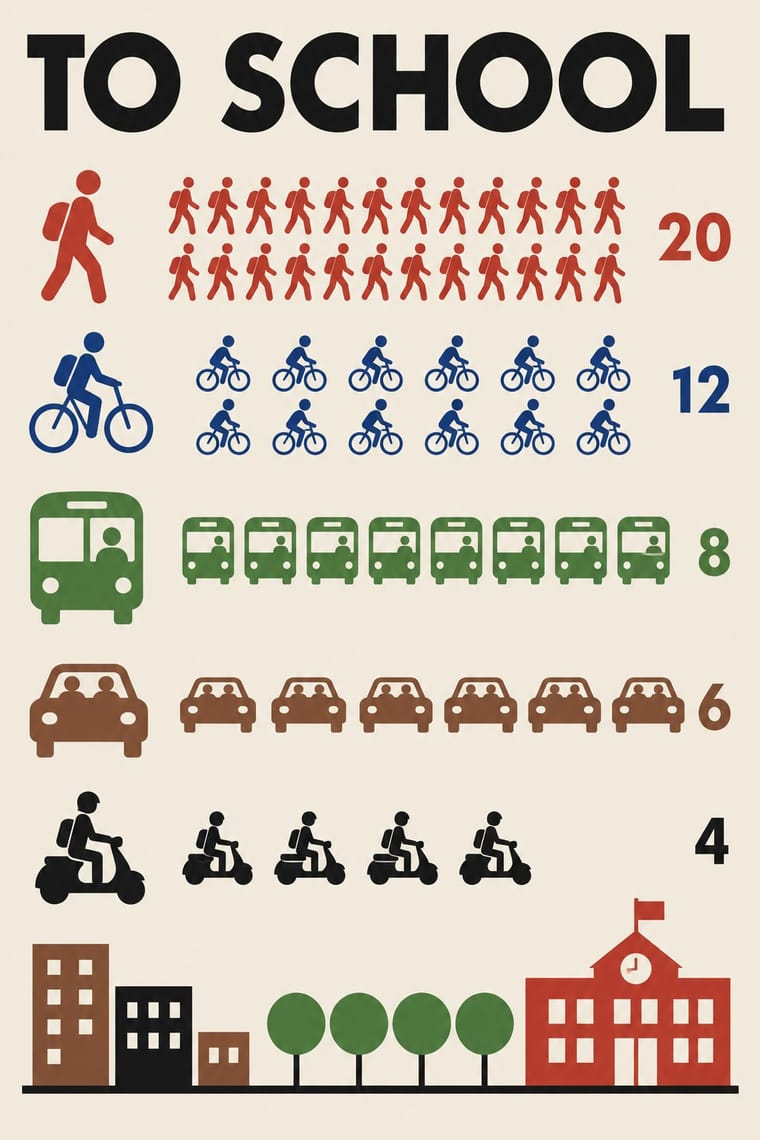
Isotype Pictorial Statistics × Warli Painting
Both build people from a few reduced shapes and repeat them in rows; Isotype's figures count data in flat colours on a light ground, Warli's narrate ritual and village life in white on earth, so borrow the repetition but not the meaning.
Mix them and make something Isotype Pictorial Statistics Warli Painting
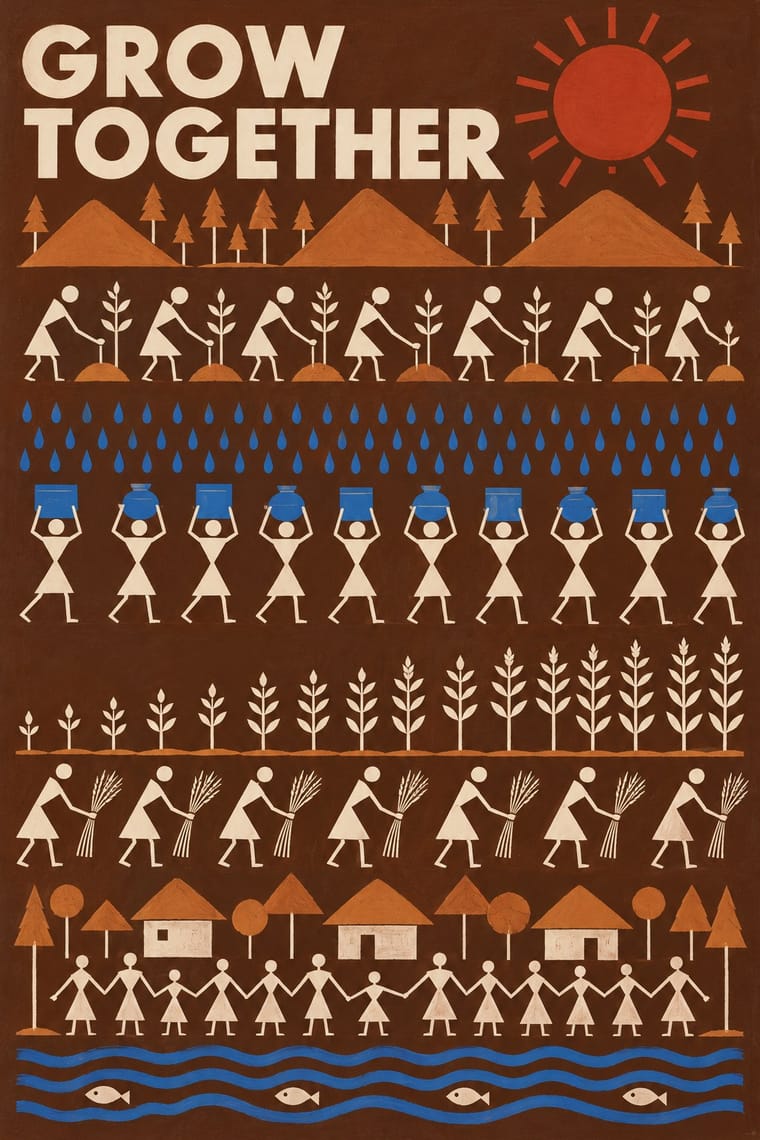
01
What each style brings
Each part of the design comes from the style with the stronger say in it, and each style gives at least two.
Isotype Pictorial Statistics Warli Painting
- Type from Isotype Pictorial Statistics
- Colour from Warli Painting
- Form from Warli Painting
- Composition from Isotype Pictorial Statistics
- Surface from Warli Painting
02
The type
Open fonts standing in for each style’s own type, which is often hand-drawn or commercial.
Text · Warli Painting
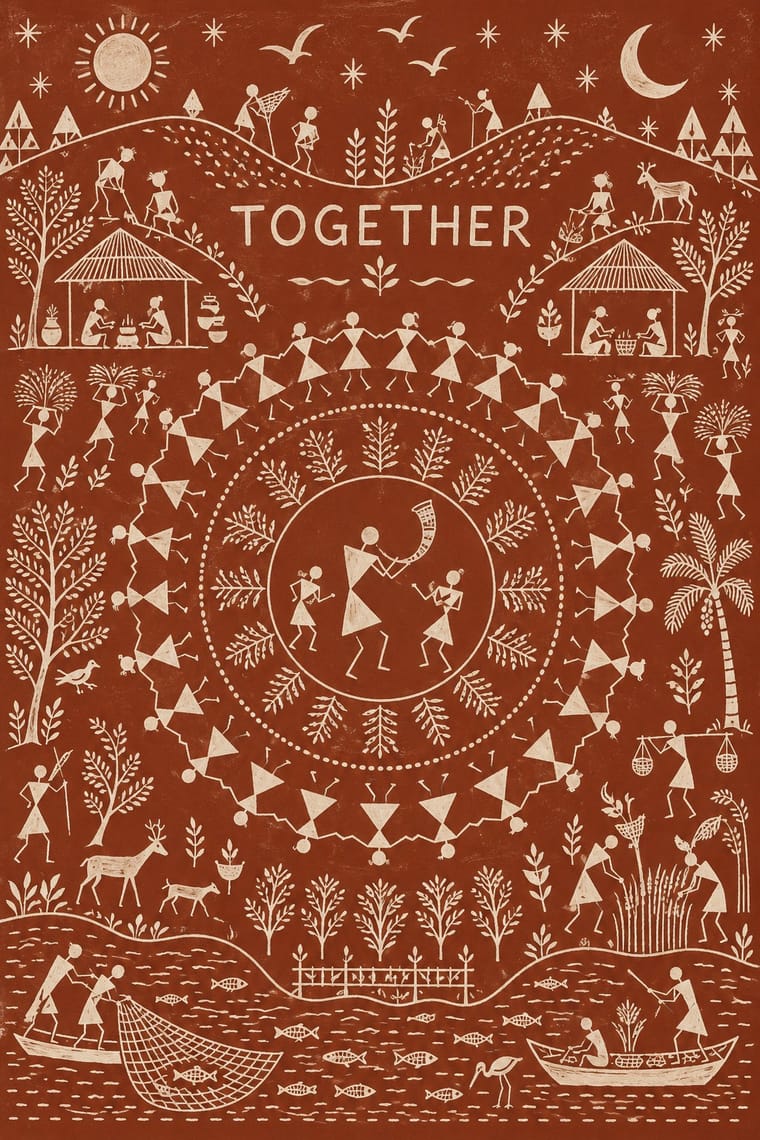
The ritual wall painting of the Warli, an Adivasi people of the northern Sahyadri in Maharashtra, carried onto paper and canvas from the 1970s by Jivya Soma Mashe and others. White rice paste (on paper and cloth often white poster colour or watercolour), drawn with a chewed bamboo twig on a red-earth and cow-dung ground, builds every form from circle, triangle and square: a person is two triangles joined at the tip. Rows of farmers, fishers and dancers fill the field around a sacred square (chauk) or wheel in the spiral of the tarpa dance, flat and without perspective.
Archivo; Warli Painting used No script inside the scene and Monoline Devanagari (Marathi) or Gujarati hand-lettering drawn in the same white stroke, kept small and outside the scene, when text must accompany Warli-derived graphics
03
The colours
The ground and leading colours come from Warli Painting, with a counter-accent from Isotype Pictorial Statistics. The ink reads on the ground at 4.5:1 or more.
Isotype Pictorial Statistics Warli Painting
-
#4a2f20ground · 36% -
#f3ede0ink · 14% -
#b5643aaccent · 18% -
#c8372daccent · 14% -
#8e3b25accent · 10% -
#2c5aa0accent · 8%
As CSS
:root {
  --ground: #4a2f20;
  --ink: #f3ede0;
  --accent-1: #b5643a;
  --accent-2: #c8372d;
  --accent-3: #8e3b25;
  --accent-4: #2c5aa0;
  --font-display: "Jost", sans-serif;
  --font-text: "Archivo", sans-serif;
}
Use it with care
Warli Painting: Warli painting is the living art of an Adivasi community, and its wall form is ritual: married women (suvasini) painted the chauk with the mother goddess Palaghata for weddings and harvests, and at some weddings still draw its first lines before men painters finish it, while women priests who officiate at weddings (Dhavleri, described as widows in Scroll's 2022 account of the Warli women's revival) sing. Do not use the chauk or Palaghata as decoration, and do not call the art 'primitive' or prehistoric. Its easy-to-copy figures are widely reproduced on products and campaigns, often without credit or payment to Warli painters; 'Warli Painting' is a Geographical Indication registered by the Adivasi Yuva Seva Sangh, but it does not stop Warli-style graphics made elsewhere. Commission, license from or credit named Warli artists, do not sell Warli-style goods as Warli handicraft, and never present a generated image as a Warli painting. Since the 1970s the paid form has been painted mostly by men, who now paint many wedding chauks too; credit the women whose ritual practice it comes from, and the Warli women reclaiming it, such as the Dhavleri group in Palghar district (Kirti Vartha, Suchita Kamadi and others), who paint wedding chauks and murals.
04
The two styles
05
More combinations
With Isotype Pictorial Statistics
- International Typographic Style Pairs well · Set Isotype rows of pictograms on a Swiss grid for public information that is rigorous yet friendly.
- Socialist Realist Propaganda Poster Contrasts · Socialist Realism dramatises with heroic figures while Isotype persuades by counting; choose evidence over emotion when trust matters.
- Flat Design Pairs well · Flat icon sets are Isotype's heirs; apply its one-symbol-one-meaning rule to keep an icon family consistent.
- Corporate Memphis Contrasts · Corporate Memphis uses flat figures for mood; Isotype's figures always count something, so use people icons only when they carry data.
- Ancient Egyptian Hieroglyphic & Register Composition Pairs well · Otto Neurath called his visual autobiography From hieroglyphics to Isotype, with chapters on hieroglyphics through the centuries and their renaissance; borrow the rule-bound sign family and rows of standing figures, but note the opposite rule of size: Isotype shows more by adding signs of equal size, Egypt shows rank by making one figure bigger.
- Data Humanism Contrasts · Isotype fixes one standard sign per thing and counts by repeating it so anyone can read the chart; data humanism invents a new code for each dataset and asks for slow reading. Choose Isotype for public information, data humanism for portraits of particular lives.
- Schematic Transit Diagram (Beck Tube Map Idiom) Pairs well · Add pictorial statistics beside the diagram to carry quantities as well as connections.
- Nutri-Score (Front-of-Pack Colour-Grade Label) Pairs well · Both turn data into a sign anyone can read at a glance; borrow Isotype's repeated pictograms to explain the five grades on shelf talkers, leaflets or school material.
With Warli Painting
- Kalighat Pat & Battala Bazaar Prints Contrasts · Both are Indian painting traditions taken up by a market; Kalighat isolates one brushed, coloured figure on a pale ground, Warli spreads many white pictogram figures over a dark one, so choose between a single satirical figure and a communal crowd.
- Uli & Nsibidi Line and Sign Tradition Contrasts · Both are women's wall painting built on line; uli usually draws one dark tone on a light ground, skin or paper and leaves wide empty ground around single motifs, the reverse of Warli's white on earth with rows of figures filling the field, so borrow uli's restraint to calm a crowded Warli-derived layout.
- Bògòlanfini Mud Cloth Pairs well · Both set pale marks on an earth-dark ground in a hand-made, slightly irregular repeat; bògòlan reserves mostly abstract signs in strip compartments, while Warli's signs depict people, animals, trees, the sun and the moon. Borrow the shared light-on-earth principle, but do not mix bògòlan signs and Warli figures into one generic 'tribal' surface; keep each set of motifs, its meaning and its makers apart.