Style combination · Contrasts
Egyptian Painted Film Poster × Ancient Egyptian Hieroglyphic
A brief that just says 'Egyptian' need not mean pharaonic: the painted cinema posters of 20th-century Cairo float naturalistic star heads in a painterly collage under Arabic calligraphic titles, the opposite of flat registers ruled by ground lines and columns of signs.
Mix them and make something Egyptian Painted Film Poster Ancient Egyptian Hieroglyphic
01
What each style brings
Each part of the design comes from the style with the stronger say in it, and each style gives at least two.
Egyptian Painted Film Poster Ancient Egyptian Hieroglyphic & Register Composition
- Type from Egyptian Painted Film Poster
- Colour from Ancient Egyptian Hieroglyphic
- Form from Ancient Egyptian Hieroglyphic
- Composition from Egyptian Painted Film Poster
- Surface from Egyptian Painted Film Poster
02
The type
Open fonts standing in for each style’s own type, which is often hand-drawn or commercial.
Display · Egyptian Painted Film Poster
Atlas
Rakkas, standing in for Hand-painted Arabic calligraphic title logotypes
Text · Ancient Egyptian Hieroglyphic
The visual system of pharaonic Egypt, in which writing is made of pictures and pictures are ruled like writing. Scenes stand in horizontal registers; figures are drawn in composite view, sized by rank rather than distance and laid out to a canon of proportions, in flat mineral colour without depth. Hieroglyphs run in columns or rows, packed into square groups facing the start of the line, and fill the spaces around figures as captions. Book of the Dead papyri add black text with red rubrics and framed vignettes; royal names stand in cartouches.
Inter; Ancient Egyptian Hieroglyphic used Monumental hieroglyphs, carved in raised or sunk relief and usually painted, grouped in square blocks (quadrats) in columns or rows and Cursive hieroglyphs (hieroglyphic book hand), written with a reed brush in black and red ink on papyrus, wood or leather, usually in columns, for religious texts such as the Book of the Dead and the Coffin Texts
03
The colours
The ground and leading colours come from Ancient Egyptian Hieroglyphic, with a counter-accent from Egyptian Painted Film Poster. The ink reads on the ground at 4.5:1 or more.
Egyptian Painted Film Poster Ancient Egyptian Hieroglyphic & Register Composition
-
#e8dcb5ground · 36% -
#1c1a17ink · 14% -
#d4a03aaccent · 18% -
#d1262faccent · 14% -
#a63d24accent · 10% -
#1f5fa8accent · 8%
As CSS
:root {
  --ground: #e8dcb5;
  --ink: #1c1a17;
  --accent-1: #d4a03a;
  --accent-2: #d1262f;
  --accent-3: #a63d24;
  --accent-4: #1f5fa8;
  --font-display: "Rakkas", cursive;
  --font-text: "Inter", sans-serif;
}
Use it with care
Ancient Egyptian Hieroglyphic & Register Composition: Hieroglyphs were 'the words of the gods', and most surviving pages and walls are funerary and temple texts written for named people, spells for the afterlife and royal names that carried sacred power: do not use them as random texture, invent pseudo-hieroglyphs, or put an ordinary name in a cartouche as if it were ancient practice, since cartouches enclosed royal names; nor scatter the ankh, djed, wedjat eye, scarab or winged sun disc as décor, since the first four were protective amulets and the winged disc was the emblem of Behdety, Horus of Edfu, protector of the pharaoh. Image models cannot write hieroglyphs and make up signs, so leave text areas blank in generated images, have any real text composed or checked by an Egyptologist from Gardiner's sign list, and never present a generated image as an ancient work. Many key works left Egypt in contested ways: the Papyrus of Ani was found in 1888 by Egyptians trading in illegal antiquities and obtained by E. A. Wallis Budge for the British Museum, by his own account smuggled out after the police had sealed the dealers' houses (locals tunnelled in while he kept the guards busy with a meal), for which the Treasury later paid him a £150 'gratuity'; the Nebamun paintings were hacked from the tomb walls around 1820 and sold by Henry Salt; and the Egyptologist Zahi Hawass, formerly in charge of Egypt's antiquities, has repeatedly called for the Rosetta Stone's return as the 'icon of our Egyptian identity'. Credit objects with their findspots and holding institutions, treat pharaonic heritage as part of modern Egypt's identity rather than as exotic 'Egyptomania' décor, and avoid casting the ancient Egyptians to fit modern racial claims.
04
The two styles
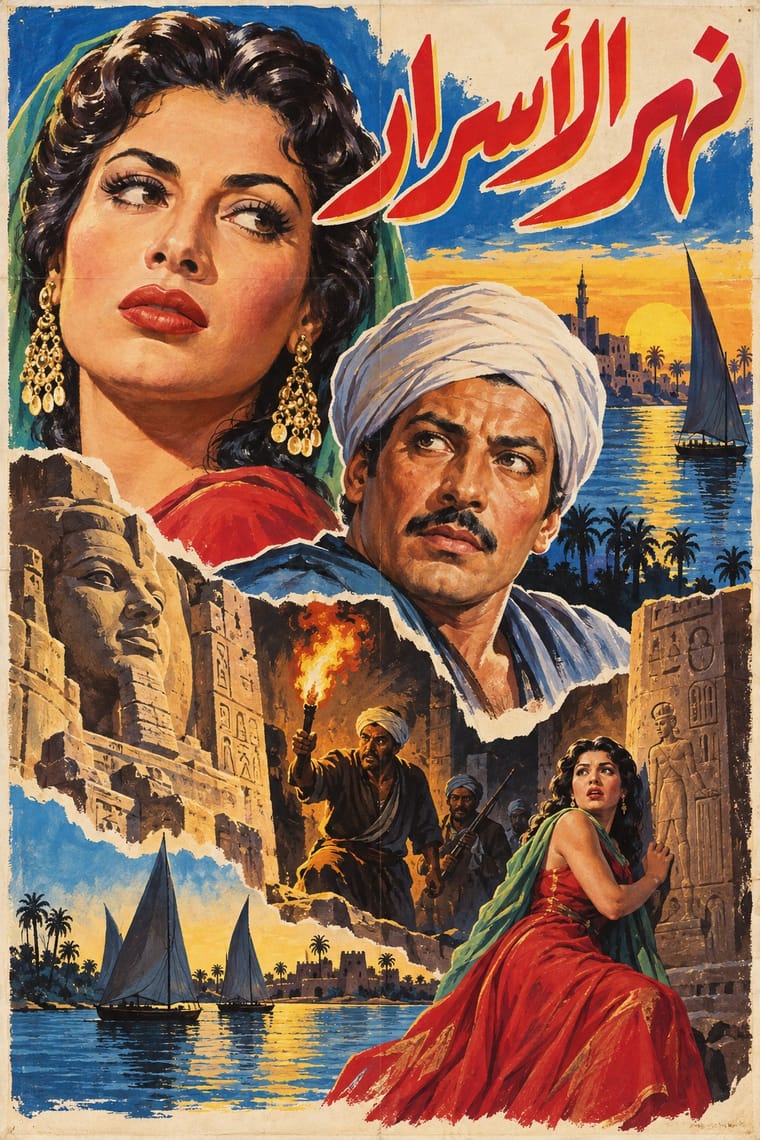
05
More combinations
With Egyptian Painted Film Poster
- Hand-Painted Bollywood Poster Pairs well · Share floating star heads and painted title logos across a film-heritage programme, setting Arabic calligraphic titles beside Devanagari and Nastaʿlīq ones.
- Belle Époque Lithographic Poster Pairs well · Both are colour-lithographed street posters; borrow the Belle Époque's flat colour and single animated figure to calm a crowded star montage.
- Cairo–Beirut Arab Modernist Book & Periodical Design Pairs well · Combine the cinema poster's glamorous painted title with the book designers' rough line and folk borders for a Cairo identity that spans screen and print.
- International Typographic Style Contrasts · Place one painted Arabic title and star head on a neutral grid with grotesque credits to make the clash of melodrama and order the subject.
- Hong Kong Cinema Poster (Shaw Brothers and Golden Harvest era) Pairs well · Another painted studio-era film poster; borrow its heroic face scale and melodrama.
- Giallo Mondadori Covers (I Libri Gialli) Pairs well · Both paint a lurid, cinematic moment of crime or melodrama for a mass public; the poster's calligraphic logotype and floating heads can loosen the giallo's sober capitals.
- Thai Hand-Painted Film Poster and Billboard Pairs well · Another painted cinema-advertising tradition built on a crowded montage of faces, a parallel rather than a documented influence; borrow its scale contrast between star and scene.
- Yeşilçam Film Poster (Turkish Hand-Painted Afiş) Pairs well · Both put painted star heads above a melodramatic scene. Pair them to compare Latin-script Istanbul lettering with Arabic calligraphic titles.
With Ancient Egyptian Hieroglyphic
- Isotype Pictorial Statistics Pairs well · Otto Neurath called his visual autobiography From hieroglyphics to Isotype, with chapters on hieroglyphics through the centuries and their renaissance; borrow the rule-bound sign family and rows of standing figures, but note the opposite rule of size: Isotype shows more by adding signs of equal size, Egypt shows rank by making one figure bigger.
- Egyptian Revolutionary Street Art (Mohamed Mahmoud Murals) Pairs well · In 2012 Luxor-trained muralists such as Alaa Awad recast tomb painting on Cairo's Mohamed Mahmoud Street: profile processions of mourning women, registers, a sarcophagus and the weighing of the heart, brushed in acrylic around the faces of the martyrs. Look there for a living Egyptian use of the register and the procession, credited to its painters, rather than Egyptomania décor.
- Art Deco Pairs well · The expeditions that led to Howard Carter's discovery of Tutankhamun's tomb in 1922 set off a 1920s Egyptian Revival often counted as part of Art Deco (the papyrus-plant elevator doors of the Chrysler Building); a deco treatment can borrow lotus and papyrus motifs, stepped frames and flat colour, but should not invent pseudo-hieroglyphs.
- Ethiopian Ge'ez Manuscript & Haräg Illumination Contrasts · Both write black text with red rubrics in ruled columns, but Ethiopian books are Christian parchment codices in the Ge'ez abugida with haräg interlace bands, while Book of the Dead papyri are rolls of cursive hieroglyphs with framed vignettes set between the text columns.
- Mixteca-Puebla Codex Painting Contrasts · Both are sacred pictorial records in contour and flat colour with no depth, but Mixtec screenfolds lead the eye in a zigzag along red guidelines past big-headed figures and name glyphs, while Egyptian pages keep strict horizontal registers and ruled columns of a largely phonetic script, with figures sized by rank and drawn to a canon; do not merge them as generic 'ancient glyphs'.
- Egyptian Cigarette Packaging (Cairo Tobacco Houses) Pairs well · Draw the pharaonic motifs from real register compositions rather than souvenir clichés to give the vignettes more weight and accuracy.