Style combination · Contrasts
Arab Children's Comic Magazines × Arab Independent Comics
The adult, black-ink, dialect satire of Samandal and TokTok answers these mostly state-backed children's weeklies: set one raw independent strip against a bright magazine page to show the break.
Mix them and make something Arab Children's Comic Magazines Arab Independent Comics
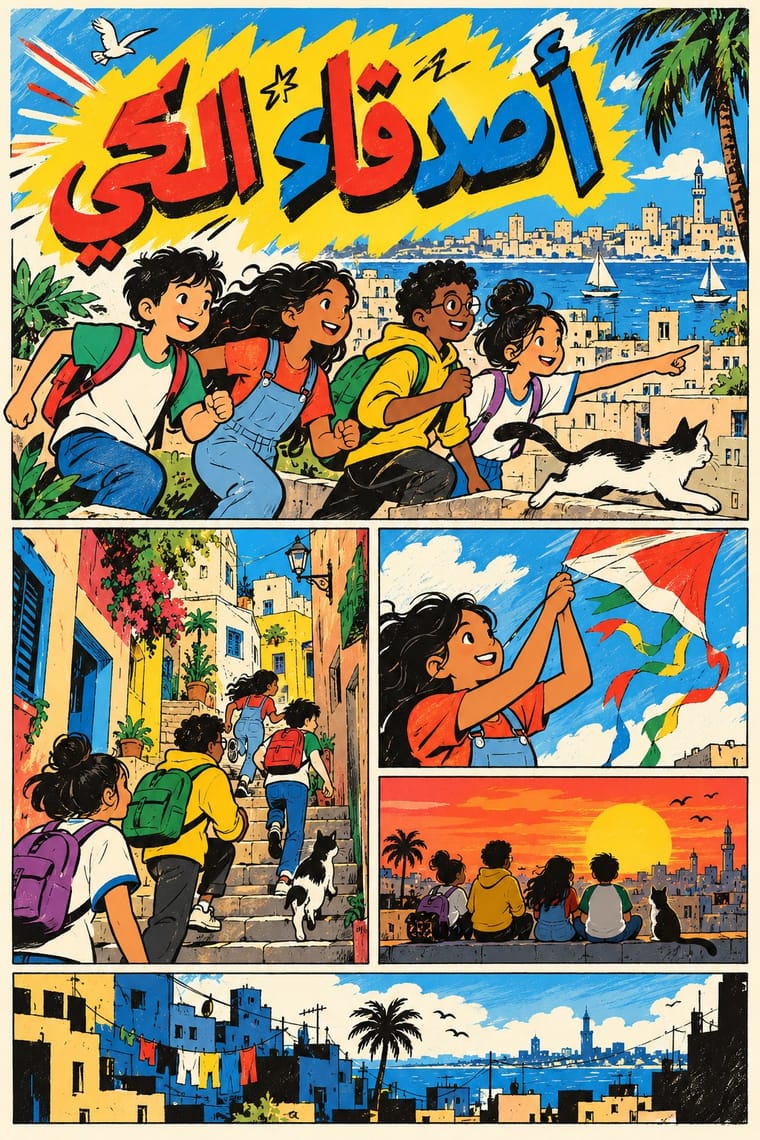
01
What each style brings
Each part of the design comes from the style with the stronger say in it, and each style gives at least two.
Arab Children's Comic Magazines (Samir to Majid) Arab Independent Comics (Samandal, TokTok, Lab619, Skefkef)
- Type from Arab Independent Comics
- Colour from Arab Children's Comic Magazines
- Form from Arab Children's Comic Magazines
- Composition from Arab Children's Comic Magazines
- Surface from Arab Independent Comics
02
The type
Open fonts standing in for each style’s own type, which is often hand-drawn or commercial.
Display · Arab Independent Comics
Pop
Rakkas, standing in for Hand-lettered colloquial Arabic balloons (Egyptian ʿāmmiyya in TokTok and Garage, Tunisian in Lab619, Moroccan darija, with Amazigh, in Skefkef)
Text · Arab Children's Comic Magazines
Arabic children's comics weeklies, from Dar al-Hilal's Samir in Cairo (1956) to Abu Dhabi's Majid (1979), mixing translated Western strips with house characters by Egyptian, Lebanese, Armenian and European artists. Pages read right to left: flat bright full-colour panels, rounded cartoon children in local dress, hand-lettered Arabic balloons and drawn sound effects, shared with quizzes, puzzles, contests, letters and lessons, under a boy mascot who names the magazine. The look is that of the colour weeklies of the 1950s to 1990s; Majid went monthly in 2020, redesigned by Studio Safar.
Archivo; Arab Children's Comic Magazines used Hand-lettered Arabic balloon text, read right to left and Drawn Arabic onomatopoeia and expressive balloon lettering
03
The colours
The ground and leading colours come from Arab Children's Comic Magazines, with a counter-accent from Arab Independent Comics. The ink reads on the ground at 4.5:1 or more.
Arab Children's Comic Magazines (Samir to Majid) Arab Independent Comics (Samandal, TokTok, Lab619, Skefkef)
-
#f6f0dcground · 36% -
#1d1a17ink · 14% -
#f6c928accent · 18% -
#e23b2eaccent · 14% -
#2f8fd0accent · 10% -
#3f9b4aaccent · 8%
As CSS
:root {
  --ground: #f6f0dc;
  --ink: #1d1a17;
  --accent-1: #f6c928;
  --accent-2: #e23b2e;
  --accent-3: #2f8fd0;
  --accent-4: #3f9b4a;
  --font-display: "Rakkas", cursive;
  --font-text: "Archivo", sans-serif;
}
Use it with care
Arab Children's Comic Magazines (Samir to Majid): Samir, Majid, Kaslan Jiddan, Fudooli, Ammouna and the magazines' mastheads belong to their publishers (Dar al-Hilal, Abu Dhabi Media) and artists, and the Arabic Disney and Tintin pages to Disney and Hergé's estate: draw your own mascot, characters and masthead, never ask an image model for these characters or a named artist's hand, and never present a generated page as a vintage issue. The tradition's artists also drew caricature, such as 'Ib Goha and Sambo' by Samir co-founder Haroon, about an Arab boy and his Black Nubian sidekick Sambo: give every character, Black, Nubian, foreign or villain, the same drawing care, and never make skin colour or features the joke. Draw everyday Egyptian, Levantine and Gulf children in the dress they actually wear (gallabiya, kandura and ghutra, shayla, school uniforms), not Orientalist shorthand (camels, harem veils, oil-sheikh caricatures, pseudo-Arabic squiggles), and do not copy Hergé's stereotyped Arabs of the invented Khemed, who are 'always the punchline' (Nadim Damluji). Leave religious pages to writers and readers of the faith, and have all Arabic lettering written or checked by a fluent reader, joined and running right to left.
Arab Independent Comics (Samandal, TokTok, Lab619, Skefkef): These are living, named artists working under real censorship: Samandal's editors were prosecuted and fined over two comics, and an Egyptian cartoonist was arrested in January 2016, so never attribute invented political or religious satire to a real artist or collective, and never ask an image model for their work by name. Draw the contemporary city life these artists draw, not Orientalist shorthand: no camels, veiled women, sheikhs or gunmen as stand-ins for 'Arab', and no pseudo-Arabic squiggles. Have every line of dialect Arabic, Darija or Amazigh written or checked by a fluent speaker; if no fluent reader can check it, leave the balloons empty or letter them in Latin script only. Do not borrow the religious and sectarian jokes as edgy decoration outside the communities that made them.
04
The two styles
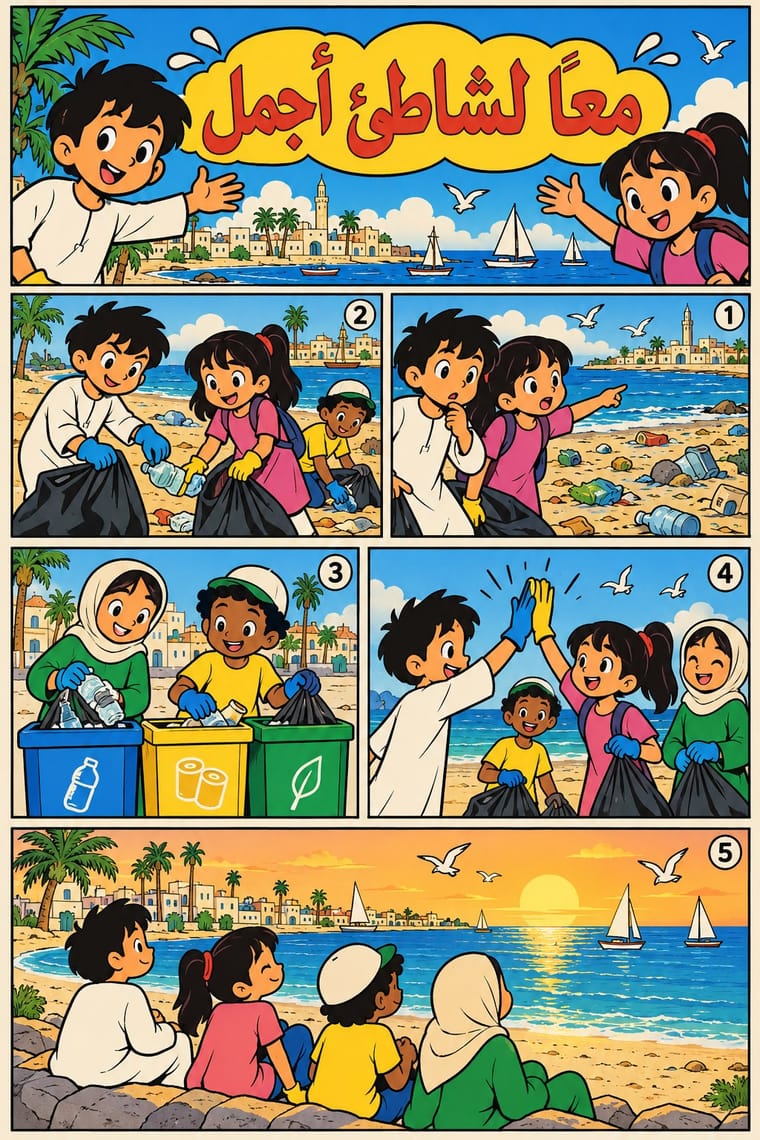
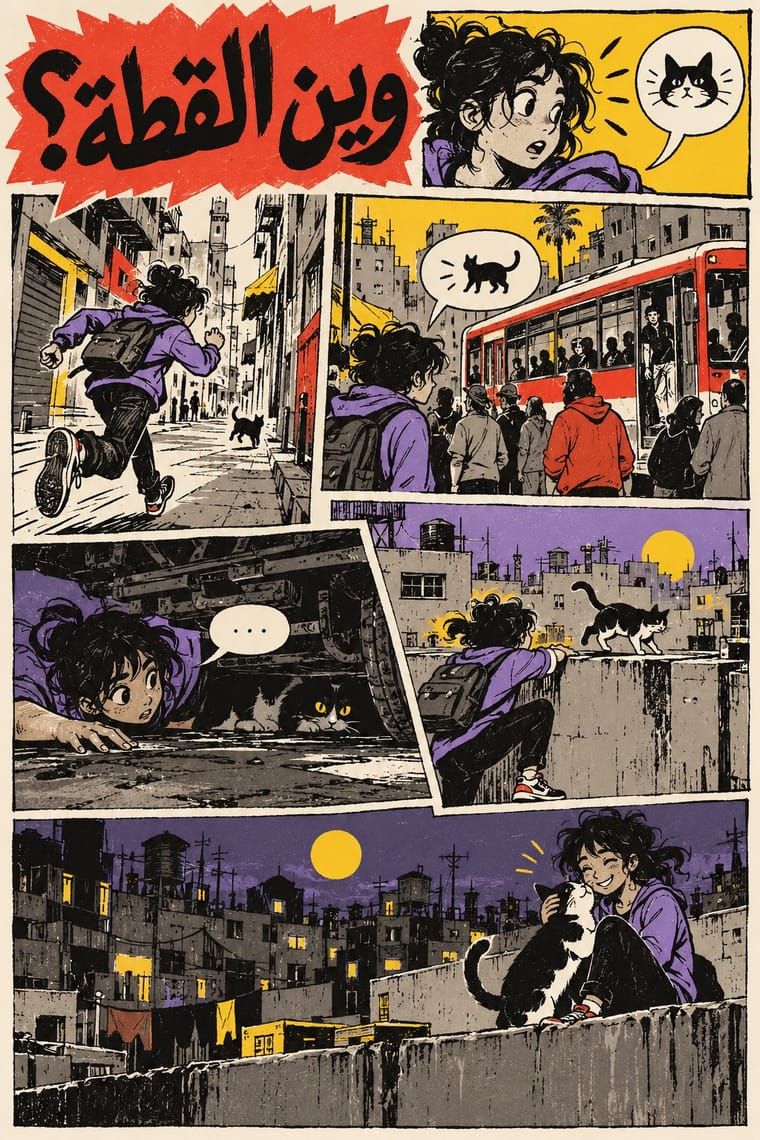
05
More combinations
With Arab Children's Comic Magazines
- Amar Chitra Katha Comics Pairs well · Another postcolonial children's comic that teaches heritage in flat colour; combine its narrated caption boxes with the Arab weekly's gag strips and puzzle pages.
- Turkish Weekly Humour Magazines (Gırgır to Uykusuz) Contrasts · The same weekly cartoon-magazine machine aimed at adults and at power: its swollen caricature and political covers show what the children's weeklies kept out.
- Cairo–Beirut Arab Modernist Book & Periodical Design Pairs well · The same Cairo and Beirut artists (Ellabbad, Hegazi) drew for both: add its hand-drawn Kufic-derived titles, folk borders and spot colour to a magazine cover.
- Ligne Claire (Franco-Belgian Clear Line) Pairs well · Samir took the Belgian Tintin weekly as its model; borrow the even contour and evenly lit, legible settings to tighten a looser cartoon page.
With Arab Independent Comics
- Story Manga (Postwar Japanese Comics) Contrasts · Manga is one codified visual language read right to left. The new wave of Arab comics counts it among its sources, beside European comics and American cartoons, and some artists build a style on it (Hanan al-Kararji, who drew the Cairo graphic novel 18 Days, calls hers 'a blend of manga and Arabness'), but these anthologies set it beside brush caricature and fine-art pages, and may run both reading directions in one issue.
- Risograph & Indie Print Culture Pairs well · Samandal printed Topia (2017) by Risograph, and Lab619 planned its ninth issue in a 2017 residency, to be printed by Risograph and bound by hand; add two or three translucent riso inks to a black-ink anthology for its cover or centrefold, but keep the dialect lettering and the many hands.
- Contemporary Arabic & Dual-Script Type Design Contrasts · Both set Arabic beside Latin, but that type culture matches the two scripts in font families on rational, mirrored grids, while these anthologies letter both scripts by hand, one story at a time, and mirror whole pages so that the reader turns the magazine round with the script.
- American Four-Colour Comic Book (Golden to Bronze Age) Contrasts · TokTok's Andeel called superhero culture foreign: no genre industry, no ruled grid of four-colour panels and no single drawing code, but adult, local stories in whatever hand and dialect each artist brings.
- Egyptian Revolutionary Street Art (Mohamed Mahmoud Murals) Pairs well · The same Cairo moment on paper and on walls: TokTok appeared two weeks before 25 January 2011, and many of these artists mix caricature, illustration, comics and graffiti. Carry a wall's sardonic caricature and slogan into a sequence of panels.
- Lebanese Civil War Party Poster Contrasts · The party posters glorified martyrs and leaders; Lena Merhej said Samandal refused to write about the war, 'a subject that exasperates us', and turned instead to religion, politics and sex, with irony rather than tribute.
- Turkish Weekly Humour Magazines (Gırgır to Uykusuz) Contrasts · Both are collectives' magazines that satirise power in street dialect and have been taken to court for it. The Arab magazines are small art-comics anthologies with no house style and no topical cover; the Turkish weeklies were mass newsstand titles built around one cover caricature of the week's news.
- L'Association and French Alternative Comics Pairs well · A younger many-handed small-press scene that also prints mostly in black ink; one of its Beirut titles won Angoulême's alternative comics prize in 2019. Pair the French book design with its dialect lettering and Risograph colour.