Style combination · Contrasts
Arab Children's Comic Magazines × Turkish Weekly Humour Magazines
The same weekly cartoon-magazine machine aimed at adults and at power: its swollen caricature and political covers show what the children's weeklies kept out.
Mix them and make something Arab Children's Comic Magazines Turkish Weekly Humour Magazines
01
What each style brings
Each part of the design comes from the style with the stronger say in it, and each style gives at least two.
Arab Children's Comic Magazines (Samir to Majid) Turkish Weekly Humour Magazines (Gırgır to Uykusuz)
- Type from Turkish Weekly Humour Magazines
- Colour from Arab Children's Comic Magazines
- Form from Turkish Weekly Humour Magazines
- Composition from Arab Children's Comic Magazines
- Surface from Arab Children's Comic Magazines
02
The type
Open fonts standing in for each style’s own type, which is often hand-drawn or commercial.
Display · Turkish Weekly Humour Magazines
Hello
Londrina Solid, standing in for Hand-lettered capitals in speech balloons and caption blocks, with the Turkish İ, Ş, Ğ and Ç drawn in (the Uykusuz cover of 12 November 2008, the Gırgır cover of 10 August 2011)
Text · Arab Children's Comic Magazines
Arabic children's comics weeklies, from Dar al-Hilal's Samir in Cairo (1956) to Abu Dhabi's Majid (1979), mixing translated Western strips with house characters by Egyptian, Lebanese, Armenian and European artists. Pages read right to left: flat bright full-colour panels, rounded cartoon children in local dress, hand-lettered Arabic balloons and drawn sound effects, shared with quizzes, puzzles, contests, letters and lessons, under a boy mascot who names the magazine. The look is that of the colour weeklies of the 1950s to 1990s; Majid went monthly in 2020, redesigned by Studio Safar.
Archivo; Arab Children's Comic Magazines used Hand-lettered Arabic balloon text, read right to left and Drawn Arabic onomatopoeia and expressive balloon lettering
03
The colours
The ground and leading colours come from Arab Children's Comic Magazines, with a counter-accent from Turkish Weekly Humour Magazines. The ink reads on the ground at 4.5:1 or more.
Arab Children's Comic Magazines (Samir to Majid) Turkish Weekly Humour Magazines (Gırgır to Uykusuz)
-
#f6f0dcground · 36% -
#1d1a17ink · 14% -
#f6c928accent · 18% -
#e23b2eaccent · 14% -
#2f8fd0accent · 10% -
#3f9b4aaccent · 8%
As CSS
:root {
  --ground: #f6f0dc;
  --ink: #1d1a17;
  --accent-1: #f6c928;
  --accent-2: #e23b2e;
  --accent-3: #2f8fd0;
  --accent-4: #3f9b4a;
  --font-display: "Londrina Solid", cursive;
  --font-text: "Archivo", sans-serif;
}
Use it with care
Arab Children's Comic Magazines (Samir to Majid): Samir, Majid, Kaslan Jiddan, Fudooli, Ammouna and the magazines' mastheads belong to their publishers (Dar al-Hilal, Abu Dhabi Media) and artists, and the Arabic Disney and Tintin pages to Disney and Hergé's estate: draw your own mascot, characters and masthead, never ask an image model for these characters or a named artist's hand, and never present a generated page as a vintage issue. The tradition's artists also drew caricature, such as 'Ib Goha and Sambo' by Samir co-founder Haroon, about an Arab boy and his Black Nubian sidekick Sambo: give every character, Black, Nubian, foreign or villain, the same drawing care, and never make skin colour or features the joke. Draw everyday Egyptian, Levantine and Gulf children in the dress they actually wear (gallabiya, kandura and ghutra, shayla, school uniforms), not Orientalist shorthand (camels, harem veils, oil-sheikh caricatures, pseudo-Arabic squiggles), and do not copy Hergé's stereotyped Arabs of the invented Khemed, who are 'always the punchline' (Nadim Damluji). Leave religious pages to writers and readers of the faith, and have all Arabic lettering written or checked by a fluent reader, joined and running right to left.
Turkish Weekly Humour Magazines (Gırgır to Uykusuz): Avanak Avni, Penguen's penguin trying to fly, Uykusuz's man in a vest and the magazines' mastheads belong to their makers and publishers: draw your own characters and masthead, never ask an image model for a named cartoonist's hand or a real magazine's cover, and do not present a generated cover as an issue of Gırgır, LeMan, Penguen or Uykusuz. This satire has cost its makers dearly (Penguen's Bahadır Baruter faced a one-year prison sentence in 2011 over words drawn on a mosque wall, and LeMan's editors were detained in 2025 over a cartoon read as depicting the Prophet Muhammad), and it carried its own prejudices: Uykusuz and Gırgır caricatures that turned Erdoğan into Obama drew their humour from exaggerating Obama's racial features (Çetintaş 2023), and gag strips such as Otisabi on Uykusuz's back cover made comedy of a man's manipulative seduction of women, which a 2026 study reads as objectifying them, even as it finds the strips also critique and subvert those norms. Do not reproduce either. Aim the satire at power and its pomposity, not at faith, ethnicity, gender or the bodies of the powerless: the swollen head belongs to the leader. Remember too that caricaturing a Turkish head of state has repeatedly brought lawsuits.
04
The two styles
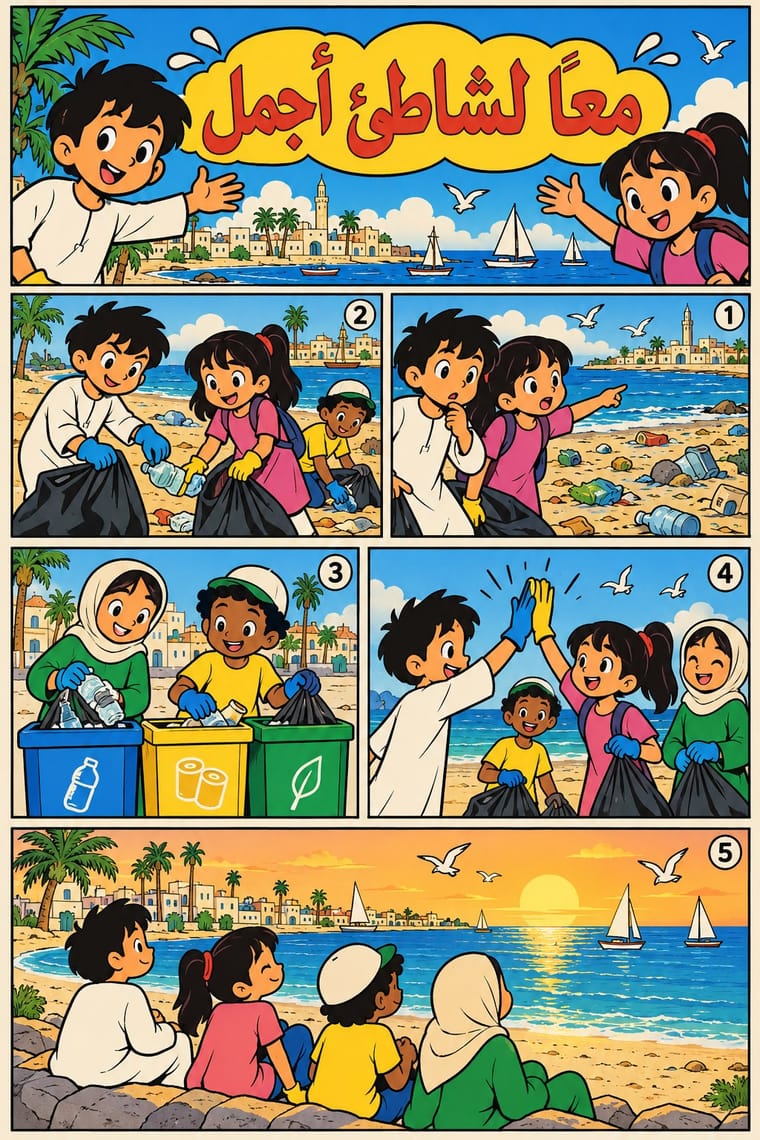
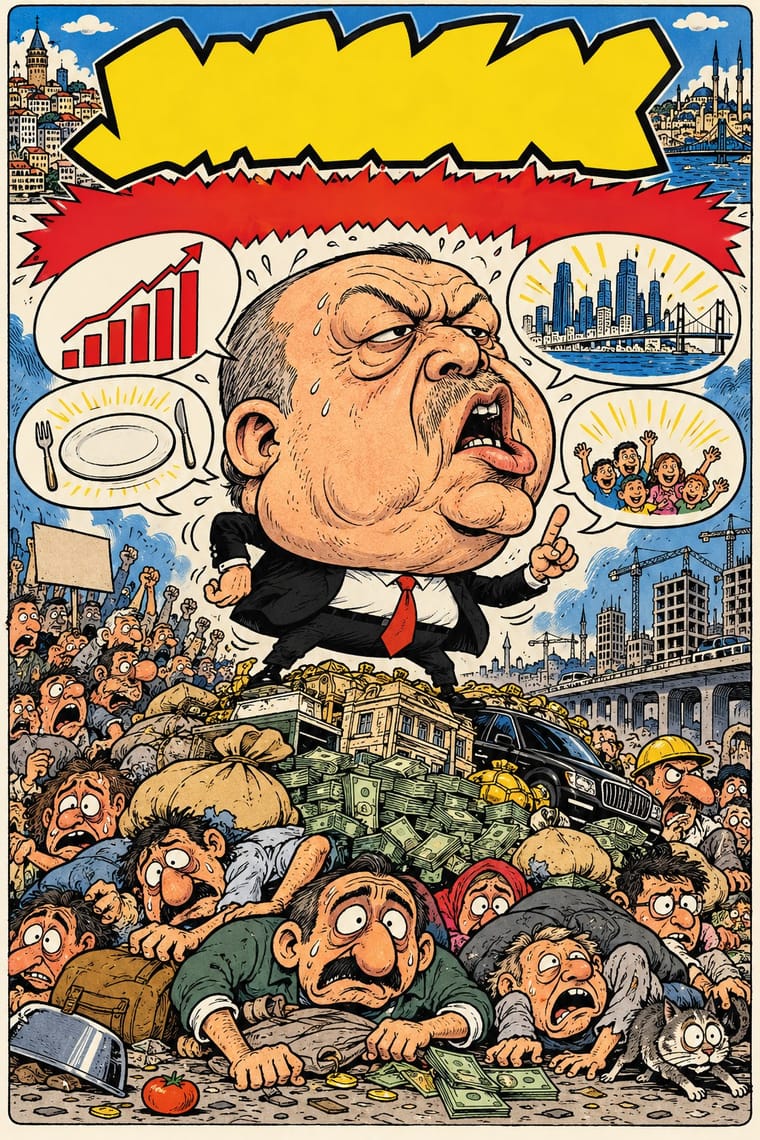
05
More combinations
With Arab Children's Comic Magazines
- Arab Independent Comics (Samandal, TokTok, Lab619, Skefkef) Contrasts · The adult, black-ink, dialect satire of Samandal and TokTok answers these mostly state-backed children's weeklies: set one raw independent strip against a bright magazine page to show the break.
- Amar Chitra Katha Comics Pairs well · Another postcolonial children's comic that teaches heritage in flat colour; combine its narrated caption boxes with the Arab weekly's gag strips and puzzle pages.
- Cairo–Beirut Arab Modernist Book & Periodical Design Pairs well · The same Cairo and Beirut artists (Ellabbad, Hegazi) drew for both: add its hand-drawn Kufic-derived titles, folk borders and spot colour to a magazine cover.
- Ligne Claire (Franco-Belgian Clear Line) Pairs well · Samir took the Belgian Tintin weekly as its model; borrow the even contour and evenly lit, legible settings to tighten a looser cartoon page.
With Turkish Weekly Humour Magazines
- Escuela Bruguera (Spanish Humour Comics) Contrasts · Both are weekly humour magazines from a stable of cartoonists, with grotesque caricature in hand-lettered panels. Bruguera kept its satire of manners under children's slapstick for Franco's censors; the Turkish weeklies put named politicians on the cover every week and took the lawsuits that followed.
- Arab Independent Comics (Samandal, TokTok, Lab619, Skefkef) Contrasts · Both are collectives' magazines that satirise power in street dialect and have been taken to court for it. The Arab magazines are small art-comics anthologies with no house style and no topical cover; the Turkish weeklies were mass newsstand titles built around one cover caricature of the week's news.
- ROSTA Windows Contrasts · Both turn the day's political news into hand-lettered satirical drawings for a mass audience. ROSTA stencilled numbered frames as agitation for the new state; the Turkish weeklies caricatured whoever held power, from Özal to Erdoğan, and were banned or sued for it.
- American Four-Colour Comic Book (Golden to Bronze Age) Contrasts · Both lettered balloons by hand in capitals over cartoon figures for the newsstand, and Gırgır took its balloons and photomontage from Mad, which began in 1952 as Harvey Kurtzman's comic book for EC. The American comic book told serial adventures in four-colour letterpress; the Turkish weeklies built each issue around one topical caricature of the week's politics, then an anthology of signed gag corners.
- Turkish Modernist Poster & Graphic Design Contrasts · Same city, same decades, opposite density: Istanbul's poster designers reduced a play or film to one flat idea on an open field, while the humour weeklies packed a cover with a caricature, balloons, headline band and price box. Borrow the poster's single idea to calm a crowded cover.
- Simplicissimus Satirical Style (Munich) Contrasts · A later weekly humour magazine of the same satirical stance: Gırgır, Penguen and Uykusuz pack covers with speech balloons, comic strips and colour; Simplicissimus gives one framed drawing and one caption.
- Underground Comix Contrasts · Both learned from Mad and crowd hand-lettered caricature into the panel, but the Istanbul weeklies are mass-circulation collective magazines whose cover lampoons the week's politics, while comix are self-published books whose shock is sex, drugs and taboo.
- O Pasquim Satirical Press Pairs well · Another cartoonist-led weekly where satire and local idiom carry political commentary under pressure.