Counterculture · 1980–1989 · Eastern Europe
Solidarność & Polish Underground Graphics
Also known as Solidarity graphics, Grafika Solidarności, Solidaryca (Solidarics) lettering, Drugi obieg (second-circulation) print
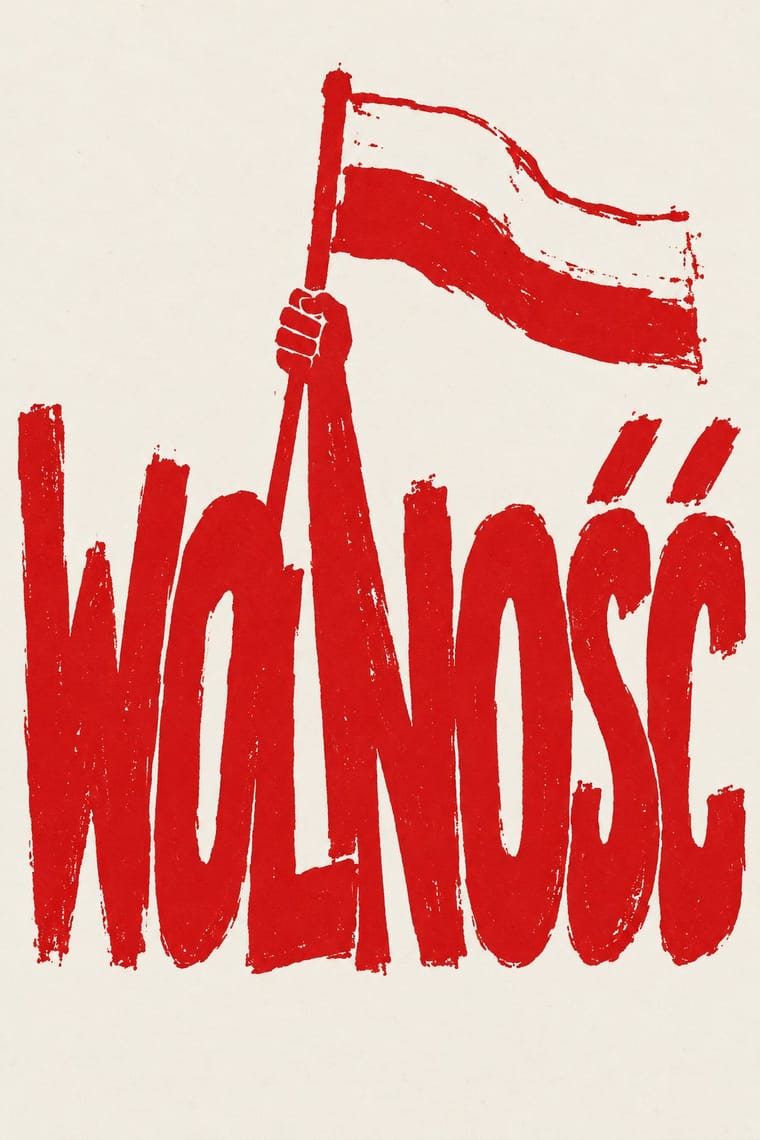
The graphic language of Poland's Solidarność movement, from the August 1980 shipyard strike to the semi-free election of 4 June 1989. Jerzy Janiszewski's logo, hand-drawn red letters crowding together like marchers under a small Polish flag, became a lettering style copied on posters, badges, banners and mastheads. Under martial law it went underground in one- or two-colour posters, typed bulletins, calendars and stamps built from shared signs (the cross, candles, the V sign, the torn flag), while the separate Orange Alternative painted ironic dwarfs on the walls.
Make something in this styleGet advice in this styleMix it with another style
Use it with care
This is still a living, contested sign: the NSZZ Solidarność union claims the logo, and a Gdańsk court awarded it the copyright and barred Janiszewski from licensing it, a ruling the Warsaw Court of Appeal upheld (reported in November 2025), while Fydrych won a copyright case over his Orange Alternative dwarf against the city of Wrocław in 2014; do not reuse the logo, or a pastiche of it, for a brand or campaign as if it were public domain. The iconography also carries Catholic symbols and the memory of people killed under martial law and after it (the nine Wujek miners shot in December 1981; Father Jerzy Popiełuszko, murdered by security-service officers in October 1984). Solidaryca is still used for logos and slogans about Poland, freedom and democracy, its designer has criticised its exploitation by right-wing groups, and the union itself has grown increasingly aligned with Law and Justice, so do not use the cross, the candles or the lettering as decoration or to suggest an endorsement nobody gave.
01
How it works
- Draw the one word by hand and crowd its letters together until they touch and lean on one another like people marching arm in arm, then raise a small white-and-red flag from one letter; let that word be the whole picture.
- Print in red on white or cheap paper, with black, or now and then brown or green, as the second ink, and settle for a single colour, red on cheap brown paper or black alone from a duplicator, when that is all a hidden press allows.
- Speak in signs everyone already knows: the cross, the anchor, the torn white-and-red flag, prison bars, a loaf of bread, a burning candle, the two-finger V and dates such as August '80 or 13 December, rather than in a private metaphor.
- Use whatever press can be hidden or borrowed, from a typewriter and a stencil duplicator to a silkscreen frame or an offset machine, and keep the layout simple enough to survive it.
- Answer force with irony: mock the generals of the WRON 'crow' and Jaruzelski's dark glasses, or, as the Orange Alternative did, paint a dwarf over the patch of paint that covers an anti-government slogan.
- Make the work for the wall, the lapel, the banner, the calendar and the bulletin, and mark every anniversary of a national uprising or a strike.
Gdańsk, late August 1980: a few days after the name 'Solidarność' first appeared on the title of the strike bulletin at the Lenin Shipyard on 23 August, Jerzy Janiszewski, a young Gdańsk graphic artist and poster maker from the city's art school (PWSSP), drew the movement's logo after the slogans written and stencilled on the shipyard walls; it won the Grand Prix of the 1981 Katowice Poster Biennale, and Henryk Tomaszewski, one of the masters of the Polish Poster School, made a poster for the union in 1989. From there the union's posters, badges, banners and papers spread across Poland and, after martial law was declared on 13 December 1981, went underground into the uncensored 'second circulation' (drugi obieg) presses. From 1982 the dwarf graffiti of Waldemar Fydrych's Orange Alternative appeared beside them in Wrocław: a separate art-activist movement of 'socialist surrealism', commonly seen as more leftist and less mainstream than Solidarity, whose orange stood apart from both socialist red and papal yellow
02
Its design choices
From Stylogeny’s vocabulary of design choices: defining choices make the style, characteristic ones are usual, occasional ones turn up now and then.
- Layout & composition
- Space & hierarchy
- Typography
- Colour
- Surface & texture
- Imagery
- Medium & production
- Tone & intent
- Avoids
- Full polychrome, Gradients, Fluorescent & neon, Eclectic mixing, Ornamented display, Abundant decoration, Gloss & highlights, Luxurious & glamorous
Palette
#f3efe6#d4161f#161616#a5835c#3f7a3c
Typefaces
Solidaryca (Solidarics)
the hand-drawn, crowded, mutually supporting letters of Janiszewski's 1980 logo, copied by hand for banners, mastheads and slogans; commercial 'Solidarics' fonts exist, but the V&A notes there is no established letter shape beyond the original logo
Typewriter text of the second circulation
retyped by typists onto protein stencils for hand frames and duplicators, with titles pricked through templates or built from typewriter characters; Letraset section heads in the photo-offset paste-ups from May 1981; and, in Biuletyn Dolnośląski from 1983, justified IBM composer setting
Hand-painted wall and banner lettering of the August 1980 strike and of martial law ('Zima wasza, wiosna nasza': winter is yours, spring will be ours), and the slogans stencilled on shipyard walls that inspired the logo
Set grotesque capitals for captions and dates on printed posters
'POLSKA '80' beside the logo in 1980, 'W SAMO POŁUDNIE 4 CZERWCA 1989' under Sarnecki's sheriff
Red hand-drawn capitals on amateur posters of the 1989 election campaign, such as Chylak's 'Głosuj na Solidarność'
Known for
Jerzy Janiszewski, Solidarność logo
(Gdańsk, late August 1980; English Wikipedia also credits 'K. Janiszewski' and Polish Wikipedia names Krystyna Janiszewska as co-designer): hand-drawn red letters that merge like people walking arm in arm under a white-and-red flag waving over the N; Grand Prix of the Katowice Poster Biennale, 1981; reprinted abroad as a black and red lithograph with 'Polska '80' in small set capitals (V&A title 'Solidarity. Poland '80', E.3124-1990)
Tygodnik Solidarność (from 1981), the first high-circulation independent weekly east of the Elbe since 1945, with its title written in solidaryca
Tygodnik Mazowsze (Warsaw, 11 February 1982 – 12 April 1989; 290 issues)
the underground weekly of Solidarity's Mazowsze region edited by Helena Łuczywo, with a Wałęsa motto under its title and the union's logo: usually four A4 pages, printed offset in runs of 50,000–80,000 including regional editions
Biuletyn Dolnośląski (Wrocław, from 1979; long edited by Kornel Morawiecki, later published by Fighting Solidarity)
typists retyped every text onto protein stencils on typewriters kept for that work, and the A4 pages were pulled on a hand frame or a duplicator in black alone; the first issue under martial law set a large red diagonal 'Solidarność' with its flag across the cover, and most other 1982 issues were duplicated, though the April–May 1982 issue was printed offset, as the paper had been in A5 from May 1981 until martial law
Gerard Lewandowski, poster for Solidarity's first anniversary (1981; V&A title 'Solidarity's First Year')
a photomontage of a hand making the V sign over a marching crowd, printed in brown and red with the logo (V&A, E.2101-1990)
Anonymous, 'Pax Sovietica' (1982)
a tank in the shape of a dove, cream on red, printed in secret on an underground press under martial law (V&A, E.1398-1993)
Anonymous, 'Solidarność żąda uwolnienia wszystkich więźniów politycznych'
(ca 1981 by the V&A's date field; V&A title 'Solidarity asks for the release of all political prisoners'): one colour, red on brown paper, the logo and sans capitals around a red creature of bars and jaws, closing 'Czyżby nie obowiązywało Porozumienie Gdańskie?' (Is the Gdańsk Agreement no longer in force?); the V&A reads its cheap paper and simple printing as signs of an underground edition, of the kind made quickly and secretly in private flats and studios (V&A, E.167-1991)
Calendar-poster of the Fighting Solidarity factory group of the Wrocław municipal transport company (1989; V&A title '8th Anniversary of the Uprising'): dates of national and Solidarity history marked with Polish flags, over a photograph of a demonstration (V&A, E.2216-1990)
03
Make something in this style
Say what you need, and Stylogeny’s image studio draws it from Solidarność & Polish Underground Graphics’s design choices and checks it against them. It takes about a minute, and you get a link to share.
04
Where it comes from, and what it’s close to
Before it
The style it grew out of, and the styles it borrowed from.


After it
The styles that grew out of it.
No later style in the atlas grew out of it yet.
Alike in its design choices
Styles that make many of the same choices, related or not, besides those above.
- Atelier Populaire (May '68 Screenprint Poster)69% alike
- Palestinian Watermelon and Keffiyeh Graphics68% alike
- Oaxacan Protest Printmaking & Street Graphics (ASARO)67% alike


05
Sources
- Victoria and Albert Museum, Pro-democracy Poster Collection and 'Solidarnosc Posters pre 1989' (the V&A marks most of these titles as 'generic title', i.e. cataloguers' titles): Jerzy Janiszewski, 'Solidarity. Poland '80', E.3124-1990, https://collections.vam.ac.uk/item/O192065/ (logo designed by Janiszewski in August 1980; inspired by slogans written and stencilled on the shipyard walls; letters form the shape of people joined together in a dense crowd; the socialist motif of a leader conducting a crowd replaced by the national flag; source of the 'Solidarics' (Solidaryca) typeface, 'often used for logos and slogans which refer to Poland in general as well for content relating to themes of nationalism freedom and democracy', with no established letter shape beyond the original logo); Ewa Baluk-Zaborowska, 'Elections '89', red and green, E.165-1991, https://collections.vam.ac.uk/item/O193612/
- Victoria and Albert Museum: Tomasz Sarnecki, 'High Noon. 4 June 1989', offset in black and red, style 'photo-montage', E.3125-1990, https://collections.vam.ac.uk/item/O76024/; Gerard Lewandowski, 'Solidarity's First Year' (1981), E.2101-1990, https://collections.vam.ac.uk/item/O191047/; 'Pax Sovietica' (1982, title assigned by the artist), printed in secret on an underground press, E.1398-1993, https://collections.vam.ac.uk/item/O76022/; 'Solidarity asks for the release of all political prisoners', red on brown paper, date ca 1981, E.167-1991, https://collections.vam.ac.uk/item/O193614/; '8th Anniversary of the Uprising' calendar-poster (1989), E.2216-1990, https://collections.vam.ac.uk/item/O191162/ (posters, postcards, stamps, leaflets and calendars; decentralised publishing); Henryk Tomaszewski, 'May Poland be Poland. 2+2 must always equal four' (1989), E.137-1991, https://collections.vam.ac.uk/item/O193584/ (Tomaszewski 'one of the greatest masters of the Polish Poster School'); Mikołaj Chylak, 'Vote for Solidarity' (1989), colour offset lithograph, E.2207-1990, https://collections.vam.ac.uk/item/O191153/ (amateur election poster; a spontaneous campaign with no professional staff and no funds); Solidarity badges, lithograph and screenprint on polystyrene, E.2247-1990, https://collections.vam.ac.uk/item/O148328/
- Jerzy Brukwicki and Czesław Bielecki, Dziękujemy za „Solidarność”: Plakaty „Solidarności” z lat 1980–1989 / Thank You for the 'Solidarity', exhibition catalogue, Krajowa Szkoła Administracji Publicznej and Stowarzyszenie Wolnego Słowa, Warsaw, 27 August – 27 December 2010, ISBN 978-83-61713-88-3, https://ksap.gov.pl/ksap/sites/default/files/files/katalog_wystawy.pdf (name on the strike bulletin on 23 August 1980 and the logo a few days later by Janiszewski, 'a graphic artist and a poster maker from Gdańsk'; hand-painted red letters under a white-and-red flag over the N; the new iconography of cross, anchor, torn flag, bread, bars, V sign, the number 13, Jaruzelski's dark glasses, flower crosses and candles; leaflets, posters, cards, calendars and underground stamps; 'Zima wasza, wiosna nasza' on the walls; the 1989 candidates photographed with Wałęsa, 260 of 261 elected, and Piotr Baumgart, who lost, 'the only one that didn't take a picture with Wałęsa')
- Wikipedia, 'Solidarity logo', https://en.wikipedia.org/wiki/Solidarity_logo (designed by 'Jerzy Janiszewski and K. Janiszewski in 1980'; Grand Prix of the Katowice Poster Biennale, 1981; letters meant to represent united individuals); Wikipedia (pl), 'Solidaryca', https://pl.wikipedia.org/wiki/Solidaryca (credits Krystyna Janiszewska and Jerzy Janiszewski, students of the Gdańsk PWSSP; letters meant to evoke a crowd supporting one another; the title of Tygodnik Solidarność, July 1981, written in solidaryca)
- Wikipedia (pl), 'Drugi obieg wydawniczy', https://pl.wikipedia.org/wiki/Drugi_obieg_wydawniczy (Mirosław Chojecki's duplicating from September 1976 and NOWa from September 1977; duplicators with protein and wax stencils, silkscreen and offset; typewriters making several copies; runs above 100,000 in silkscreen print shops; growth after martial law; over 4,500 book titles from 1981 to 1988); Wikipedia (pl), 'Tygodnik Mazowsze', https://pl.wikipedia.org/wiki/Tygodnik_Mazowsze (underground from its first issue on 11 February 1982 to the 290th on 12 April 1989; Helena Łuczywo editor-in-chief; a Wałęsa motto under the title and the union logo; offset, mostly four A4 pages, 50,000–80,000 copies including regional editions)
- Romuald Lazarowicz, 'Techniki powielania na przykładzie Biuletynu Dolnośląskiego', Solidarność Walcząca website, https://old.sw.org.pl/techniki.html (hand frame and protein stencils from 1979, typed by typists on dedicated typewriters; black and white only, no greys; two or three stencils typed at once under martial law; first martial-law issue with a large red diagonal 'Solidarność' and flag on the cover; the other 1982 issues duplicated; Letraset section heads; IBM composer from May 1983)
- Culture.pl, 'The Orange Alternative: There Is No Freedom without Dwarfs', https://culture.pl/en/article/the-orange-alternative-there-is-no-freedom-without-dwarfs (Fydrych and Cupała's first dwarf in 1982 in Biskupin, Wrocław, on walls painted over anti-government slogans; more than a thousand dwarf graffiti; over 60 happenings 1985–1990; Fydrych's 'Manifesto of Socialist Surrealism'; the movement 'commonly considered as more leftist and less mainstream than the Solidarity movement'; orange 'a colour distinct from both socialist red and Papal yellow'; Fydrych's 2014 copyright win against the city of Wrocław); Wikipedia, 'Orange Alternative', https://en.wikipedia.org/wiki/Orange_Alternative (first graffiti on the night of 30–31 August 1982)
- Notes from Poland, 'Poland's Solidarity trade union wins legal battle for control of iconic logo' (25 November 2025), https://notesfrompoland.com/2025/11/25/polands-solidarity-trade-union-wins-legal-battle-for-control-of-iconic-logo/ (Gdańsk court award of the copyright upheld on appeal; Janiszewski 'particularly critical of its exploitation by right-wing groups'; the union 'increasingly aligned with right-wing political groups, in particular the Law and Justice (PiS) party')
- Wikipedia, 'Martial law in Poland', https://en.wikipedia.org/wiki/Martial_law_in_Poland (declared 13 December 1981, suspended 31 December 1982, lifted 22 July 1983); Wikipedia, 'Pacification of Wujek', https://en.wikipedia.org/wiki/Pacification_of_Wujek (nine striking miners killed on 16 December 1981); Wikipedia, 'Jerzy Popiełuszko', https://en.wikipedia.org/wiki/Jerzy_Popie%C5%82uszko (beaten to death by three Security Police officers on 19 October 1984)
How Stylogeny researches and checks a style: where the facts come from.