Pictorial & machine age · 1923–1949 · East Asia
Republican Chinese Book Cover Design (Lu Xun & Tao Yuanqing)
Also known as New Literature book design of the Republican era (民国新文艺书籍装帧), New Literature book covers, Tao–Qian–Feng covers (陶钱丰: Tao Yuanqing, Qian Juntao, Feng Zikai)
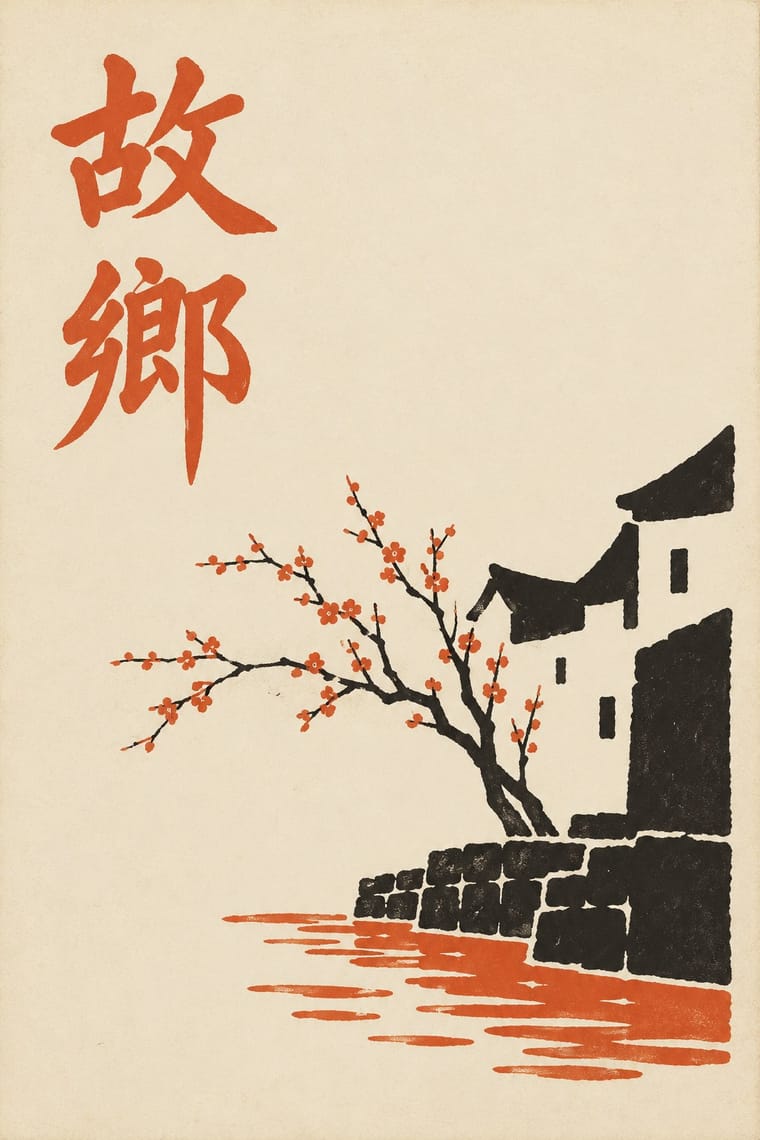
The covers of China's New Literature. From 1923 the writer Lu Xun took up cover design in earnest, and from 1924 he commissioned the painter Tao Yuanqing; he called covers with titles inscribed by famous people or set in lead type 'old hat' (老套). A hand-drawn title, two or three flat colours and one symbolic motif sit on a wide, plain field with generous margins. The motif is often taken from Han and Six Dynasties stone carvings, cut into angular silhouettes or, more rarely, painted in free brush. Qian Juntao and Feng Zikai carried the manner on at Shanghai's Kaiming Bookstore.
Make something in this styleGet advice in this styleMix it with another style
Use it with care
Hand-drawn titles must be real, correctly formed Chinese characters checked by a fluent reader: pseudo-characters, mirrored strokes or random hanzi used as texture read as nonsense, a common failure of image models imitating this style. Tao Yuanqing's and Lu Xun's designs are in the public domain, but Qian Juntao's (he died in 1998) and Feng Zikai's (he died in 1975, so still protected in life-plus-70 countries) are not; draw new motifs, and do not copy an artist's personal seal or monogram as decoration.
01
How it works
- Draw the title by hand, in a brush hand or in constructed 'art lettering', rather than having a famous person inscribe it or setting it in lead type.
- Leave most of the cover empty: one plain paper or single-colour field, wide margins and a single motif placed off-centre.
- Print in two or three flat inks, black with an earth red, ochre or orange, with no modelling or gradation.
- Let one emblematic figure, object or sun stand for the book's mood instead of illustrating a scene from it.
- Redraw motifs from Han stone reliefs, tomb art and seals (clouds, beasts, processions) as flat modern ornament, framed by a few rules.
- Design the whole book as one object: cover, endpapers, title page, type area and untrimmed (毛边) page edges together.
Beijing and Shanghai, China: the New Literature presses (Xinchao she, Beixin Bookstore, Weiming she, later Kaiming Bookstore), where the writer Lu Xun, whose first cover design was Yuwai xiaoshuo ji (Tokyo, 1909), designed his own covers from 1923 and from 1924 commissioned the painter Tao Yuanqing; Qian Juntao, Feng Zikai, Sun Fuxi and Situ Qiao followed. Lu Xun borrowed from Japanese book design (plainness, a single colour, empty space) and from modern Western book design; the Bixia yicong cover pattern came from a Japanese art series. This entry covers only that New Literature strand. Chen Zhifo, who also emerged under Lu Xun's influence, made ornate patterned covers, such as Yu Dafu's Chanyu ji (Tianma Bookstore, 1933): an earth-yellow ground over the whole cover, bronze-vessel ornament outside a black frame and a pattern of pavilions, trees, clouds and rivers inside it. Those covers, and the Art Deco and photomontage magazines of 1930s Shanghai such as Modern Sketch (see shanghai-modern), belong to other strands.
02
Its design choices
From Stylogeny’s vocabulary of design choices: defining choices make the style, characteristic ones are usual, occasional ones turn up now and then.
- Layout & composition
- Space & hierarchy
- Typography
- Colour
- Form & shape
- Surface & texture
- Ornament
- Imagery
- Medium & production
- Tone & intent
- Avoids
- Gradients, Full polychrome, Naturalistic depiction, Straight photography, Abundant decoration, Horror vacui, Illusion of depth, Luxurious & glamorous
Palette
#efe8d8#1e1b16#e39a2d#d4552b#8b2b22
Typefaces
Lu Xun's hand-drawn and brush-written title characters
Nahan, 1926; Eryi ji
Meishuzi (美术字, 'art lettering')
constructed display characters, favoured by Qian Juntao
Songti (Song/Ming) lead type for author, publisher and running text, and for plain printed covers such as Huagai ji
Seal marks
carved seals and circled monograms set into a corner of the design (Tao Yuanqing, Qian Juntao) and the tilted seal on Huagai ji xubian
Known for
Tao Yuanqing (1893–1929), cover for Lu Xun's translation of Kuriyagawa Hakuson's Kumen de xiangzheng (Symbol of Depression, March 1925), the first cover of their collaboration, which Lu Xun said dressed the book in a 'bleak and gorgeous new attire' (凄艳的新装)
Tao Yuanqing, cover for Lu Xun's Panghuang (Wandering, Beixin Bookstore, 1926)
three flat black, angular figures on a chair and a small rayed sun on an orange field between red bands
Tao Yuanqing, cover for the Wuhe congshu (乌合丛书) series edited by Lu Xun
a black-and-white frieze of angular figures, stripes, zigzags and chevrons above an empty field, the series title hand-drawn between double rules
Tao Yuanqing, cover for Lu Xun's Zhaohua xishi (Dawn Blossoms Plucked at Dusk), painted in a free-brush (写意) manner
a woman in white walking through a garden with a bare branch, on bright yellow; Lu Xun had the book credit '陶元庆作书面' (cover by Tao Yuanqing)
Lu Xun (1881–1936), cover and title for Nahan (Call to Arms, Beixin Bookstore, May 1926)
jujube-red paper with a nested black and red frame around the drawn title and author's name
Lu Xun, cover for his translation of Eroshenko's Taose de yun (Peach-Coloured Clouds, Xinchao she, July 1923), decorated with figures, birds, beasts and flowing clouds taken from Han pictorial stones
Lu Xun, title-page design for Fen (The Grave)
the hand-drawn title boxed in a frame of cloud, rain, moon and tree motifs under an owl (Beijing Lu Xun Museum)
Lu Xun, covers for Eryi ji (pale yellow, lettering only, between handwriting and art lettering) and Xin de tanxian
Beixin Bookstore, 1926, with clouds, immortals and beasts from Six Dynasties tomb art
03
Make something in this style
Say what you need, and Stylogeny’s image studio draws it from Republican Chinese Book Cover Design (Lu Xun & Tao Yuanqing)’s design choices and checks it against them. It takes about a minute, and you get a link to share.
04
Where it comes from, and what it’s close to
Before it
The style it grew out of, and the styles it borrowed from.

After it
The styles that grew out of it.
No later style in the atlas grew out of it yet.
Alike in its design choices
Styles that make many of the same choices, related or not, besides those above.


05
Sources
- Wei Ren, 'The Writer's Art: Tao Yuanqing and the Formation of Modern Chinese Design (1900–1930)', dissertation, Harvard University (2015) (https://dash.harvard.edu/handle/1/42693623)
- Zhang Yunlong (张云龙), '论鲁迅对我国现代书籍装帧设计的贡献' (On Lu Xun's contribution to modern Chinese book design), Dongyue luncong 2022, no. 7, reprinted by China Social Sciences Net, 7 September 2023 (https://www.cssn.cn/ysx/ysx_xksy/202309/t20230907_5684003.shtml)
- Wang Mei (王梅), '鲁迅&陶元庆:赠先生一束西湖梅' (Lu Xun and Tao Yuanqing), Beijing Evening News, 28 February 2023, via China Writers Network (https://www.chinawriter.com.cn/n1/2023/0228/c404063-32632624.html)
- Zhang Xinge (张欣阁), '中国现代文学馆举办"鲁迅先生与书籍装帧"展' (The China Museum of Modern Literature holds the exhibition 'Mr Lu Xun and Book Design'), China Writers Network, 25 September 2021 (https://www.chinawriter.com.cn/n1/2021/0925/c403994-32236006.html)
- Zhang Xinge (张欣阁), '探索书籍装帧的“新”形式——鲁迅版本档案的分析与研究' (Lu Xun's editions and the new forms of book design), China Writers Network, 30 November 2021, quoting Qian Juntao's 我对鲁迅的回忆, in the anthology 回忆鲁迅的美术活动 (续编, 1981) (https://www.chinawriter.com.cn/n1/2021/1130/c419387-32295451.html)
- People's Daily Overseas Edition, '走进鲁迅的艺术世界' (Into Lu Xun's art world, on the Beijing Lu Xun Museum exhibition at the Chengdu Museum), 25 June 2024 (https://paper.people.com.cn/hwbwap/html/2024-06/25/content_26065430.htm)
- Xie Qizhang (谢其章), '封面画的署名' (Signatures on cover pictures), Shanghai Review of Books, The Paper, 2 February 2019 (https://www.thepaper.cn/newsDetail_forward_2940140)
- Qun Shan (群山), '《忏余集》的封面装帧艺术' (The cover design of Chanyu ji, on Chen Zhifo), Cangshu bao, via China Writers Network, 9 March 2023 (https://www.chinawriter.com.cn/n1/2023/0309/c419387-32640094.html)
- James Woudhuysen, 'The graphics of China', review of Scott Minick and Jiao Ping, Chinese Graphic Design in the Twentieth Century (Thames and Hudson, 1990), Design Week, November 1990 (https://woudhuysen.com/the-graphics-of-china)
- Wikimedia Commons, 'File:Panghuang bookcover.jpg', Tao Yuanqing's cover design, from Beijing Lu Xun Museum (ed.), 北京鲁迅博物馆藏画选 (1986) (https://commons.wikimedia.org/wiki/File:Panghuang_bookcover.jpg)
- Wikimedia Commons, 'File:Wuhecongshu book cover.jpg', Tao Yuanqing's cover design for the Wuhe series, from the same Beijing Lu Xun Museum volume (https://commons.wikimedia.org/wiki/File:Wuhecongshu_book_cover.jpg)
- Wikimedia Commons, 'File:Fen-book cover.jpg', Lu Xun's design drawing for Fen, from the same Beijing Lu Xun Museum volume (https://commons.wikimedia.org/wiki/File:Fen-book_cover.jpg)
- Wikipedia (Chinese), '陶元庆' (Tao Yuanqing) (https://zh.wikipedia.org/wiki/%E9%99%B6%E5%85%83%E5%BA%86)
- Wikipedia (Chinese), '钱君匋' (Qian Juntao) (https://zh.wikipedia.org/wiki/%E9%92%B1%E5%90%9B%E5%8C%8B)
- Wikipedia (Chinese), '彷徨' (Panghuang) (https://zh.wikipedia.org/wiki/%E5%BD%B7%E5%BE%A8)
- Wikipedia (Chinese), '域外小说集' (Yuwai xiaoshuo ji, Tokyo, 1909) (https://zh.wikipedia.org/wiki/%E5%9F%9F%E5%A4%96%E5%B0%8F%E8%AF%B4%E9%9B%86)
- Wikipedia (Chinese), '韦丛芜' (Wei Congwu, author of Junshan) (https://zh.wikipedia.org/wiki/%E9%9F%A6%E4%B8%9B%E8%8A%9C)
- Wikipedia, 'Feng Zikai' (https://en.wikipedia.org/wiki/Feng_Zikai)
- Wikipedia, 'Modern Sketch' (Art Deco and photomontage in the Shanghai magazine, 1934–37) (https://en.wikipedia.org/wiki/Modern_Sketch)


How Stylogeny researches and checks a style: where the facts come from.