Style combination · Contrasts
Indie Pixel Art Revival × Isometric Tech Illustration
Clean, front-lit, rational SaaS geometry against moody, side-on, nostalgic landscapes built from visible pixels.
Mix them and make something Indie Pixel Art Revival Isometric Tech Illustration
01
What each style brings
Each part of the design comes from the style with the stronger say in it, and each style gives at least two.
Indie Pixel Art Revival Isometric Tech Illustration
- Type from Indie Pixel Art Revival
- Colour from Isometric Tech Illustration
- Form from Isometric Tech Illustration
- Composition from Indie Pixel Art Revival
- Surface from Indie Pixel Art Revival
-
02
The type
Open fonts standing in for each style’s own type, which is often hand-drawn or commercial.
Display · Indie Pixel Art Revival
Pop
Pixelify Sans, standing in for Custom bitmap lettering drawn per game for titles and interface
Text · Isometric Tech Illustration
Small diorama worlds of devices, servers, desks, factories and city blocks drawn on one isometric grid (about 30 degrees; pixel work uses a 2:1 step, about 26.6 degrees) with no vanishing point. Each volume has one flat tone for its top and two for its sides, on a white or pale ground, so it reads as three-dimensional without lighting or rendering. Used for hero images, onboarding, icons and explainers, it gave flat design back its depth while keeping its clean vector surfaces and its technological optimism.
Inter; Isometric Tech Illustration used Geometric and neo-grotesque web sans-serifs set flat beside the drawing, such as those of the SaaS interfaces the illustrations sit in and Isometric lettering
03
The colours
The ground and leading colours come from Isometric Tech Illustration, with a counter-accent from Indie Pixel Art Revival. The ink reads on the ground at 4.5:1 or more.
Indie Pixel Art Revival Isometric Tech Illustration
-
#f4f6fbground · 36% -
#1f2440ink · 14% -
#ffb648accent · 18% -
#e0607eaccent · 14% -
#5b6cffaccent · 10% -
#5fc9c4accent · 8%
As CSS
:root {
  --ground: #f4f6fb;
  --ink: #1f2440;
  --accent-1: #ffb648;
  --accent-2: #e0607e;
  --accent-3: #5b6cff;
  --accent-4: #5fc9c4;
  --font-display: "Pixelify Sans", monospace;
  --font-text: "Inter", sans-serif;
}
04
The two styles
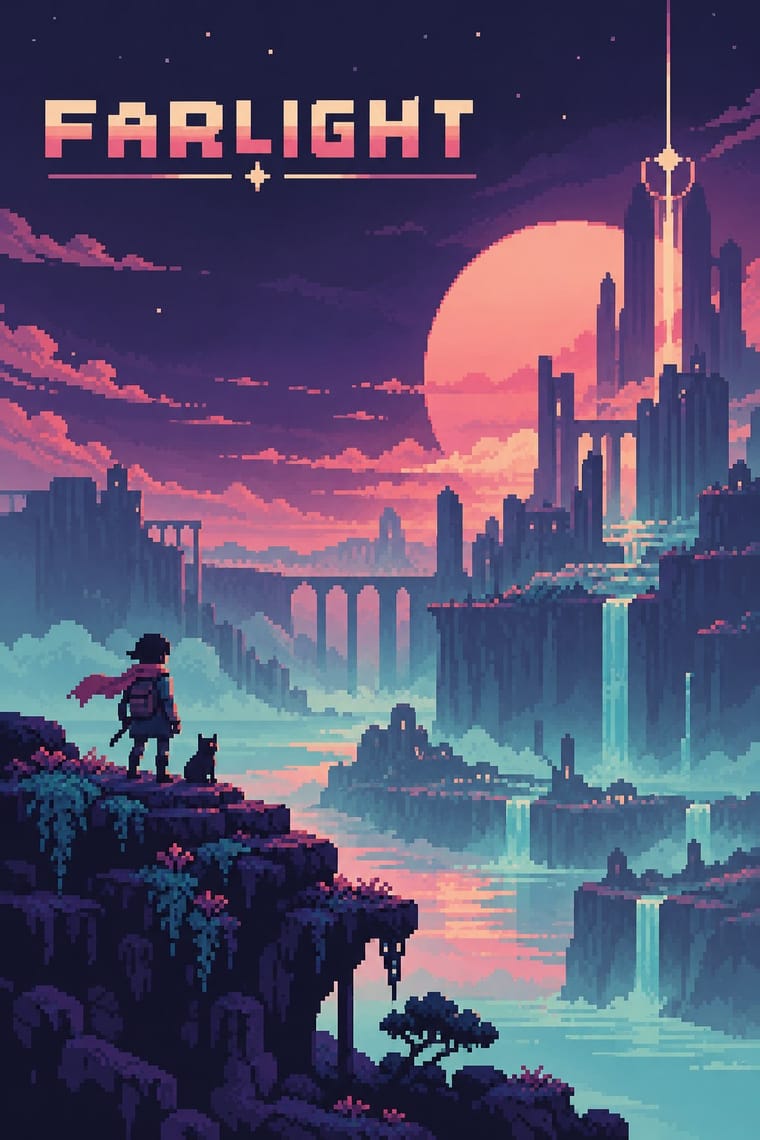

05
More combinations
With Indie Pixel Art Revival
- Flat Design Contrasts · Resolution-independent vector flatness against a deliberately coarse grid lit with glows and depth.
- Synthwave / Outrun Pairs well · Borrow the neon sunset and horizon gradient for key art, keeping the figure and type on the pixel grid.
- Lo-fi Anime Aesthetic Pairs well · Both keep a quiet figure in a moody dusk scene; lo-fi's painted warmth softens the pixel grid for loops and covers.
- Story Manga (Postwar Japanese Comics) Pairs well · Expressive manga portraits in dialogue boxes give the tiny sprites a face, as many of these games do.
With Isometric Tech Illustration
- Bitmap & Pixel Graphics Pairs well · Draw the same isometric world in visible pixels for an eBoy-like, game-flavoured version.
- Claymorphism & Soft 3D Contrasts · Soft, inflated 3D forms against crisp axonometric blocks: the same toy worlds, rendered rather than projected.
- Isotype Pictorial Statistics Pairs well · Borrow Isotype's counted pictograms to turn a diorama into an honest explainer of quantities.
- Low Poly Illustration Contrasts · Faceted meshes with perspective against parallel-projected boxes in three flat tones.
- Corporate Memphis Pairs well · Its rubbery flat figures often stand inside isometric scenes on the same landing page; keep them small so the grid still rules.
- Isometric Pixel Art Contrasts · Same tilted projection, opposite temper: sparse vector SaaS diagrams on white against a crammed, ironic pixel city.