Style combination · Contrasts
French-Pattern Playing Cards × Mamluk Playing-Card Design
Same job of ranking suit and court at a glance, but this one names courts in script and emblem where the French pattern draws double-headed figures with corner indices.
Mix them and make something French-Pattern Playing Cards Mamluk Playing-Card Design
01
What each style brings
Each part of the design comes from the style with the stronger say in it, and each style gives at least two.
French-Pattern Playing Cards (Court Cards and Indices) Mamluk Playing-Card Design (Mulūk wa-Nuwwāb)
- Type from Mamluk Playing-Card Design
- Colour from French-Pattern Playing Cards
- Form from French-Pattern Playing Cards
- Composition from Mamluk Playing-Card Design
- Surface from French-Pattern Playing Cards
02
The type
Open fonts standing in for each style’s own type, which is often hand-drawn or commercial.
Display · Mamluk Playing-Card Design
Hello
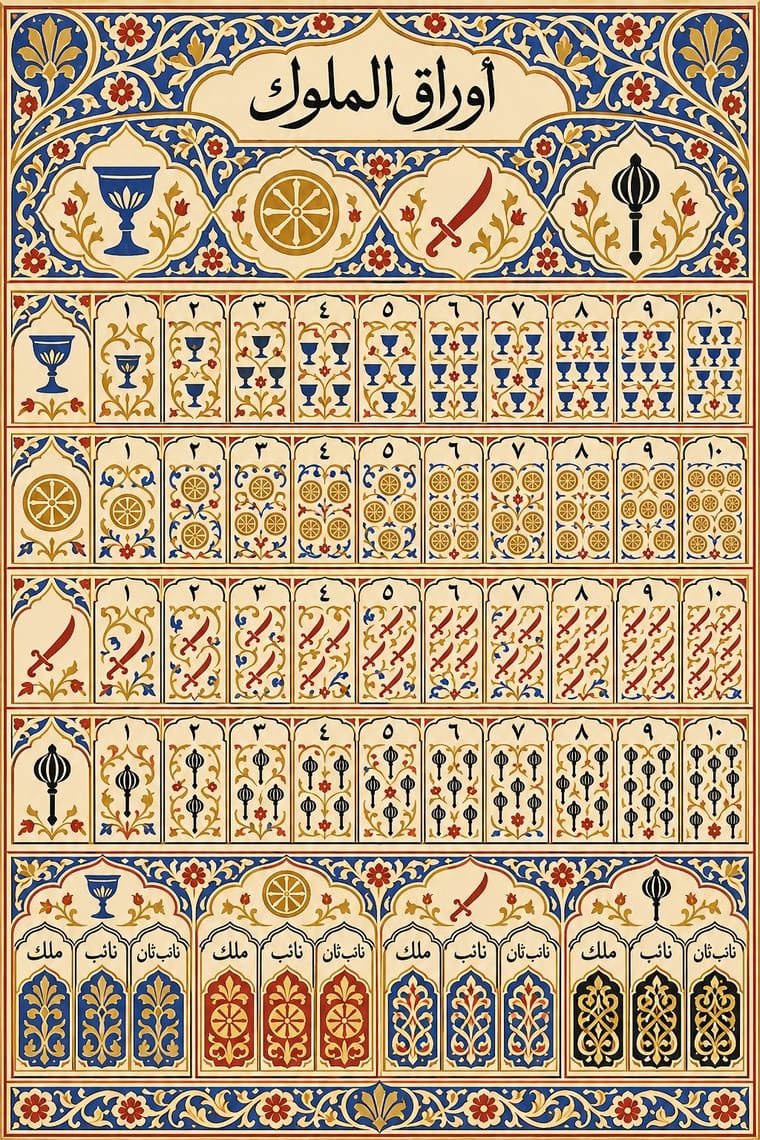
Rakkas, standing in for Arabic calligraphic bands of verse in gold on blue along the tops of the cards (partly later additions; the verse is unrelated to the cards)
Text · French-Pattern Playing Cards
The standard 52-card deck, a design system for playing rather than a single allegorical image: four reduced suit signs in red and black, thirteen ranks, and court cards drawn as flat-coloured, outlined figures. In the English pattern the courts are mirrored double-headed figures so they read from either side, and small numerals and suit signs in the corners (indices) name every card at a glance, even in a fanned hand. Printed from blocks and plates, later by lithography.
Libre Caslon Text; French-Pattern Playing Cards used Small roman numerals and letters (A, K, Q, J) in the corner indices, in serif or later sans forms and Hand-cut or engraved suit signs and court emblems drawn as part of the card design
03
The colours
The ground and leading colours come from French-Pattern Playing Cards, with a counter-accent from Mamluk Playing-Card Design. The ink reads on the ground at 4.5:1 or more.
French-Pattern Playing Cards (Court Cards and Indices) Mamluk Playing-Card Design (Mulūk wa-Nuwwāb)
-
#f4efe2ground · 36% -
#1a1a1aink · 14% -
#e8b923accent · 18% -
#c9a24aaccent · 14% -
#c8202aaccent · 10% -
#2a4f9eaccent · 8%
As CSS
:root {
  --ground: #f4efe2;
  --ink: #1a1a1a;
  --accent-1: #e8b923;
  --accent-2: #c9a24a;
  --accent-3: #c8202a;
  --accent-4: #2a4f9e;
  --font-display: "Rakkas", cursive;
  --font-text: "Libre Caslon Text", serif;
}
Use it with care
Mamluk Playing-Card Design (Mulūk wa-Nuwwāb): The pack is a mixed, partly replaced survival (a composite of up to three packs): sources disagree on how many cards remain and how ranks were assigned, the blue and gold panels are partly later additions, many reproductions are the flawed 1972 facsimile or colourised photographs, and the dates are a bracket. The absence of portraits in this pack is not a rule for all Islamic card traditions.
04
The two styles
05
More combinations
With French-Pattern Playing Cards
- European Heraldry Pairs well · Flat tinctures, emblems and mirrored figures give a court card its crest-like look; pair heraldic charges with a double-headed court for an armorial deck or label.
- Tarot de Marseille Woodcut Cards Contrasts · Both use outlined figures in a few flat colours, but the tarot card isolates one allegorical subject under a numeral and a title, while the playing card mirrors its court and counts its suit signs; choose tarot for a single symbol, the playing card for a repeatable system.
With Mamluk Playing-Card Design
- Islamic Geometric & Calligraphic Tradition Pairs well · Borrow its arabesque and calligraphic bands, but confine them to fixed rank panels instead of letting a tiling run on without limit.
- Hanafuda Card Design (Japanese Flower Cards) Pairs well · Another non-European card system where emblem, rank and seasonal or suit identity are carried by flat painted signs.