Rational modernism · 2012–present · Oceania, Western Europe, Northern Europe, North America, Global / networked
Plain Tobacco Packaging
Also known as Plain packaging, Standardised packaging, Paquet neutre (France), Drab dark brown packs, Pantone 448 C packs
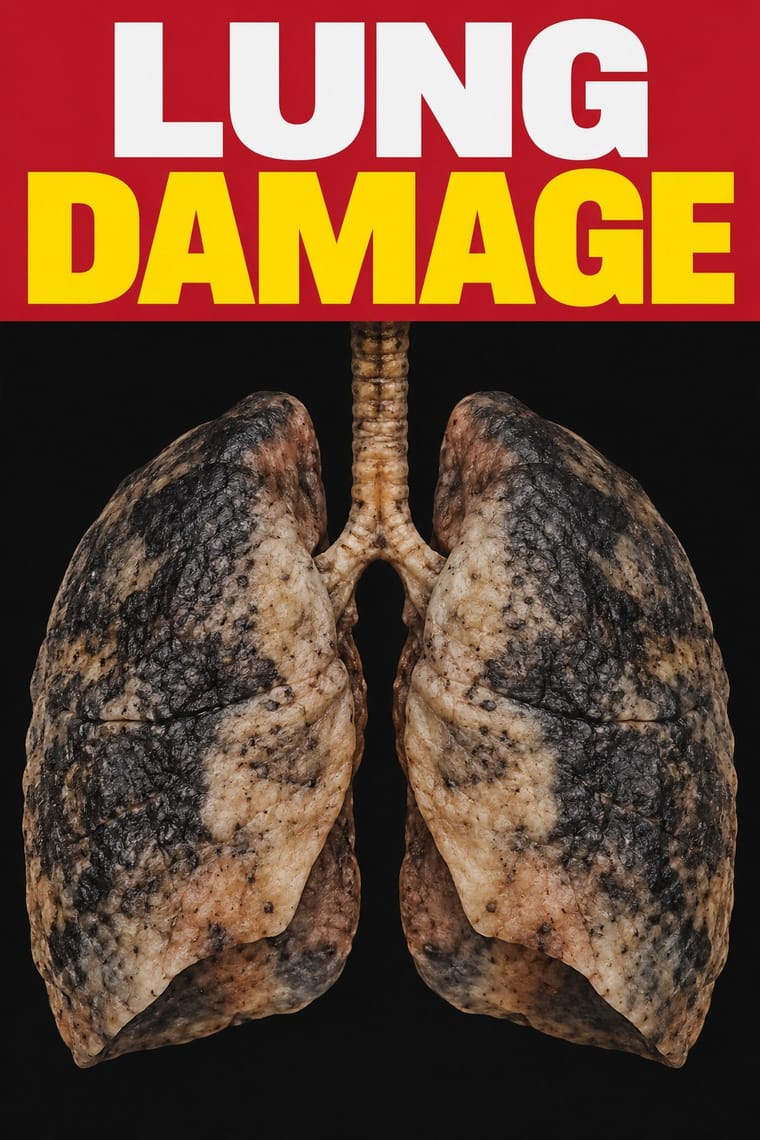
A packaging language written into law to strip tobacco of persuasion. Since Australia's Tobacco Plain Packaging Act 2011 (all retail packs from 1 December 2012), logos, brand colours, imagery and embossing are banned: every pack is a rigid, matt rectangle in Pantone 448C 'drab dark brown', chosen in consumer testing as the least appealing colour. Clinical photographs of disease under bold Helvetica capitals fill most of the front and back, and the brand survives as one small centred line of grey sans-serif, with the variant name on a smaller line below. More than twenty countries followed.
Make something in this styleGet advice in this styleMix it with another style
Use it with care
Graphic health warnings show real disease and are official public-health instruments; WHO's warning database lists the Australian Government as the owner of its warning images, which it may license to other countries free of charge. Use the shock imagery only for genuine health communication, never as decoration or as a parody that could mislead about a product's risks, and check the terms before reproducing a country's actual warning photographs or mandated layouts. Respect the dignity of the people pictured, never generate imagery that could pass for an official warning, and do not turn the drab-pack look into anti-brand styling for tobacco, vaping or nicotine products, which would make a tool against persuasion persuasive again.
01
How it works
- Ban every brand asset: no logos, trade marks, pictures, patterns, promotional text or embellishments; let only the brand, company and variant names survive, each on a single line with the variant directly below the brand, and no more than once on each permitted face.
- Print every outer surface in one flat, matt and deliberately unappealing colour (Pantone 448C, drab dark brown), keep the inside white, and allow no gloss, metallic ink, embossing or textured finish.
- Give the face to the warning: usually a clinical photograph of disease, with a blunt statement in bold Helvetica capitals, over most of the front and back (75% and 90% of a cigarette pack in Australia), on black, red and yellow bands.
- Set the brand name small and standard: one prescribed sans (Lucida Sans in Australia, Helvetica in the UK), regular weight, no larger than 14 pt (variant names 10 pt), in pale Cool Gray 2C, centred in the space below the warning (initial capitals only in Australia; the UK also allows a lower-case first letter).
- Fix the object as well as the print: in Australia, a rigid cardboard box with straight edges, 90-degree corners and a plain flip-top lid, and white cigarettes with white filters, so that no shape, opening or stick can stand in for a brand; the UK requires only a cuboid packet, allowing bevelled or rounded edges and a flip-top or shoulder-box lid (SI 2015/829 reg. 4).
- Write every decision as a number in the law (Pantone references, point sizes, percentages, positions), so that every brand comes out identical and nothing is left to a designer's judgement.
Canberra, Australia: the Tobacco Plain Packaging Act 2011 (No. 148, assented to 1 December 2011) and the Tobacco Plain Packaging Regulations 2011, with the graphic health warnings of the Competition and Consumer (Tobacco) Information Standard 2011; plain packs were required for tobacco made from 1 October 2012 and for all retail sales from 1 December 2012. The pack colour followed consumer testing by GfK Bluemoon for the Department of Health and Ageing (August 2011). Earlier proposals came from New Zealand's Toxic Substances Board (1989: white packs, black text, no colours or logos) and Canadian health officials (1994). The WHO Framework Convention's guidelines for Articles 11 and 13, adopted at the third Conference of the Parties in Durban in November 2008 (decisions FCTC/COP3(10) and FCTC/COP3(12)), recommended that Parties consider plain packaging, with only brand and product names displayed in a standard colour and font style. The UK, France, New Zealand, Norway, Ireland, Thailand, Uruguay, Canada, Singapore and others followed Australia, each writing its own specification into law, and WHO urged all governments to prepare for plain packaging on World No Tobacco Day, 31 May 2016. The packs were specified by health officials, lawmakers and market researchers rather than by designers working in a lineage; their kinship with corporate modernism lies in the method, a manual of Pantone references, point sizes and positions
02
Its design choices
From Stylogeny’s vocabulary of design choices: defining choices make the style, characteristic ones are usual, occasional ones turn up now and then.
- Layout & composition
- Space & hierarchy
- Colour
- Surface & texture
- Medium & production
- Tone & intent
- Avoids
- Abundant decoration, Emblems & badges, Gloss & highlights, Jewel & metallic, Gradients, Pastel, Ornamented display, Script, Luxurious & glamorous, Playful & witty
Palette
#4a412a#d0d0ce#ffffff#111111#c8102e#ffd100
Typefaces
Lucida Sans (Charles Bigelow and Kris Holmes)
the only face allowed for brand, business, company and variant names on Australian packs, in regular weight with initial capitals only, the brand no larger than 14 pt and the variant no larger than 10 pt, in Pantone Cool Gray 2C
Helvetica (Max Miedinger with Eduard Hoffmann, 1957)
Australia's warning statements in bold capitals and its explanatory and information messages in upper and lower case, under the Competition and Consumer (Tobacco) Information Standard 2011
Helvetica for brand and variant names in the UK under the Standardised Packaging of Tobacco Products Regulations 2015, in a normal regular weight and Pantone Cool Gray 2 C with a matt finish; the first letter of a word may be upper- or lower-case and the rest is lower-case
Known for
Tobacco Plain Packaging Act 2011 (Australia, No. 148, assented to 1 December 2011)
matt surfaces in drab dark brown, no trade marks or marks other than the brand, business, company and variant names, each across one line only, the variant immediately below the brand, no more than once on the front, top and bottom, and centred in the space below the health warning on the front
Tobacco Plain Packaging Regulations 2011 (Australia)
all outer surfaces Pantone 448C, inner surfaces white, foil lining silver with a white paper backing; names in Lucida Sans, regular weight, brand no larger than 14 pt and variant no larger than 10 pt, in Pantone Cool Gray 2C; white cigarette paper (or imitation cork tip), white filter tips and an optional alphanumeric code in Lucida Sans of no more than 8 pt
Competition and Consumer (Tobacco) Information Standard 2011 (Australia)
graphic health warnings over at least 75% of the front and 90% of the back of cigarette packs, with warning statements such as 'SMOKING CAUSES BLINDNESS' and 'SMOKING KILLS' in Helvetica bold capitals, white on black on the front and white on red on the back, and a 'WARNING' information message in black on yellow
GfK Bluemoon, Market Research to Determine Effective Plain Packaging of Tobacco Products
(August 2011), the consumer testing for the Australian Department of Health and Ageing behind the pack colour; the shade, first described as 'olive green', was renamed 'drab dark brown' after objections from the Australian Olive Association
Standardised Packaging of Tobacco Products Regulations 2015
(UK, made 19 March 2015, in force 20 May 2016, for all retail supply from 21 May 2017): external packaging in Pantone 448 C with a matt finish; brand and variant names in Helvetica in Pantone Cool Gray 2 C, no larger than 14 pt and 10 pt, each on one line with the variant immediately below the brand, centred on the surface, the first letter of a word in upper- or lower-case; a cuboid cigarette packet that may have bevelled or rounded edges and a flip-top or shoulder-box lid (reg. 4)
Later plain-pack laws in France (1 January 2017), New Zealand (6 June 2018), Norway (1 July 2018), Ireland (30 September 2018), Thailand (8 December 2019, warnings over 85% of the pack), Uruguay (21 December 2019), Canada (7 February 2020) and Singapore (1 July 2020)
WHO, Plain packaging of tobacco products
evidence, design and implementation (30 May 2016), published for World No Tobacco Day 2016
03
Make something in this style
Say what you need, and Stylogeny’s image studio draws it from Plain Tobacco Packaging’s design choices and checks it against them. It takes about a minute, and you get a link to share.
04
Where it comes from, and what it’s close to
Before it
The style it grew out of, and the styles it borrowed from.


After it
The styles that grew out of it.
No later style in the atlas grew out of it yet.
Alike in its design choices
Styles that make many of the same choices, related or not, besides those above.


05
Sources
- Tobacco Plain Packaging Act 2011 (Cth), No. 148, 2011, as made (https://legislation.gov.au/C2011A00148/asmade/2011-12-01/text/original/pdf): assent 1 December 2011; commencement 1 October and 1 December 2012; s. 18 (no embossing or embellishment, rigid cardboard, rectangular faces, 90-degree edges, flip-top lid), s. 19 (matt finish, drab dark brown), s. 20 (no trade marks or marks), s. 21 (names no more than once on the front, top and bottom, s. 21(2)(d) each across one line only, centred below the health warning on the front; table item 4: the variant name horizontally and immediately below the brand, business or company name)
- Tobacco Plain Packaging Regulations 2011 (Cth), as made (https://legislation.gov.au/F2011L02644/asmade/2011-12-12/text/original/word): reg. 2.2.1 (Pantone 448C outer surfaces, white inner surfaces, silver foil lining with white paper backing), reg. 2.4.1 (Lucida Sans, 14 pt brand and 10 pt variant names, initial capitals only, regular weight, Pantone Cool Gray 2C), regs 3.1.1 to 3.1.3 (white cigarette paper, alphanumeric code in Lucida Sans no larger than 8 pt, white filter tips)
- Tobacco Plain Packaging Amendment Regulation 2012 (No. 1) (Cth) (https://legislation.gov.au/F2012L00563/asmade/2012-03-13/text/original/pdf): the same name rules for other tobacco packaging, with adhesive labels in Pantone 448C
- Competition and Consumer (Tobacco) Information Standard 2011 (Cth), F2011L02766, as made (https://legislation.gov.au/F2011L02766/asmade/2011-12-23/text/original/pdf): ss. 9.10 to 9.12 (warning statements in Helvetica bold capitals, white on black on the front and white on red on the back; explanatory messages white on black; information messages black on yellow); the warning statements and graphics of Part 3; and its Explanatory Statement (https://legislation.gov.au/F2011L02766/asmade/2011-12-23/es/original/pdf): warnings over 75% of the front and 90% of the back of cigarette packs
- GfK Bluemoon (Victoria Parr, Benita Tan, Patrick Ell and Kylie Miller), Market Research to Determine Effective Plain Packaging of Tobacco Products, report for the Department of Health and Ageing, August 2011 (https://www.health.gov.au/sites/default/files/market-research-to-determine-effective-plain-packaging-of-tobacco-products.pdf)
- The Standardised Packaging of Tobacco Products Regulations 2015 (UK SI 2015/829), as made (https://www.legislation.gov.uk/uksi/2015/829/made), its regulation 4 (https://www.legislation.gov.uk/uksi/2015/829/regulation/4/made) and Schedule 1 (https://www.legislation.gov.uk/uksi/2015/829/schedule/1/made): made 19 March 2015, in force 20 May 2016, transition to 21 May 2017; Pantone 448 C with a matt finish; reg. 4(2) to (6): a cigarette packet of carton or soft material, cuboid but allowed bevelled or rounded edges, with a flip-top lid hinged at the back or a shoulder-box hinged lid; Sch. 1 para 1: names in Helvetica, normal regular weight, first letter of any word upper- or lower-case and the rest lower-case, Pantone Cool Gray 2 C matt, no larger than 14 pt and 10 pt, each on one line with the variant immediately below the brand, centred
- WHO, Tobacco plain packaging: global status update (WHO/NMH/PND/NAC/18.9, 2018) (https://escholarship.org/uc/item/5kg1j3w9): quotes paragraph 46 of the Guidelines for implementation of Article 11 ('logos, colours, brand images or promotional information on packaging other than brand names and product names displayed in a standard colour and font style (plain packaging)') and paragraph 17 of the Article 13 guidelines; cites decisions FCTC/COP3(10) (November 2008) and FCTC/COP3(12)
- WHO FCTC, Third session of the Conference of the Parties (https://fctc.who.int/convention/conference-of-the-parties/sessions/third-session-of-the-conference-of-the-parties-to-the-who-fctc): Durban, South Africa, 17 to 22 November 2008, focused on the adoption of guidelines for Articles 5.3, 11 and 13
- WHO, Plain packaging of tobacco products: evidence, design and implementation (30 May 2016) (https://www.who.int/publications/i/item/9789241565226)
- WHO, Pictorial health warnings on tobacco products database, 'Smoking causes blindness' (Australia, back of pack, 2006 to 2012) (https://www.who.int/tools/pictorial-health-warnings-on-tobacco-products/tobacco-image-database/smoking-causes-blindness---back-of-pack): 'Australian Government owns rights to both image and text'; and 'Smoking causes peripheral vascular disease' (Australia, 2012) (https://www.who.int/tools/pictorial-health-warnings-on-tobacco-products/tobacco-image-database/smoking-causes-peripheral-vascular-disease---australia): 'Australia Government owns image. Australia may license image to other countries free of charge'
- Wikipedia, 'Plain tobacco packaging' (https://en.wikipedia.org/wiki/Plain_tobacco_packaging): New Zealand (1989) and Canadian (1994) proposals, the olive-green renaming, WHO's call of 31 May 2016, High Court (August 2012) and WTO (2018, 2020) rulings, and the table of national implementation dates and warning sizes
- Wikipedia, 'Pantone 448 C' (https://en.wikipedia.org/wiki/Pantone_448_C): the colour (#4A412A), its selection as the least attractive colour and its renaming after concerns from the Australian Olive Association
How Stylogeny researches and checks a style: where the facts come from.