Style combination · Pairs well
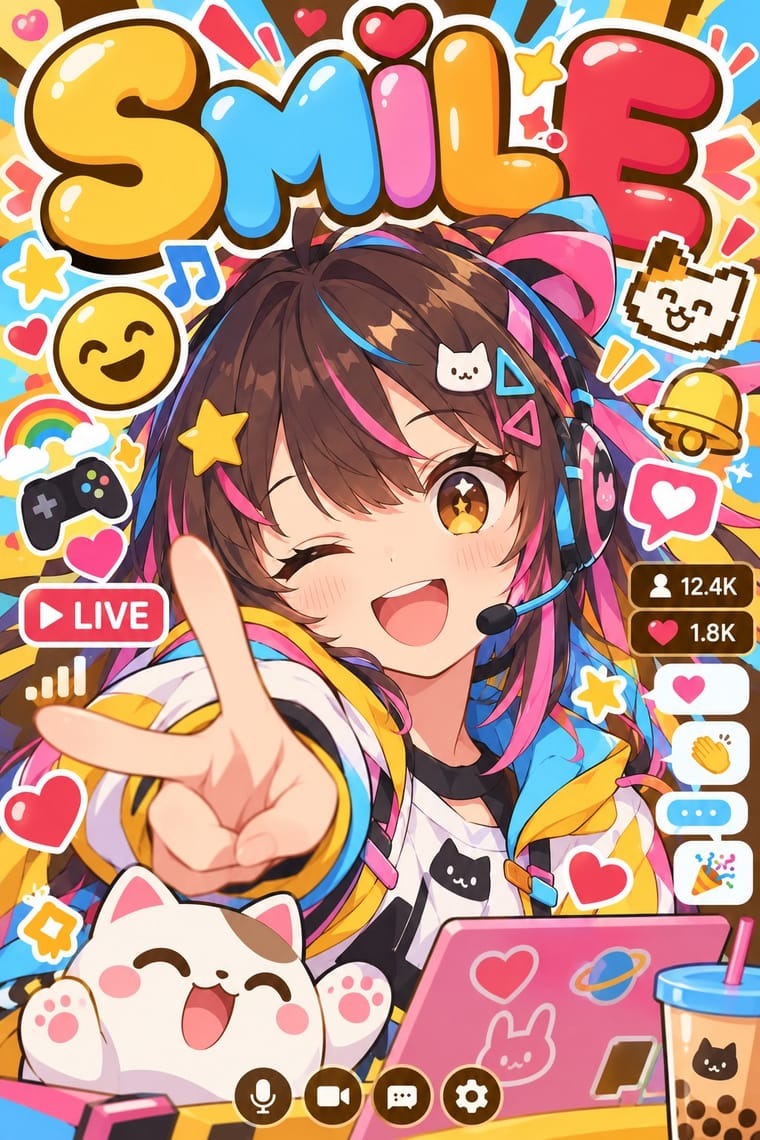
Emoji Pictographic Language × VTuber Avatar and Stream Graphics
Reduce the character and its motifs to small square pictographs for channel emotes and membership badges, so the community can type the persona into chat.
Mix them and make something Emoji Pictographic Language VTuber Avatar and Stream Graphics
01
What each style brings
Each part of the design comes from the style with the stronger say in it, and each style gives at least two.
Emoji Pictographic Language VTuber Avatar and Stream Graphics
- Type from VTuber Avatar and Stream Graphics
- Colour from Emoji Pictographic Language
- Form from Emoji Pictographic Language
- Composition from VTuber Avatar and Stream Graphics
- Surface from Emoji Pictographic Language
02
The type
Open fonts standing in for each style’s own type, which is often hand-drawn or commercial.
Display · VTuber Avatar and Stream Graphics
Hello
Mochiy Pop One; VTuber Avatar and Stream Graphics used Heavy, simple bold lettering for thumbnails and A custom name logo drawn for each character
Text · Emoji Pictographic Language
Pictographs typed as characters and set inline in running text. Born on Japanese mobile phones (J-Phone's 90 monochrome signs of 1997, the 176 single-colour signs that Shigetaka Kurita led for NTT DoCoMo's i-mode in 1999, on 12 x 12 pixel grids) and encoded in Unicode in 2009-2010, each emoji is one face, hand, object, food or flag centred on a square em with no ground. Unicode fixes the code point and name; each vendor draws its own full-colour version, flat, glossy or rendered in 3D, so one sign circulates in many visual dialects.
Shippori Mincho; Emoji Pictographic Language used The 12 x 12 dot external-character (gaiji) glyphs in which Japanese carriers first delivered emoji, typed into mobile mail and i-mode pages beside kana and kanji and Apple Color Emoji (2008)
03
The colours
The ground and leading colours come from Emoji Pictographic Language, with a counter-accent from VTuber Avatar and Stream Graphics. The ink reads on the ground at 4.5:1 or more.
Emoji Pictographic Language VTuber Avatar and Stream Graphics
-
#ffcc4dground · 36% -
#664500ink · 14% -
#f4a223accent · 18% -
#5bc8f5accent · 14% -
#dd2e44accent · 10% -
#ff7eb6accent · 8%
As CSS
:root {
  --ground: #ffcc4d;
  --ink: #664500;
  --accent-1: #f4a223;
  --accent-2: #5bc8f5;
  --accent-3: #dd2e44;
  --accent-4: #ff7eb6;
  --font-display: "Mochiy Pop One", sans-serif;
  --font-text: "Shippori Mincho", serif;
}
Use it with care
Emoji Pictographic Language: Reuse emoji artwork only from the open sets and on their terms (Twemoji graphics CC BY 4.0 with attribution, OpenMoji CC BY-SA 4.0, Noto fonts SIL OFL 1.1, Fluent Emoji MIT); the platform sets are their vendors' own artwork, so do not lift their drawings into a logo or print. Remember too that a code point reaches each reader in that reader's vendor drawing, which may differ in detail, colour or even meaning from the one you chose.
VTuber Avatar and Stream Graphics: VTuber characters are owned designs, by agencies or by the performers who commissioned them, and early contracts often gave the character's rights to the company, so performers who left had to start again as someone new: draw an original persona rather than a look-alike of Kizuna AI, Hololive or Nijisanji characters, and credit the illustrator ('mama') and the rigger ('papa'). The performer's anonymity is part of the form, so never attach a real person's face, name or photograph to an avatar or speculate about who is 'inside'. Do not default to a sexualised cute-girl type: scholars argue that avatar idols perpetuate female stereotypes and that the virtual idol industry commercialises sexism (Lu et al., CHI 2021).
04
The two styles

05
More combinations
With Emoji Pictographic Language
- Bitmap & Pixel Graphics Pairs well · Kurita's i-mode set was drawn on a 12 x 12 pixel grid; redraw a set on a coarse grid in a few flat colours for an early-keitai look, or set pixel emoji beside a bitmap font.
- Isotype Pictorial Statistics Contrasts · Isotype repeats identical pictograms in rows to count quantities; an emoji stands in for a word or a tone of voice inside a sentence. Use Isotype when the signs must count, emoji when they must talk.
- Kawaii Design Pairs well · The atlas counts emoji among the channels through which kawaii went global (Kurita's set is a kawaii exemplar), and Pen magazine writes that kawaii culture 'gave birth to emojis'; the two share round faces and hearts. But emoji also cover neutral objects, hands, flags and symbols in saturated full colour, and live inside running text. Borrow kawaii's pastel tints and blushing cheeks to soften an emoji set for a children's product.
- Story Manga (Postwar Japanese Comics) Pairs well · Kurita took manga's symbols for feeling (manpu), such as the sweat drop for nerves; lift more of manga's visual shorthand, speed lines, anger marks, sparkles, into a set's faces.
- Flat Design Pairs well · Twemoji and Fluent Flat use flat fills with no gradients or outlines, like flat UI icons; choose a flat set when emoji must sit inside a flat interface, a glossy or 3D set when they must stand out from it.
- Claymorphism & Soft 3D Contrasts · Microsoft's 3D Fluent set comes close to claymorphism's soft rendered forms, and the atlas's claymorphism entry counts the 3D Fluent set among its sources; but claymorphism builds whole interface scenes from inflated pastel shapes, while an emoji stays one sign at text size on a transparent ground. Pair a 3D emoji with clay cards only when it plays the role of an icon, not of a scene.
- Japanese Dense Web Design Pairs well · Emoji came out of Japan's phone web (J-Phone in 1997, i-mode in 1999), which commentators also credit with keeping these pages text-heavy; small pictographs set inline with text links add colour and signal to a dense list without taking space.
- Chat Reaction-Sticker Cartooning (LINE) Contrasts · Emoji are standardised, encoded pictographs; the shared trait is a pictorial reply, but these are authored, larger character performances.
With VTuber Avatar and Stream Graphics
- Lo-fi Anime Aesthetic Contrasts · Both put an anime figure on a 24/7 YouTube screen, but lofi's figure is a looping painting turned away from the viewer; a VTuber faces the camera, lip-syncs to a real performer and reads the chat, so use lofi for background calm and VTuber graphics for presence and talk.
- Kawaii Design Contrasts · Its parent in cute character culture, but kawaii fixes a static mascot on pastel goods and print; switch to VTuber graphics when the character has to move, talk and answer a live chat, with a performer's voice and a whole stream screen around it.
- Superflat Contrasts · Both draw on anime and otaku imagery, but superflat flattens it ironically into all-over, unshaded fields; VTuber graphics play one character sincerely, with cel shading, overlap and a 2.5D rig that turns the head, as a persona fans follow from week to week.
- Fantasy User Interface (FUI) & Sci-Fi HUD Pairs well · For a science-fiction or AI persona in the manner of Kizuna AI, frame the avatar with HUD-style rings, brackets and hairline panels as its overlay, keeping the warm character in front of the cold interface.
- Danmaku Bullet-Comment Overlay Pairs well · On Bilibili and Niconico, viewers' bullet comments fly across the stream over the avatar. Leave the top lanes clear of the character's face and title, so the crowd's comments and the avatar share the screen without hiding it.
- Vocaloid Fan Illustration (Hatsune Miku Culture) Pairs well · Both use a shared, character-led look; add stream overlays and avatar frames.
- Light Novel Cover Illustration Pairs well · The same anime idiom moved onto live avatars; borrow its outlined name logos for a series mark, keep the cover's single still portrait.
- YouTube Thumbnail Style (the 'YouTube Face') Pairs well · VTubers follow the same rules for their thumbnails, a big cut-out at a third of the frame, a few outlined words, warm colours; swap the photographed face for the avatar to bring the idiom to a channel whose performer stays unseen.