Style combination · Contrasts
Burmese Parabaik Painting × Mixteca-Puebla Codex Painting
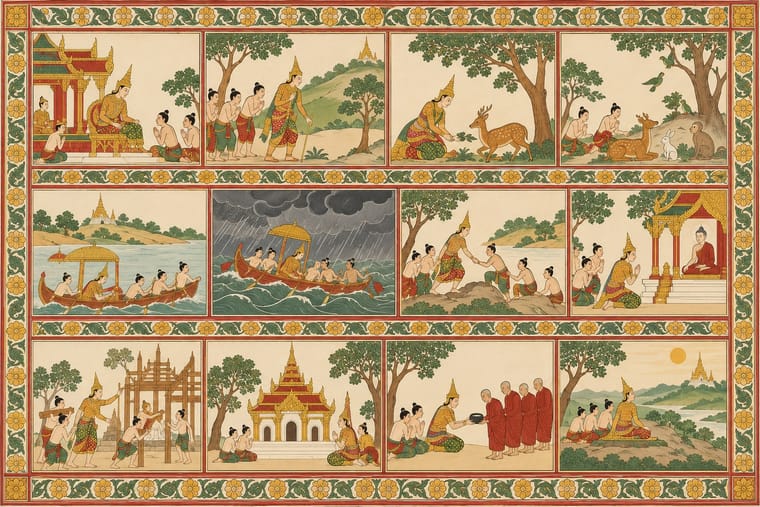
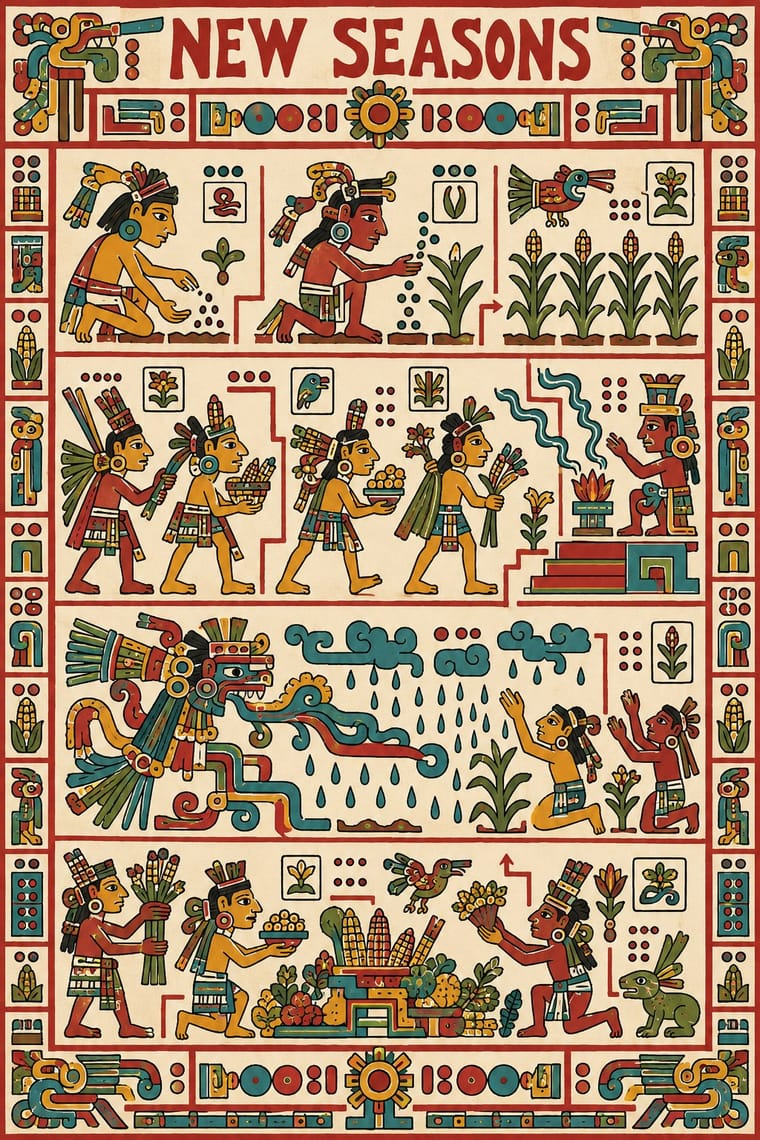
Both are screenfold books, but the Mixtec codex reads glyphic figures along red guide-lines on flat colour, while the parabaik frames painted, captioned scenes with European depth.
Mix them and make something Burmese Parabaik Painting Mixteca-Puebla Codex Painting
01
What each style brings
Each part of the design comes from the style with the stronger say in it, and each style gives at least two.
Burmese Parabaik Painting (Konbaung Folding Books) Mixteca-Puebla Codex Painting
- Type from Burmese Parabaik Painting
- Colour from Mixteca-Puebla Codex Painting
- Form from Mixteca-Puebla Codex Painting
- Composition from Burmese Parabaik Painting
- Surface from Burmese Parabaik Painting
-
02
The type
Open fonts standing in for each style’s own type, which is often hand-drawn or commercial.
Display · Burmese Parabaik Painting
Notice
Yatra One; Burmese Parabaik Painting used Burmese round script (Myanmar script) written in ink as captions in the band beneath each scene and Burmese and Pali in Burmese script for the texts of Buddhist and court parabaik
Text · Mixteca-Puebla Codex Painting
The painted screenfold books of Postclassic southern and central Mexico (not the Maya codices): long strips of gesso-coated deerskin, folded like a screen and painted on both sides. In the Mixtec histories red guidelines lead the reader in a zigzag through the deeds and marriages of rulers; in the divinatory Borgia Group, pages pair deities with periods of the 260-day count. Profile figures with large heads, glyphs for names, dates and places, and flat colour inside an even black contour make picture and writing one codified system.
Fira Sans; Mixteca-Puebla Codex Painting used Calendar-name glyphs and Place signs, most built on a hill glyph that carries the attributes naming the town
03
The colours
The ground and leading colours come from Mixteca-Puebla Codex Painting, with a counter-accent from Burmese Parabaik Painting. The ink reads on the ground at 4.5:1 or more.
Burmese Parabaik Painting (Konbaung Folding Books) Mixteca-Puebla Codex Painting
-
#f1ead8ground · 36% -
#1a1714ink · 14% -
#d49a2aaccent · 18% -
#b22a2aaccent · 14% -
#3f8f97accent · 10% -
#6f7a34accent · 8%
As CSS
:root {
  --ground: #f1ead8;
  --ink: #1a1714;
  --accent-1: #d49a2a;
  --accent-2: #b22a2a;
  --accent-3: #3f8f97;
  --accent-4: #6f7a34;
  --font-display: "Yatra One", cursive;
  --font-text: "Fira Sans", sans-serif;
}
Use it with care
Burmese Parabaik Painting (Konbaung Folding Books): Many parabaik show the life of the Buddha, previous Buddhas and Jataka stories and were made as acts of merit; treat these scenes and every Buddha image as sacred to Myanmar's Buddhists, and do not crop them into decoration, merchandise or tattoos, place them low or on footwear, or alter or parody the Buddha. The captions are real Burmese texts: have a Burmese reader write or check any caption and never fill the bands with invented script, which image models produce. Many court books left Mandalay Palace after the British captured it in 1885 (the V&A's 1882 manuscript IM.128-1918 was taken from Queen Supayalat's apartments), so credit each book to its court, place and present collection, work with Burmese scholars and painters, and never present a generated image as a historical parabaik.
Mixteca-Puebla Codex Painting: These books are Indigenous sacred and dynastic records: Mixtec speakers called them ñee ñuhu, 'sacred skins'; the Borgia Group almanacs set out deities and the ritual 260-day count, and the Mixtec histories record the genealogies of ruling houses whose Ñuu Dzaui (Mixtec) descendants live in Oaxaca, Puebla, Guerrero and the diaspora today. Almost all surviving books left Mexico during the conquest, the colonial period or the nineteenth century and are now in European libraries and museums; the Codex Colombino in Mexico City is a rare exception. 'Mixteca-Puebla' itself is an archaeologists' label, not a name the painters used: George Vaillant described a Mixteca-Puebla 'culture' or 'civilization', H. B. Nicholson redefined it as a style shared by Nahua and Mixtec artists, and its questions remain open. Do not lift deities, calendar signs or named rulers as decoration, logos or generic 'Aztec pattern', never invent pseudo-glyphs or present generated pages as historical, and work with Mixtec and Nahua scholars, artists and communities, crediting the codex and its people.
04
The two styles
05
More combinations
With Burmese Parabaik Painting
- Korean Webtoon Graphics Pairs well · A parabaik is a continuous strip read panel by panel; turn its horizontal concertina into a vertical scroll and keep the caption band under each scene for a long-form story.
- Chaekgeori & Minhwa Screen Painting Pairs well · Both are court paintings on a folding support that took Western-derived shading and recession into a local convention; set a parabaik procession beside a chaekgado shelf to compare how each folds depth into panels.
- Persian Miniature (Ilkhanid, Timurid and Safavid Book Painting) Contrasts · Persian book painting crowds a ruled picture field with pattern, architecture and figures under a high horizon without cast shadow; the parabaik leaves the cream paper open, uses European recession and keeps its rich ornament for the covers.
- Tibetan Woodblock Print Culture (Pecha & Prayer Flags) Contrasts · Tibetan pecha are loose horizontal leaves printed from carved blocks in many copies; the parabaik is a single hand-painted book that unfolds into one strip.
With Mixteca-Puebla Codex Painting
- Chicano Screenprint Poster Pairs well · Chicano screenprinters reclaimed Mexica glyphs and calendar imagery for the movement; when contour-and-flat-colour glyphs meet a modern poster, follow their example of community context and credit. Mexica (Aztec) glyphs are a different source from these Mixtec and Borgia Group books: credit a codex source as such rather than folding it into 'Aztec'.
- Northwest Coast Formline Design Contrasts · Both are Indigenous American sign systems of contour and flat colour, but formline swells and tapers its line into ovoids and U-forms in symmetric crests, while the codex keeps an even, unmodulated contour around profile figures strung along a guided reading path; do not merge them as generic 'Native' art.
- Ligne Claire (Franco-Belgian Clear Line) Pairs well · Both keep a sequential story readable with an even, unmodulated contour and flat colour, without hatching or modelling; borrow the codex's red-guideline reading path for a clear-line page, as a formal analogy rather than a lineage.
- Isotype Pictorial Statistics Pairs well · Both tell information through standardised, repeatable signs and count by repeating units; codex day signs with counting dots are a precedent for pictogram-plus-number systems.
- Andean Woven Graphic Systems Contrasts · Andean signs are built on the thread grid and repeated as pattern, while codex signs are painted freely in contour and strung along a narrative path; do not merge the two as generic 'pre-Columbian'.
- Mexican Popular Graphics (Posada) Contrasts · Posada's broadsheets carve tone and texture into relief blocks under shouting type, whereas codex painting has no tone at all, only contour and flat colour; keep them apart when the brief just says 'Mexican'.
- Ancient Egyptian Hieroglyphic & Register Composition Contrasts · Both are sacred pictorial records in contour and flat colour with no depth, but Mixtec screenfolds lead the eye in a zigzag along red guidelines past big-headed figures and name glyphs, while Egyptian pages keep strict horizontal registers and ruled columns of a largely phonetic script, with figures sized by rank and drawn to a canon; do not merge them as generic 'ancient glyphs'.