Pictorial & machine age · 2008–present · Eastern Europe
Polish Information Picture Book (Dwie Siostry)
Also known as Polish picture atlas and activity book, Dwie Siostry style, Mizielińscy style (Hipopotam Studio)
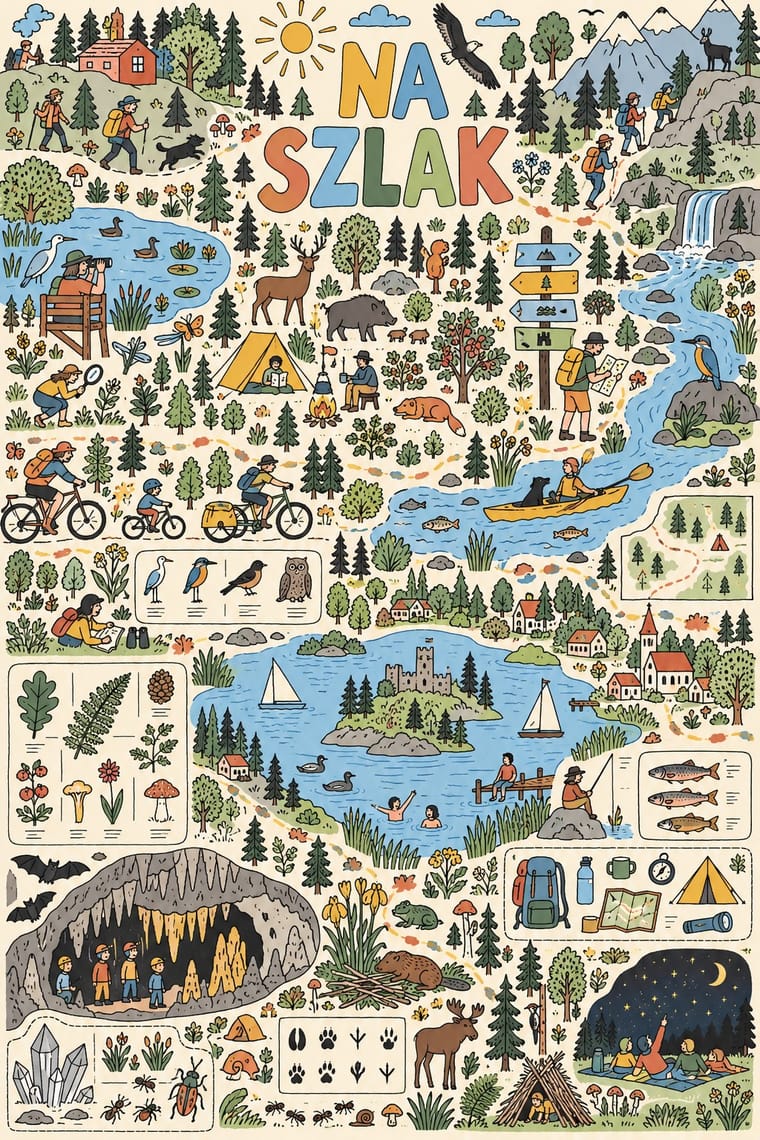
Mostly large-format information picture books made since 2008 by the Warsaw publisher Dwie Siostry with young illustrators led by Aleksandra and Daniel Mizieliński, graduates of the city's Academy of Fine Arts: atlases, cross-sections, labyrinths, activity books and wordless seek-and-find board books. Hundreds of small figures in thin line and flat colour fill the page, often a pale one, in a seemingly naive, comic manner, every picture carrying a fact. Seek-and-find is older (the German Wimmelbuch dates from the late 1960s); what sets these apart is their information design and own lettering.
Make something in this styleGet advice in this styleMix it with another style
Use it with care
The leading authors are living, named illustrators whose books are in copyright, so draw your own figures, maps and lettering instead of asking an image model for the Mizielińskis', Bajtlik's or Karski's hand, and never present a generated spread as a page from Mapy, Mamoko or another Dwie Siostry book. Picture atlases sum up whole countries in a few small figures: show people through what they do, make and celebrate, ask people from a country to check its spread, and avoid reducing a culture to costume, cliché or skin colour.
01
How it works
- Start from the content rather than a house style: decide how much a spread has to carry (the Mizielińskis wanted about 100 pictures on each map), then size the book, the figures and the line to fit it, which means a large format, small figures and thin lines.
- Fill the whole spread evenly with small, labelled scenes and give it no single focal point, so the reader wanders, searches, counts and compares; reward looking with jokes and with characters whose stories can be followed from page to page.
- Draw every figure in an even, thin outline with flat, unmodulated fills, often on a pale ground, simplified and slightly comic; leave out paint, texture and modelling, which would make small pictures unreadable. For an atlas, keep the colours muted and earthy and frame the maps with decorative borders, so that the page recalls an antique rendering.
- Letter the book yourself: draw typefaces from handwriting, with many alternate glyphs to keep them organic and small capitals for headings, and when the book is about letters, turn the letters into skyscrapers, streets, constellations or animals.
- Make the book something to do as well as read: build in hidden objects to find, paths to trace through labyrinths, blank spaces to draw in and companion activity books that send the reader off to design maps and flags of their own.
Warsaw, where the children's publisher Dwie Siostry was founded in 2005 (by Jadwiga Jędryas, Katarzyna Matuszewska, Joanna Rzyska and Ewa Stiasny) with a strong emphasis on graphic design, one of many small houses, known in Grażka Lange's words as 'Liliputian' and run by women, born in the early 2000s after the state publishers collapsed. The entry starts with D.O.M.E.K. (2008), commissioned from two graduates of the Academy of Fine Arts' Book Design Studio (Aleksandra and Daniel Mizieliński, both born 1982, who graduated in 2007 under Maciej Buszewicz and Grażka Lange and run Hipopotam Studio); other illustrators followed (Piotr Karski, also a Warsaw Academy graduate, and Jan Bajtlik). The revival is traced to a poster designer and teacher (Henryk Tomaszewski, in the account of Lange and the illustrator Józef Wilkoń) and to the 1960s–70s Polish School of Illustration, whose classics the publisher reissues (its Mistrzowie Ilustracji series). The wider Polish picture-book boom is stylistically diverse (Zachęta's 2016 survey 'I Read Here' chose fourteen illustrators for their diversity, and on Dwie Siostry's own list Piotr Socha's Bees alludes to classical atlases of animals and plants); this entry covers its crowded, flat-line information strand (Dwie Siostry won the London Book Fair's International Excellence Award in 2017 and the Bologna Prize for the Best Children's Publisher of the Year, Europe, in 2018).
02
Its design choices
From Stylogeny’s vocabulary of design choices: defining choices make the style, characteristic ones are usual, occasional ones turn up now and then.
- Layout & composition
- Space & hierarchy
- Typography
- Colour
- Form & shape
- Surface & texture
- Imagery
- Medium & production
- Tone & intent
- Avoids
- Painterly illustration, Painterly brushwork, Single focal point, Straight photography, Photomontage, Naturalistic depiction, Illusion of depth, Fluorescent & neon
Palette
#f4eedf#1f1d1b#e0876a#a8bf8a#e7b941#8fbcd0
Typefaces
Mrs White
an upright, joined monoline script with the feel of primary-school handwriting, drawn by the Mizielińskis for Mapy, with many ligatures and contextual alternates and small capitals for headlines
Cartographer
the hand-printed face drawn alongside Mrs White for Mapy
Picture letters
letters that turn into skyscrapers, streets, constellations, instruments and animals, as in Jan Bajtlik's Typogryzmol
Known for
Aleksandra and Daniel Mizieliński, D.O.M.E.K. (Dwie Siostry, 2008; English H.O.U.S.E.), a 20 × 20 cm guide to famous houses and their architects commissioned by the publisher; Book of the Year 2008 of the Polish section of IBBY, and the first of the S.E.R.I.A. books on art and design
Aleksandra and Daniel Mizieliński, Co z ciebie wyrośnie? (2010), a BolognaRagazzi non-fiction mention
listed under 2011 in Daniel Mizieliński's CV
Aleksandra and Daniel Mizieliński, Miasteczko Mamoko (In the Town of Mamoko), the first of the wordless Mamoko board books (31.5 × 23.5 cm), in which readers follow the town's inhabitants and hunt for hidden objects, followed by Dawno temu w Mamoko (2011) and Mamoko 3000 (2012)
Aleksandra and Daniel Mizieliński, Mapy (2012; English Maps, Big Picture Press)
51 maps of 42 countries on six continents in a 27.2 × 37 cm atlas packed with pictograms of places, animals, plants, people and customs, in muted earth tones with decorative borders and fine-lined drawings that School Library Journal found 'reminiscent of an antique rendering'; Prix Sorcières and Premio Andersen; over 120,000 copies printed internationally within a year; followed by the activity book Mapownik
Aleksandra and Daniel Mizieliński, Pod ziemią. Pod wodą (2015; English Under Earth, Under Water), named best children's book of 2015 in China by the Beijing News for its Chinese edition, with the activity books Podziemnik and Podwodnik (2016)
Jan Bajtlik, Typogryzmol
(Dwie Siostry; English Alphadoodler, Tate), a 160-page activity book in which letters turn into skyscrapers, streets, constellations, instruments and animals; BolognaRagazzi non-fiction mention 2015. His Nić Ariadny. Mity i labirynty (2018) turns each Greek myth into a maze crowded with tiny figures
Piotr Karski, W góry! and W morze! (Dwie Siostry), 200-page activity books about mountains and the sea
Aleksandra Cieślak, Książka do zrobienia (Dwie Siostry), nominated for the BolognaRagazzi Award for Art Books 2017
03
Make something in this style
Say what you need, and Stylogeny’s image studio draws it from Polish Information Picture Book (Dwie Siostry)’s design choices and checks it against them. It takes about a minute, and you get a link to share.
04
Where it comes from, and what it’s close to
Before it
The style it grew out of, and the styles it borrowed from.


After it
The styles that grew out of it.
No later style in the atlas grew out of it yet.
Alike in its design choices
Styles that make many of the same choices, related or not, besides those above.


05
Sources
- Wikipedia (pl), 'Wydawnictwo Dwie Siostry', https://pl.wikipedia.org/wiki/Wydawnictwo_Dwie_Siostry (founded 2005 in Warsaw by Jadwiga Jędryas, Katarzyna Matuszewska, Joanna Rzyska and Ewa Stiasny; children's books with a strong emphasis on graphic design; Mistrzowie Ilustracji, about 20 reissues; London Book Fair International Excellence Award 2017; BOP Best European Children's Publisher 2018; Typogryzmol BolognaRagazzi non-fiction mention 2015; Pod ziemią. Pod wodą best children's book of 2015 in China (Beijing News); Książka do zrobienia nominated for BolognaRagazzi Art Books 2017)
- Wikipedia (pl), 'Aleksandra Mizielińska', https://pl.wikipedia.org/wiki/Aleksandra_Mizielińska (born 1982; graduated 2007 from the Book Design Studio of the Warsaw Academy of Fine Arts under Maciej Buszewicz and Grażka Lange; Hipopotam Studio designs books, fonts and websites; a seemingly naive, comic-inspired style in bold colours for high legibility; experience of programming and game-making used to structure the books; a font imitating handwriting designed for Mapy; bibliography with years; D.O.M.E.K. IBBY Polish section Book of the Year 2008; Mapy over 120,000 copies within a year and 21 foreign editions by 2015; Prix Sorcières and Premio Andersen)
- Andrea Reece, 'The Mizielinskis under the Microscope', Books for Keeps 224, May 2017, https://booksforkeeps.co.uk/?p=15038 (met at the Warsaw Academy studying under Maciej Buszewicz; Dwie Siostry commissioned the architecture book; 'we wanted 100 images per map, so they'd have to be quite small, the lines would have to be quite thin'; 'We knew we couldn't use paint because it would be unreadable'; 'The form should always be the vehicle for the content'; state publishers collapsed after the 1990s and 'by the early 2000s lots of small publishers were being created')
- Daniel Mizieliński, CV, Narodowe Centrum Kultury, https://nck.pl/upload/2025/10/mizielin-ski-daniel.pdf (BolognaRagazzi non-fiction mention for Co z ciebie wyrośnie, 2011; Favourite Website Awards for pica-pic.com and other sites; European Design Award 2010 for bubole.pl; a stipend for the educational app Ba Ba Dum; 2011 workshops on hand lettering and its digitisation into a font)
- Wydawnictwo Dwie Siostry, Backlist 2021 (foreign-rights catalogue), https://wydawnictwodwiesiostry.pl/files//pages/64/dwie_siostry_catalog_2021_backlist.pdf (Maps: 51 maps, 42 countries, six continents, 27.2 × 37 cm, 'countless pictograms, details and facts'; H.O.U.S.E. 20 × 20 cm; Mamoko board books 31.5 × 23.5 cm; Typogryzmol/Alphadoodler; Greek Labyrinths 'crawling with tiny figures'; Piotr Karski's W góry! and W morze!; Piotr Socha's Bees)
- Wydawnictwo Dwie Siostry, classics catalogue (Mistrzowie Ilustracji), https://wydawnictwodwiesiostry.pl/files/news/444/katalog_klasyka_strony.pdf (the series reissues children's classics illustrated by leading figures of the Polish school of illustration; Babcia na jabłoni illustrated by Mirosław Pokora; Pan Maluśkiewicz i wieloryb illustrated by Bohdan Butenko); Wydawnictwo Dwie Siostry, 'Foreign rights', https://wydawnictwodwiesiostry.pl/foreign-rights (founded 2005; reviving the work of Poland's best graphic designers; London Book Fair 2017 and BOP 2018)
- Instytut Książki, 'The world of master Józef Wilkoń in Bologna', 16 June 2021, https://old.instytutksiazki.pl/en/news,2,the-world-of-master-jozef-wilkon-in-bologna,6509.html (Grażka Lange: 'small publishing houses, known as "Liliputian", which are run by women without exception'; Wilkoń and Lange agree that the roots of the success lie in the Polish School of Illustration, and both stress the role of 'the great poster designer and educationalist Henryk Tomaszewski' and of Polish painting; no Polish poster school is named)
- dPictus, 'Mapy / Maps', https://dpictus.com/synopses/book/430/ (Dwie Siostry; 37 translations listed; highly illustrated maps with places of interest, personalities, animals and plants, local peoples and cultural events); White Ravens, 'Nić Ariadny. Mity i labirynty', https://whiteravens.ijb.de/book/1090 (Jan Bajtlik, Dwie Siostry, 2018, 72 pp)
- Picture Book Makers, 'Aleksandra & Daniel Mizielińscy', https://blog.picturebookmakers.com/post/aleksandra-daniel-mizielinscy ('we designed two typefaces just for this book: Mrs White and Cartographer'; 'To keep the organic feeling, you have to create a lot of alternate glyphs'; more than a hundred images on each spread and over four thousand illustrations, each drawn separately at print scale and combined in Photoshop; 'Forty percent of this was research and fact checking')
- MyFonts, 'Mrs White' (Hipopotam Studio), https://www.myfonts.com/fonts/hipopotam/mrs-white/ ('a clean script that would give a feeling of a primary school handwriting'; ligatures and contextual alternates; small caps for headlines and acronyms; Cyrillic); Luc Devroye, type design information page, https://luc.devroye.org/fonts-57450.html (Hipopotam: 'the upright connected monoline script typeface Mrs White (2011)' and 'the hand-printed Cartographer (2011)')
- Penguin Random House, 'Maps by Aleksandra Mizielinska and Daniel Mizielinski' (review excerpts), https://www.penguinrandomhouse.com/books/228532/maps-by-aleksandra-mizielinska-and-daniel-mizielinski/ (School Library Journal: 'The artwork's muted earth tones, decorative borders, and fine-lined drawings are reminiscent of an antique rendering'; Wall Street Journal: 'chic, muted colors' and 'chic, subdued shades of beige, mauve and eau de Nil')
- Zachęta – National Gallery of Art, 'I Read Here: Contemporary Polish Illustration for Children', 20 February – 8 May 2016, with the Book Institute, https://zacheta.art.pl/en/wystawy/tu-czy-tam ('For almost ten years now Polish illustration has been enjoying a boom period'; the artists' 'diversity and ingenuity'; fourteen illustrators, including Iwona Chmielewska, Emilia Dziubak and Marta Ignerska, but not the Mizielińskis)
- Wikipedia (de), 'Wimmelbuch', https://de.wikipedia.org/wiki/Wimmelbuch (large double spreads crowded with small everyday scenes; the oldest such books date from the late 1960s, with Ali Mitgutsch's Rundherum in meiner Stadt, 1968; today mostly wordless)
How Stylogeny researches and checks a style: where the facts come from.